

Key Takeaways
- University of Georgia student Clay Chilcutt named a quasi-moon after the goddess Cardea, symbolizing transitions and change.
- Chilcutt’s name was chosen through a contest hosted by the International Astronomical Union and Radiolab, defeating six other finalists.
- The contest showcased a diverse panel, including Bill Nye, highlighting curiosity and engagement with space science.
A Unique Naming for a Quasi-Moon
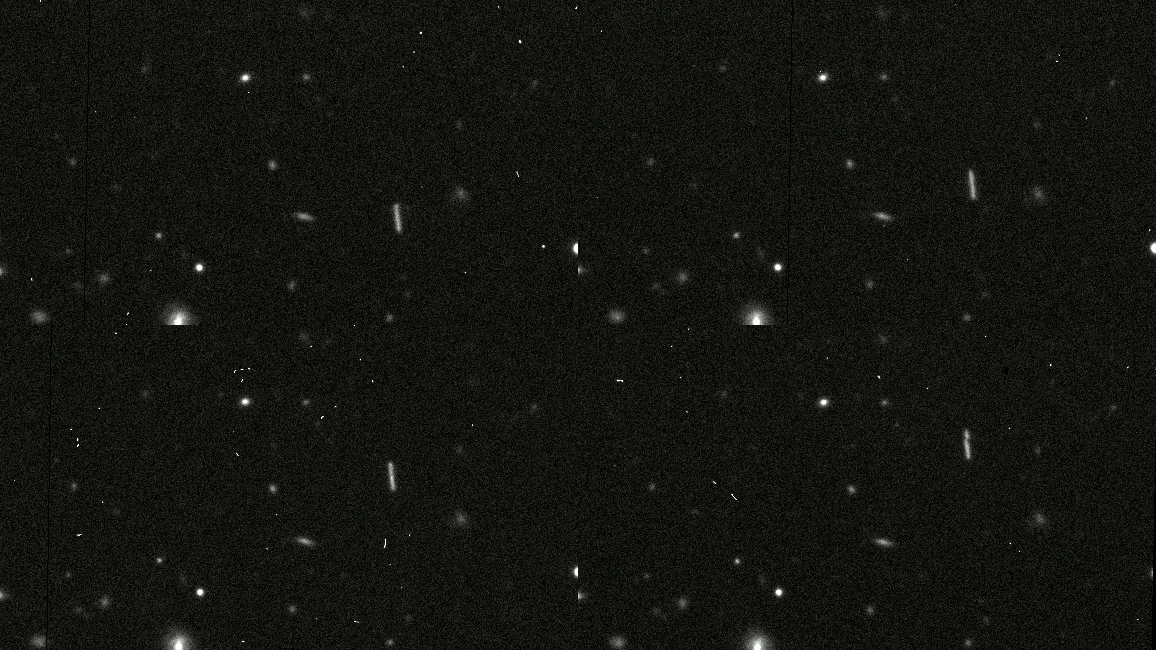
In a delightful intersection of mythology and space science, Clay Chilcutt, a student at the University of Georgia, has successfully named a quasi-moon after Cardea, a goddess who embodies transitions and liminal spaces. This opportunity emerged through a naming contest sponsored by the International Astronomical Union (IAU) in collaboration with the popular science podcast, Radiolab. The quasi-moon, previously designated as 2004 GU9, is one of seven known quasi-moons orbiting Earth.
Quasi-moons, as defined by astronomers, behave like conventional moons but orbit the sun instead of their host planet. They exist in a liminal space between being an independent asteroid and a true moon. Chilcutt’s chosen name, Cardea, captures the essence of these celestial entities, which symbolize a unique orbital path representing change and guardianship between realms.
Chilcutt’s journey to this achievement was sparked by an extra credit assignment in his astronomy class. “Before this assignment, Cardea was completely unknown to me,” he shared with Space.com. His submission eloquently described how the name reflects the quasi-moon’s unique characteristics, likening it to a “celestial gateway between Earth and space.”
In the competitive naming contest, Chilcutt faced off against six strong contenders, each rooted in rich mythological narratives. These included “Bakunawa,” a dragon from Filipino folklore, and “Ehaema,” a nocturnal spirit from Estonian lore. Other notable names included “Enkidu,” a figure from Mesopotamian mythology, and “Ótr,” a Norse shapeshifter. Each name brought unique cultural significance and history, making the selection process particularly challenging.
Upon learning of his victory, Chilcutt expressed his surprise and excitement. “It’s a very unique experience to say I’ve left my mark on history and made a contribution to science,” he said, reflecting on the meaningful nature of his accomplishment.
The contest was orchestrated by Latif Nasser, a co-host of Radiolab, who debuted the naming idea after a mix-up involving a solar system poster depicting a fictional moon of Venus, named “Zoozve.” His creative approach to naming celestial objects sparked a viral moment, ultimately leading to the official naming of the quasi-moon 2002 VE as Zoozve. This playful spirit of curiosity and imagination continued in the competition for 2004 GU9.
Nasser emphasized the significance of naming this new quasi-moon, stating, “Who better to help usher us through this liminal time than an ancient doorkeeper?” He hopes that Cardea’s unique name will inspire further interest in science and a shared curiosity about the universe.
The jury tasked with selecting the name included a notable mix of professionals, such as theoretical physicist Sean Carroll, astrophysicist Wanda Diaz Merced, actor Penn Badgley, and, much to Chilcutt’s delight, Bill Nye the Science Guy. This diverse panel underlines the contest’s aim to foster a community of science enthusiasts and engage the public in cosmic exploration.
As Cardea becomes a formal part of astronomical nomenclature, it serves as a reminder of humanity’s ongoing relationship with space, encouraging everyone to look upwards and appreciate the wonders of the cosmos.
The content above is a summary. For more details, see the source article.