Key Takeaways
- A newly discovered neutron star, ASKAP J1839-0756, is rotating at an unprecedented 6.45-hour interval, challenging existing astronomical theories.
- This star is the first recorded transient with an interpulse, providing new insights into neutron star behavior.
- Researchers suggest that the understanding of radio emissions from neutron stars may need to be revised based on recent discoveries.
Discovery of a Unique Neutron Star
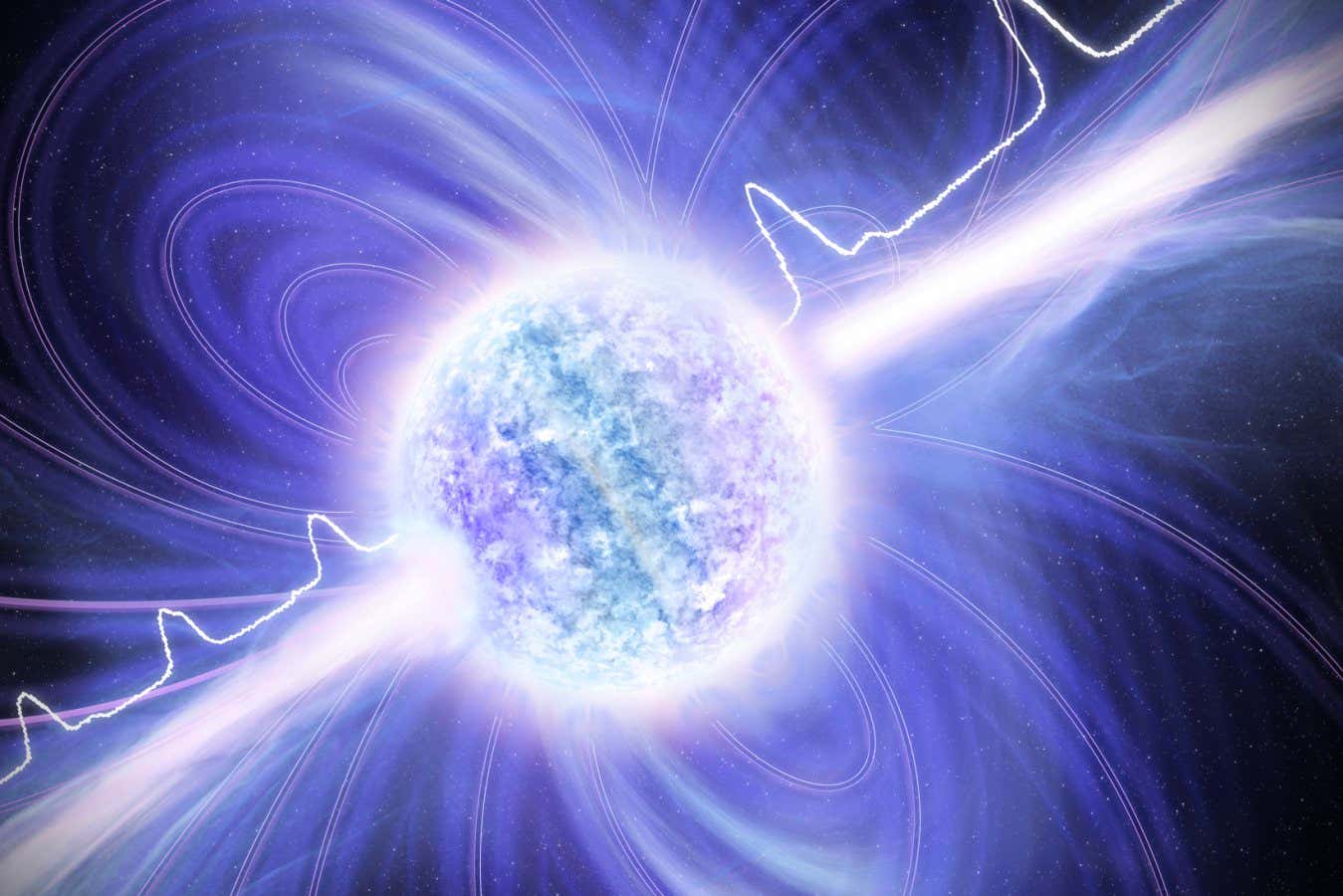
Astronomers have identified a neutron star, ASKAP J1839-0756, located approximately 13,000 light-years from Earth. Detected by the ASKAP radio telescope in Australia in January 2024, ASKAP J1839-0756 is raising eyebrows in the scientific community due to its unique characteristics that defy previous astronomical expectations.
Typically, neutron stars are the remnants of supermassive stars that have undergone supernova explosions, resulting in objects that emit rapid pulses of radio waves. Most pulsars spin rapidly, with many exceeding one revolution per second, sending out pulses in line with their rotation. However, in recent years, there has been a surprising discovery of slower-emitting radio objects, known as long-period radio transients.
A notable find from last year involved a transient that emitted pulses every 54 minutes. The latest discovery, ASKAP J1839-0756, has set a new record, rotating once every 6.45 hours. Adding to its uniqueness, it is the first transient to exhibit an interpulse—a secondary, weaker pulse occurring halfway between the main pulses, indicating signals from an opposing magnetic pole.
Initially, researchers, led by Manisha Caleb from the University of Sydney, speculated that ASKAP J1839-0756 might be a white dwarf star. However, the team concluded this was unlikely, as white dwarfs have never been observed to emit radio waves independently, and calculations revealed ASKAP J1839-0756 to be too large for such classification. Their next hypothesis considered it might be a magnetar, a type of neutron star characterized by an extraordinarily powerful magnetic field—much stronger than that of contemporary MRI machines.
While a prior magnetar has been discovered with a similar rotational period (6.67 hours), it only emitted X-rays. If ASKAP J1839-0756 is confirmed as an isolated magnetar releasing radio waves, it would be an unprecedented find, further complicating the existing understanding of neutron star behavior.
Caleb emphasizes that these findings are leading to a significant revision of what scientists have believed regarding neutron star radio emissions over the past six decades. The existence of ASKAP J1839-0756 suggests that the previously held notion that pulsars cease their radio emissions when their spin slows down requires reevaluation.
Recent findings indicate that there are neutron stars that might surpass this so-called death line, continuing to produce radio signals. These stars are being likened to “zombie stars,” suggesting they remain active in ways previously thought impossible given their slow spin rates. Scientists are now tasked with exploring the characteristics of these fascinating objects and the broader implications for astrophysics. As the discoveries unfold, the astronomical community may uncover truths about the lifecycle and emissions of neutron stars that have long been enigmatic.
The content above is a summary. For more details, see the source article.