

Key Takeaways
- Astronomers have identified the largest known cosmic structure, measuring 1.4 billion light-years across.
- This colossal formation, named Quipu, contains nearly 70 galactic superclusters.
- Quipu is hundreds of thousands of times more massive than the Milky Way galaxy.
Discovery of the Largest Cosmic Structure
Researchers at the Max Planck Institute for Physics in Munich, led by Hans Böhringer, have discovered the largest known structure in the universe, named Quipu. This colossal formation spans an astonishing 1.4 billion light years and comprises approximately 70 galactic superclusters.
Quipu is significant not only for its sheer size but also for its mass, which is hundreds of thousands of times greater than that of a single galaxy. For context, the Milky Way galaxy, one of the most well-known galaxies, pales in comparison to the mass of Quipu. This striking discovery could provide insights into the universe’s formation and evolution.
The name “Quipu” draws inspiration from the Incan civilization, which used a system of knotted ropes for counting and record-keeping. This analogy reflects the intricate and complex nature of the universe’s structure and its components.
The finding of Quipu highlights the collaborative effort of astronomers who utilized advanced observational techniques and technology to explore the vastness of space. They combined data from multiple surveys, including the Sloan Digital Sky Survey and others, to assemble a comprehensive picture of this massive cosmic entity.
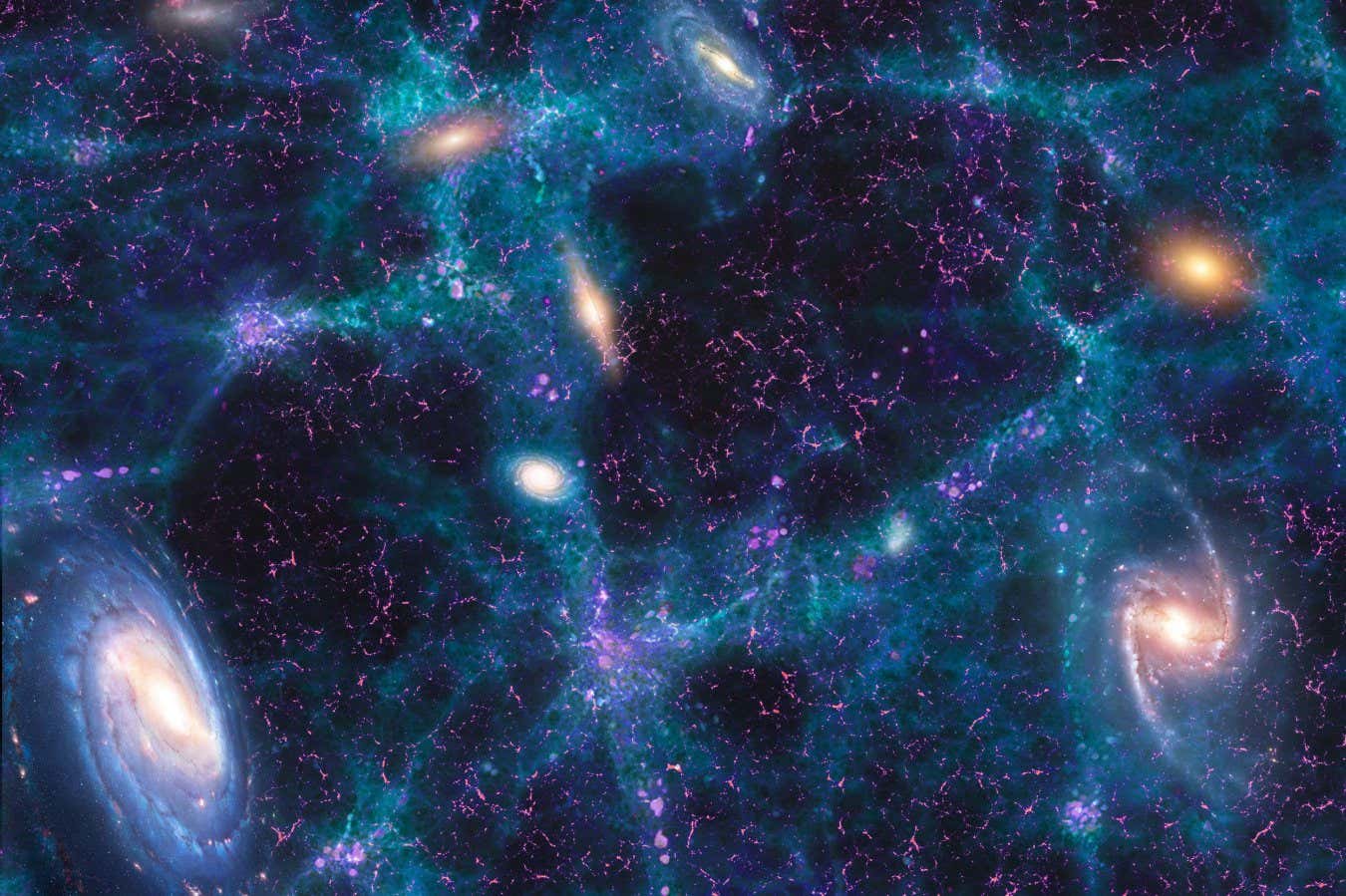
Understanding such large-scale structures is crucial for astronomers, as they play a fundamental role in the distribution of galaxies and the overall structure of the universe. Quipu’s existence provides new opportunities for research into dark matter dynamics and the cosmic web, the large-scale structure forming the framework of the universe.
As astronomers continue to study Quipu and its components, they hope to uncover more about the underlying physics governing such enormous formations. This pursuit of knowledge could lead to groundbreaking revelations about the universe’s origins and the forces that shape it.
The content above is a summary. For more details, see the source article.