

Key Takeaways
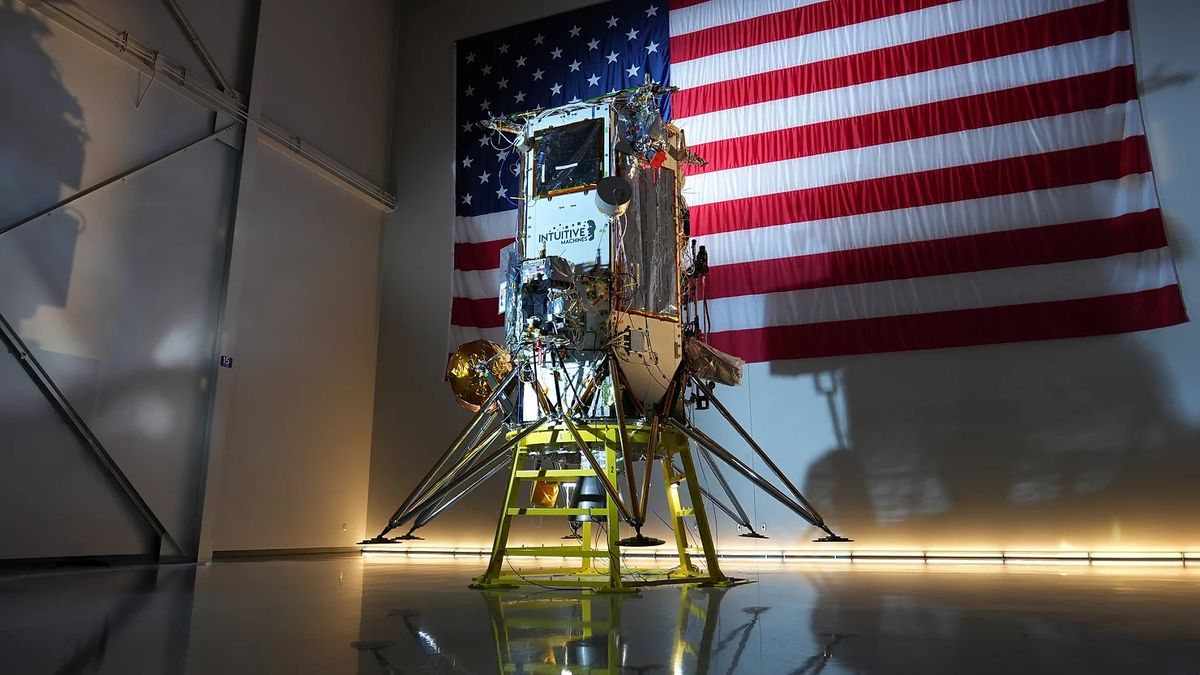
- Intuitive Machines is set to launch its second lunar lander, named Athena, aboard a SpaceX Falcon 9 rocket on February 26, 2024.
- The mission aims to explore the moon’s south pole region, focusing on resource analysis and technology demonstrations to support future human exploration.
- Athena will deploy innovative tools, including a drill to search for water ice and a Lunar Surface Communications System for enhanced communication capabilities on the moon.
Launch of Athena Lander Marks a New Era in Lunar Exploration
CAPE CANAVERAL, Florida — Intuitive Machines is preparing to launch its second lunar lander, Athena, on February 26, 2024. This mission will take off from NASA’s Kennedy Space Center on a SpaceX Falcon 9 rocket at 7:17 p.m. EST and can be watched live through NASA or SpaceX’s channels.
Athena is a Nova-C lander equipped with various lunar science instruments and technology to enhance our understanding of the moon’s environment and resources. This mission is part of NASA’s Commercial Lunar Payload Services (CLPS) program, a collaboration with private companies to deliver scientific tools for lunar exploration. Through CLPS, NASA aims to accelerate research in preparation for human missions to the moon as part of the Artemis program, with Athena’s name referencing the mythological connection to Artemis.
This upcoming launch follows the company’s inaugural mission, IM-1, which occurred in February 2024. IM-1 encountered challenges when its lander, Odysseus, tipped over during landing, but valuable lessons were learned for future endeavors. Trent Martin, Intuitive Machines’ senior vice president, expressed hopes for a more accurate landing with Athena, targeted near the moon’s south pole, specifically in the Mons Mouton region. This area is notable for its potential water ice deposits, which are crucial for future exploration.
A primary objective of IM-2 is to assess the local lunar resources. Athena will deploy NASA’s Polar Resources Ice Mining Experiment 1 (PRIME-1), which consists of a drill named TRIDENT and a mass spectrometer called MSolo. These instruments will analyze lunar material up to three feet below the surface for volatiles like water and carbon dioxide, essential for in-situ resource utilization (ISRU).
This technology demonstration, according to Niki Werkheiser from NASA, will help minimize risks for future ISRU missions, enhancing our capability to use lunar resources. Additionally, Athena carries an innovative Micro-Nova hopper vehicle named “Grace,” in homage to computer science pioneer Grace Hopper. Grace will make exploratory hops while equipped with various measurements and a situational awareness camera.
To facilitate communication with Grace during its operations, a rover named MAPP will be deployed, operating with the moon’s first cellular network. This network, developed by Nokia Bell Labs, will test high-speed communication capabilities using technology similar to current 4G/LTE systems.
Athena also features a Laser Retro-Reflector Array (LRA), which allows for precise location determination on the lunar surface. The LRA consists of small mirrors that will reflect laser signals to enhance navigation for both crewed and robotic future missions.
After launch, Athena will take four to five days to reach lunar orbit, aiming for a landing one and a half to three days later. The lander is expected to conduct operations on the moon for about ten Earth days. Alongside Athena, the Falcon 9 rocket will also deliver NASA’s Lunar Trailblazer, a satellite that will map water ice deposits on the lunar surface.
The move towards increased lunar exploration is echoed by other missions, such as Firefly Aerospace’s Blue Ghost, which is already in lunar orbit and set to land soon, highlighting a growing activity around Earth’s nearest celestial neighbor.
The content above is a summary. For more details, see the source article.