Key Takeaways
- Spacelis, a Turkish startup, is creating rollable perovskite-organic tandem solar panels for aerospace and portable energy applications.
- The lightweight modules aim to reduce weight by 50% compared to traditional solar technology, with a planned power-to-weight ratio of 10 kW/kg.
- The company is seeking $1 million for prototype development and an additional $4 million for its market strategy, with prototypes expected by 2026 and in-orbit testing in 2027.
Innovative Solar Technology Development
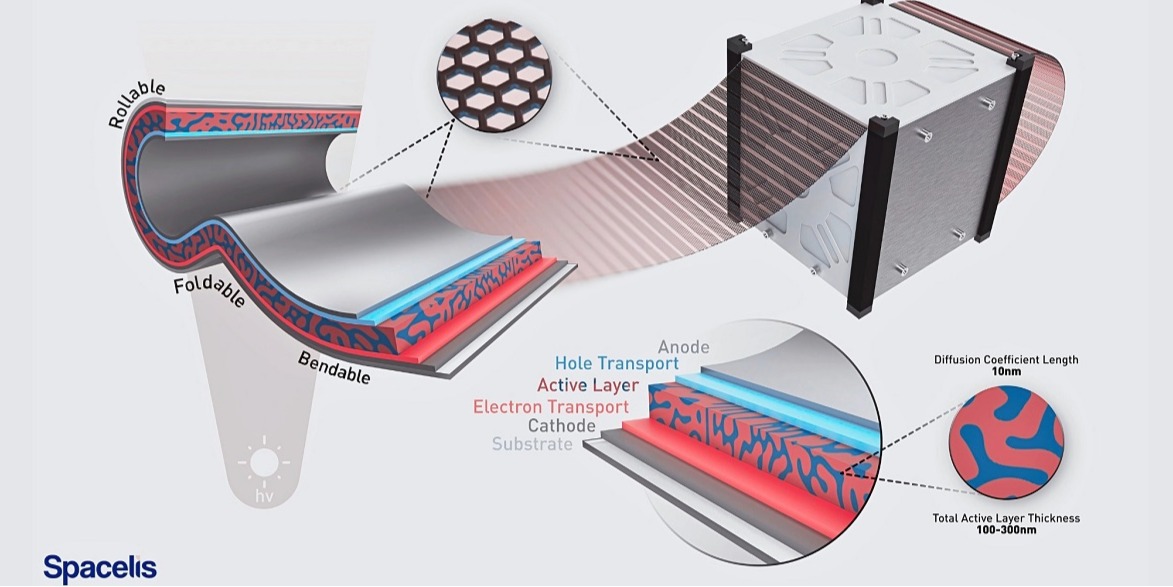
Spacelis, a startup from Ankara, Turkey, is at the forefront of developing lightweight, rollable perovskite-organic tandem solar photovoltaic (PV) technology. This pioneering innovation is tailored for aerospace, field communications, and unmanned systems, revolutionizing how solar energy is harnessed in space and on Earth.
According to Guler Kocak, founder and CEO of Spacelis, their proprietary technology can achieve a remarkable weight reduction of up to 50% compared to conventional space-grade solar modules made with organic and organic-inorganic hybrid materials. This innovation not only cuts down weight but also lowers manufacturing and launch costs. The panels’ flexibility allows them to be rolled, folded, or bent without losing efficiency, making them uniquely versatile for various applications.
The developing perovskite-organic tandem devices target a power-to-weight ratio of 10 kW/kg, with ultraviolet (UV) resistance functioning over 350 nm. Each full module is designed to weigh between 60-75 g/m², including encapsulation. The technology involves high-barrier encapsulation and an innovative polymer substrate that creates self-cleaning, dust-repellent surfaces, enhancing durability and performance.
Founded in 2023, Spacelis draws on Kocak’s PhD research at Flinders University in Australia, which investigated the efficiency and longevity of non-fullerene acceptor-based organic photovoltaics (OPV). This academic background inspired the development of scalable commercial products utilizing these materials in tandem with perovskite solar cells.
Currently, Spacelis is finalizing its prototypes while conducting concurrent research and development to fabricate space-grade prototypes projected for introduction in 2026, with an aim for in-orbit testing scheduled in 2027. The primary markets identified include Europe, Turkey, and the United States, with a focus on the space and defense sectors, particularly in providing portable energy solutions.
To finance their prototype development, the startup is organizing a funding round, seeking $1 million this year and an additional $4 million to implement its go-to-market strategy. Spacelis has already garnered support from the Scientific and Technological Research Council of Turkey (TÜBİTAK) and received a grant from the Defence Innovation Accelerator for the North Atlantic (DIANA) incubator. Furthermore, participation in startup accelerator programs in the U.K. and U.S. through Seraphim Space has bolstered their growth and visibility.
In 2024, Kocak presented the company’s advancements at the 75th International Astronautical Congress in Milan, highlighting the design of next-generation ultra-lightweight flexible space solar cells.
The content above is a summary. For more details, see the source article.