Key Takeaways
- ESA’s Hera mission successfully tested autonomous surface feature tracking during its flyby of Mars.
- The technology will assist in navigating around asteroids, including Dimorphos, for close-up imaging.
- Hera’s flyby improved its trajectory towards Dimorphos, shortening its journey and conserving fuel.
Hera’s Mars Flyby and New Navigation Technology
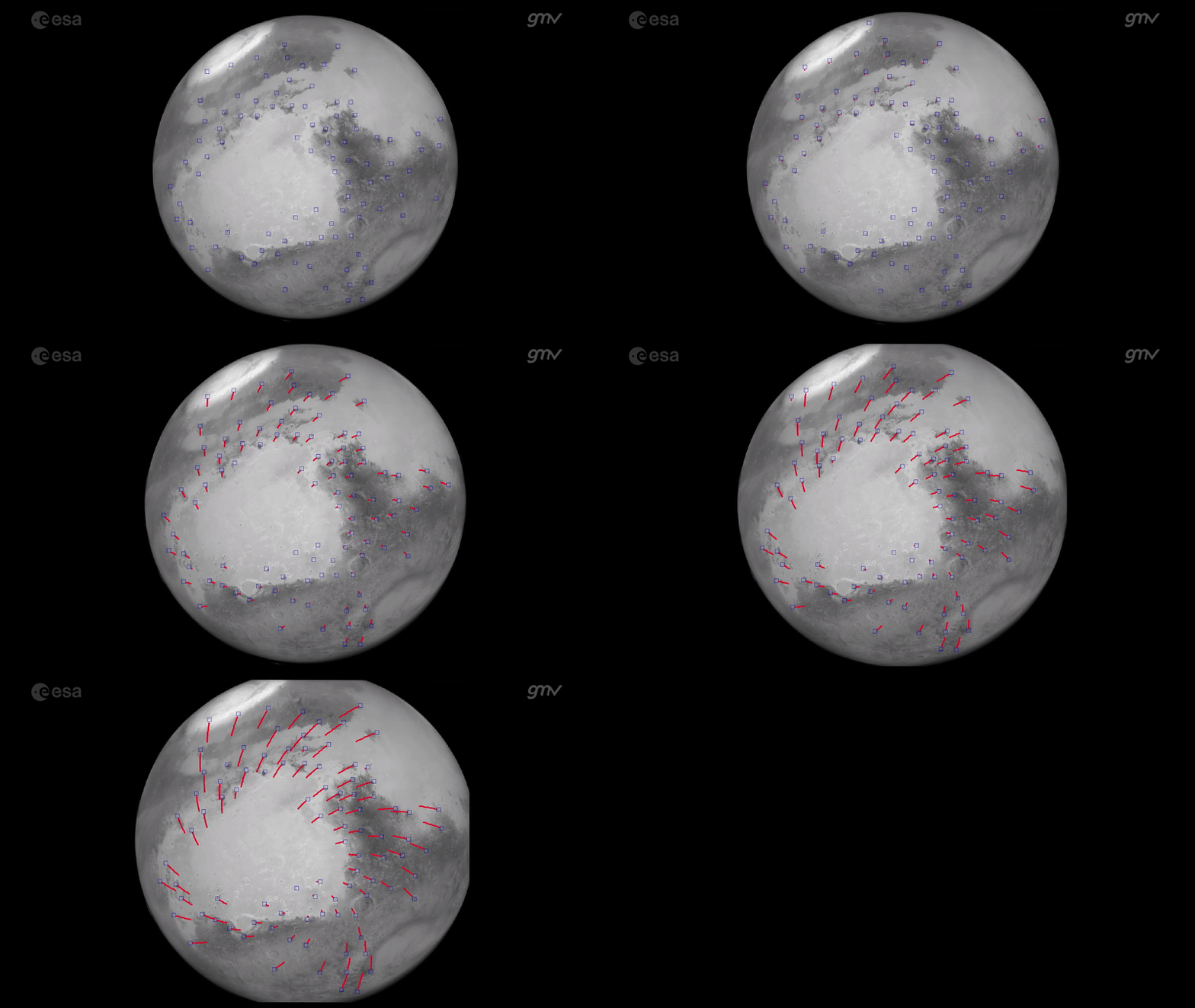
ESA’s Hera planetary defense mission completed a significant milestone during its recent Mars flyby, autonomously locking onto numerous impact craters and surface features. This event tested the spacecraft’s capability to navigate using advanced self-driving technology, critical for its future operations around target asteroids.
During the flyby, Hera operated its autonomous tracking system for 20 minutes, successfully acquiring new Martian surface features despite the increased speed and distance compared to its intended asteroid encounters. Jesus Gil Fernandez, an engineer from ESA, noted that the system captured one new image every 48 seconds, facilitating subsequent tracking of these features.
The complexity and novelty of this feature tracking are noteworthy. Previous trials involved only known landmarks, making Hera’s ability to track unmapped features unprecedented. Despite the risks associated with this testing, the system performed well, providing confidence for its upcoming asteroid navigation tasks and the critical imaging of craters formed by NASA’s DART spacecraft on Dimorphos.
Hera’s flyby brought it within 5,700 km of Mars, utilizing the planet’s gravity to adjust its trajectory, ultimately reducing travel time and fuel consumption. This maneuver demonstrated the spacecraft’s instruments far beyond Earth and the Moon, enabling imaging of Mars, its moon Deimos, and glimpses of Phobos.
As Hera approaches its target, it will navigate around the binary asteroid system of Didymos and Dimorphos, employing various techniques. Initially, it will frame Didymos in its cameras, observing the asteroid’s edges against the dark backdrop of space. Closer operations will transition to a method known as “centroid tracking,” focusing on brightly illuminated areas of the asteroid’s surface. Andrea Pellacani, a technical manager at GMV, a key collaborator in the Hera project, confirmed the effective use of centroid tracking during the spacecraft’s journey to Mars.
As Hera approaches Dimorphos, it will need to operate autonomously less than 2 km from the asteroid. Developed over nearly 15 years, the autonomous surface feature tracking system allows for real-time altitude and trajectory calculations based on consecutive images of the same surface features, such as boulders and craters.
The ground testing for the technology was limited before launch, but simulations led by GMV matched real flyby results closely, showcasing the tracking system’s robustness. The autonomous system can acquire up to 100 features across the target surface but relies on the top six for accurate positioning, limiting computational demands.
Fernandez expressed satisfaction with the success of this technology demonstration, highlighting that ESA’s approach allows for navigation without prior knowledge of the surface, in contrast to NASA’s earlier efforts with the OSIRIS-Rex mission.
The mission’s advancements can pave the way for various applications, including lunar and planetary landings. Hera, launched on October 7, 2024, is on a mission to gather detailed data on Dimorphos, which has already undergone orbital alteration due to human intervention. This data will enhance understanding of asteroid deflection techniques.
The content above is a summary. For more details, see the source article.