Key Takeaways
- Engineers at ESA developed a new radio beamforming technology that simplifies antenna control and reduces component needs.
- The technology utilizes symmetrical elements within antenna arrays to enhance efficiency and minimize power consumption.
- ESA plans to make this patented technology available for space industries in member states to promote innovative applications.
Innovative Radio Beamforming Technology from ESA
Engineers from the European Space Agency (ESA) have successfully tested a groundbreaking radio beamforming technology designed to streamline the control of radio signals in antenna arrays. This innovation allows for the focusing of multiple beams in desired directions while requiring significantly fewer components than traditional systems.
The core principle behind this advancement is the natural geometrical symmetry inherent in antennas and radio beams. As reliance on radio communications—such as mobile phone calls, satellite navigation, and weather forecasting—continues to rise alongside data demands, the complexity of antennas is escalating. Instead of relying on a single, high-power, mechanically steerable antenna, modern technologies utilize multiple low-power antennas working cohesively. These ‘antenna arrays’ can consist of hundreds or thousands of elements, each receiving signals from a beamformer that precisely calculates the timing for individual antennas.
According to Hugo Debergé, an ESA microwave engineer, the technology allows for steering signals by adjusting their phase and amplitude for each antenna element without the need for physical movement of the antenna. This advancement builds upon two key patented concepts developed by ESA. The first, established over a decade ago, identifies that symmetrical elements in an antenna array can be treated as pairs, simplifying the calculation of signals for those components.
For instance, one could visualize an antenna as a clock face, where elements at positions indicating 12 and 6 o’clock would form one pair, while elements at 3 and 9 o’clock would form another. By strategically pairing these elements and using complementary signals, functionality can be maintained akin to controlling them as independent components.
The second innovation, patented in 2023, centers on the electrical circuitry for these antenna pairs, simplifying the design to halve the number of components required without sacrificing capability. This represents a significant enhancement, substantially decreasing the complexity, weight, and power consumption of the entire antenna system.
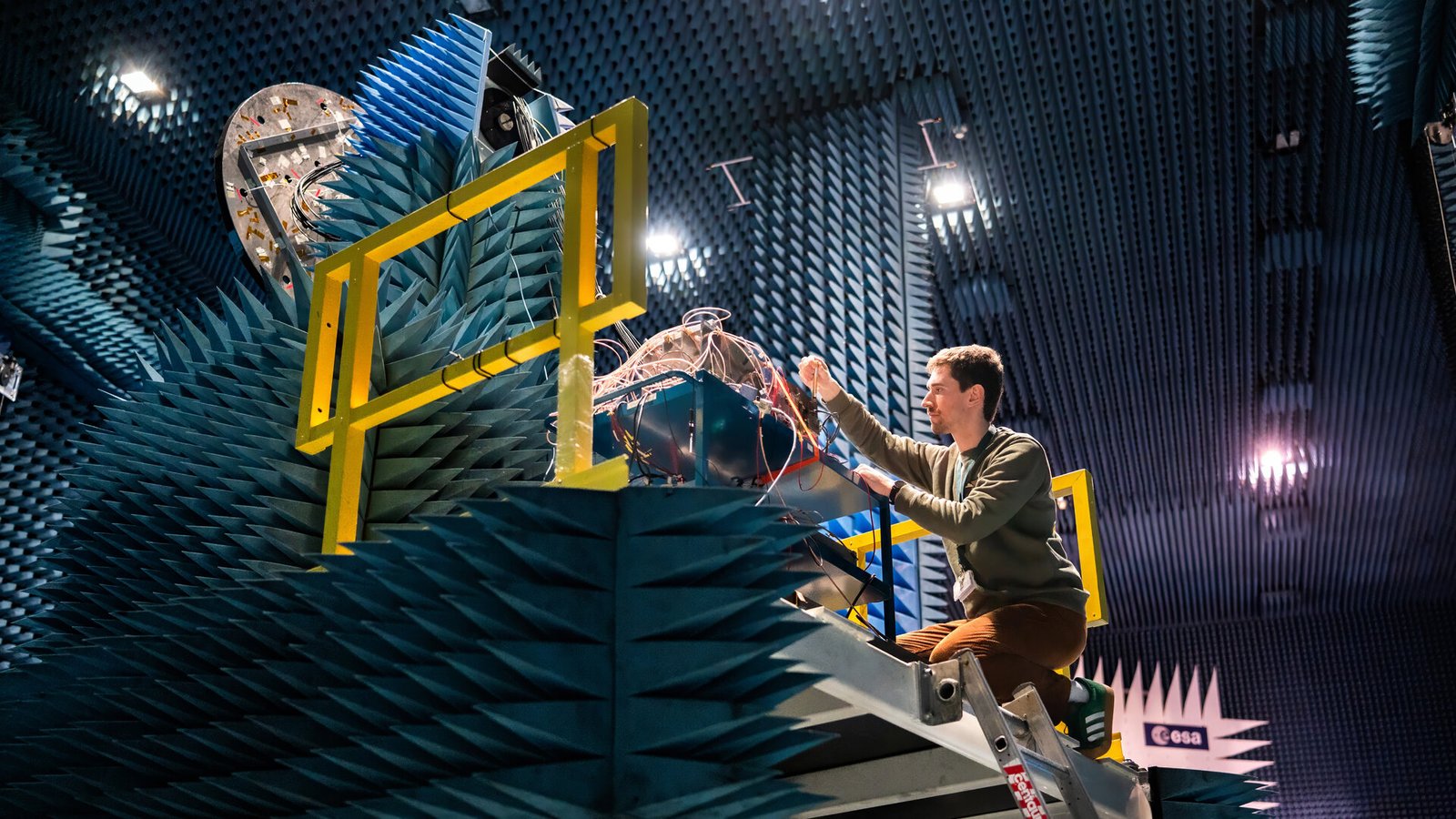
Antenna systems are crucial for spacecraft, facilitating communications and navigation by transmitting radar signals and receiving scientific data from space. To ensure the reliability of such technology in space environments, thorough testing in simulations that mimic space conditions is necessary. This is accomplished in anechoic chambers—shielded rooms designed to eliminate external signals and echoes, providing a clear measurement of the antenna’s performance. The Hybrid European Radio Frequency and Antenna Test Zone (HERTZ) serves as one of these testing facilities at ESA, located in the Netherlands.
Vaclav Valenta, another ESA microwave engineer and co-inventor of the beamforming concept, highlighted the technology’s potential, noting its early success and further opportunities for development. The patented technology and initial results will be accessible to industries in ESA member states at no cost, allowing for integration into compact, low-power solutions applicable in both space and terrestrial settings.
To further enhance the technology readiness of this beamforming innovation, ESA will soon launch a dedicated research and development program as part of the Open Space Innovation Platform (OSIP). This initiative aims to facilitate the commercial maturation of ESA inventions, leveraging its collaborative efforts between the Antenna and Microwave laboratories, thus covering the entire engineering process from design to testing. All facilities are also made available for industrial and research purposes, underscoring ESA’s commitment to advancing aerospace technology through cooperative innovation.
The content above is a summary. For more details, see the source article.