Key Takeaways
- One in three Hubble Space Telescope images may be compromised by projected satellite launches, which could total 560,000 by 2030.
- NASA’s study predicts two satellite trails in Hubble images and up to 90 in Xuntian photos due to increasing satellite numbers.
- Experts believe the actual number of operational satellites may stabilize between 50,000 and 100,000, potentially reducing impact on observations.
Satellite Launch Plans Impacting Telescopes
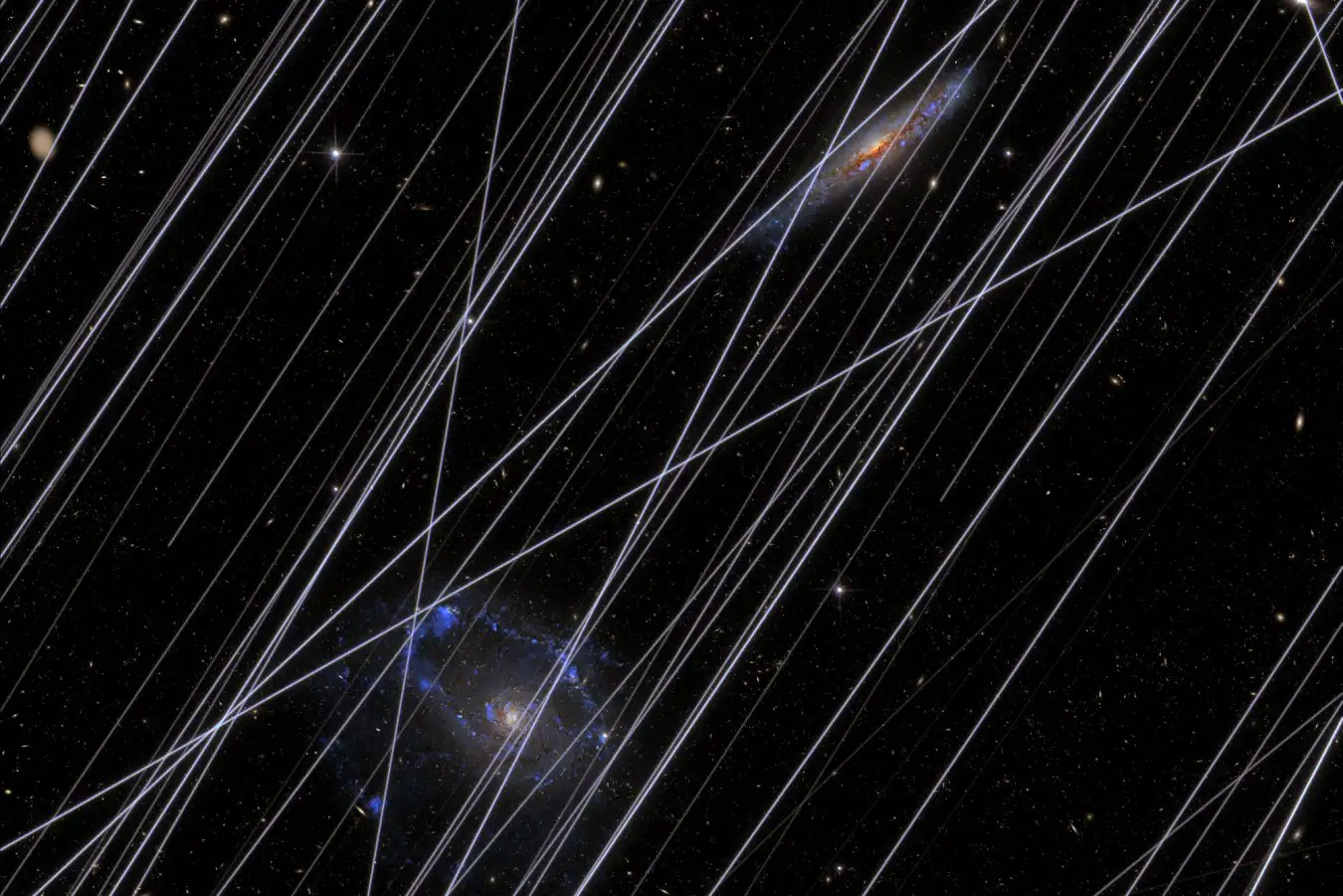
A recent study indicates that up to one in three images from the Hubble Space Telescope could be affected if current plans for mass satellite launches proceed as proposed. Over the last five years, more than three-quarters of nearly 14,000 satellites in orbit have been launched, largely due to large-scale initiatives like Starlink, Elon Musk’s satellite internet project. Projections from the U.S. Federal Communication Commission (FCC) suggest that the number of satellites could balloon to 560,000 by the end of the 2030s.
NASA’s Alejandro Borlaff and his research team have raised concerns about the effects of these satellites not only on ground-based telescopes but also on space-based observatories. Borlaff noted, “When you position a telescope in space, it’s usually a very pristine environment. Now, for the first time, you have man-made objects that are somehow polluting the images.”
Utilizing filings from the FCC and the International Telecommunication Union, Borlaff’s team simulated the predicted interference from these future satellites on four prominent observatories, including Hubble and China’s Xuntian telescope, along with two next-generation instruments: ARRAKHIS and SPHEREx. The simulations predict that if the satellite deployment continues as planned, Hubble could capture an average of two satellite trails per image, while Xuntian could see around 90 trails due to its wider field of view and higher orbit.
To validate these scenarios, the team analyzed real Hubble images and confirmed that approximately 4 percent of current images are already affected by satellite trails. This predicted increase could have serious implications for future astronomical observations.
John Barentine from Dark Sky Consulting emphasized the uncertainty in these predictions, stating, “Many experts feel that the number of satellites that will actually orbit the Earth within about the next 15 years will reach a steady-state value of something more like 50,000 to 100,000.” He pointed out that should the actual number of satellites be significantly lower than the current plans, the potential impact on space telescopes will be considerably less severe, possibly resulting in only marginal increases in the number of trails per image for some telescopes.
The increasing presence of satellites poses a significant challenge for astronomers, prompting ongoing discussions about the balance between advancing satellite technology and maintaining the integrity of astronomical observations. As satellite launches continue, the prospect of mitigating their effects becomes a priority for the scientific community.
The content above is a summary. For more details, see the source article.