

Key Takeaways
- Astronomers discovered unexpectedly high levels of chlorine and potassium in the supernova remnant Cassiopeia A, challenging existing models of element formation.
- Findings may influence our understanding of the distribution of life-essential elements in the Milky Way and where extraterrestrial life might exist.
- The X-Ray Imaging and Spectroscopy Mission (XRISM) played a crucial role in measuring these odd-Z elements, providing new data for refining astronomical models.
Discoveries in Cassiopeia A
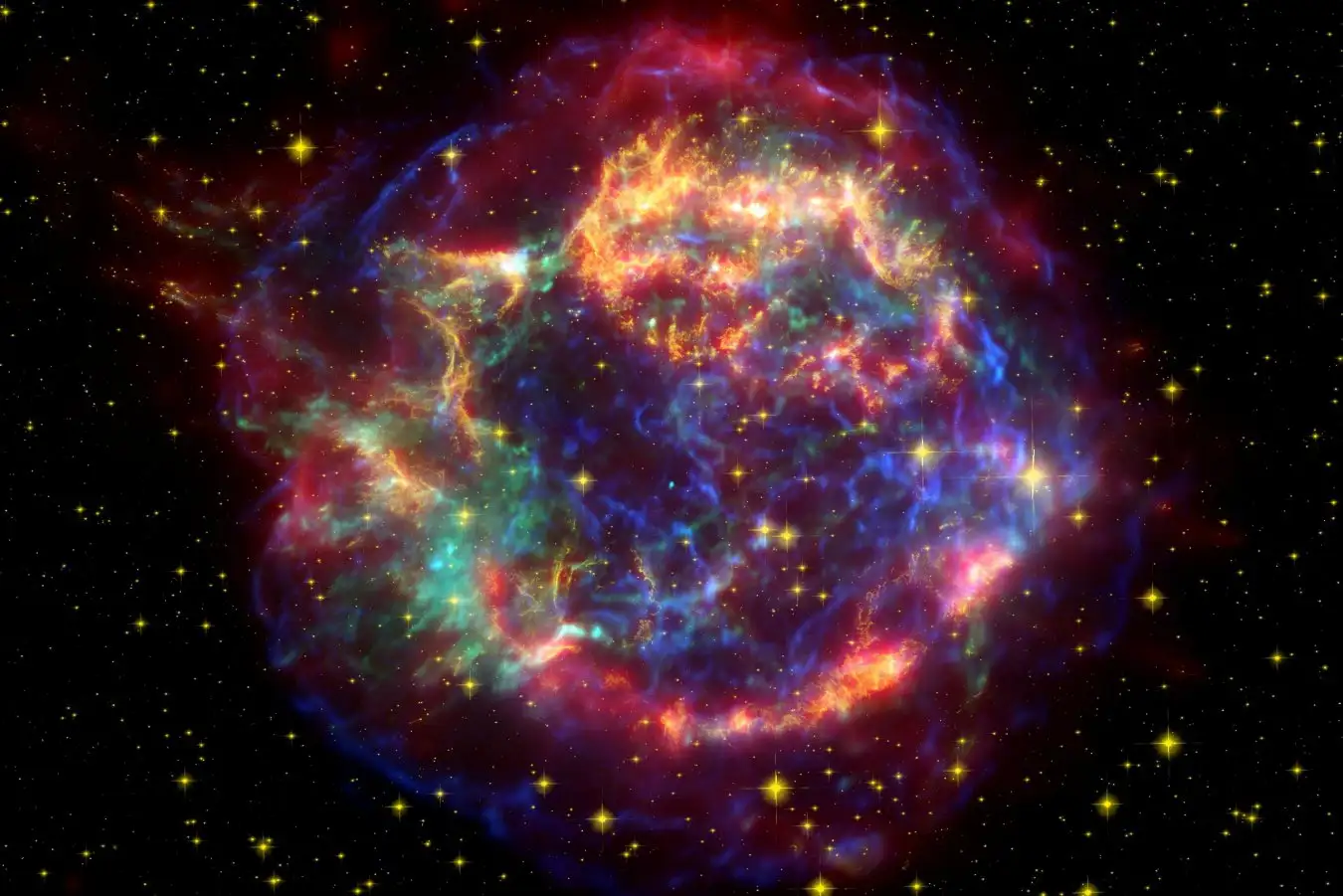
Astronomers have recently observed surprisingly elevated levels of chlorine and potassium within Cassiopeia A, the youngest known supernova remnant in our galaxy. These elements, classified as odd-Z due to their odd number of protons, are typically rarer in the universe yet are vital for planet formation and biological systems. The findings could reshape theories about the prevalence of essential elements for life within the Milky Way.
Traditionally, exploded stars—supernova remnants—yield more common elements like oxygen and magnesium, which possess even numbers of protons. The unstable nature of odd-Z elements makes their existence less likely during stellar fusion, leading to models predicting their scarcity. “The origins of these odd-Z elements have long been uncertain,” notes Kai Matsunaga from Kyoto University.
Utilizing high-resolution X-ray spectroscopy, Matsunaga and his team sought to clarify the origins of these rare elements. The recently launched X-Ray Imaging and Spectroscopy Mission (XRISM) provided the necessary sensitivity for this task. In December 2023, XRISM conducted two observations of Cassiopeia A, capturing unique X-ray emissions that allowed researchers to differentiate odd-Z elements from more abundant even-Z counterparts like sulfur and argon.
The analysis revealed that Cassiopeia A produced significantly more chlorine and potassium than previously anticipated. This discrepancy indicates a potential need for modifications in current models that explain the production of these elements during massive star explosions. While Stan Woosley from the University of California, Santa Cruz, acknowledges that not all existing models are incorrect, he emphasizes that the new observations provide vital data for improving our understanding of stellar explosions.
Moreover, this research enables testing of longstanding hypotheses regarding the formation of odd-Z elements in massive stars. Several theories exist, including those related to stellar rotation, interactions between binary star systems, and merging internal burning layers. Prior to this study, there had been no empirical method to validate these theories.
The study also raises intriguing questions regarding the origins of chlorine, which is abundant in Earth’s oceans. “We still do not have a full understanding of which type of stars contributed to [this] galactic inventory,” mentions Katharina Lodders from Washington University, highlighting the need for further investigation into how these essential elements are distributed across the galaxy.
If these results are consistent across additional supernova remnants, they may influence how astronomers view the distribution of life-supporting elements throughout the Milky Way. It may suggest that certain regions are more conducive to supporting life than others based on the types of stars that contributed to their development. Matsunaga speculates about the implications for extraterrestrial life, although definitive conclusions cannot yet be drawn. “Future observations of other supernova remnants with XRISM or other upcoming instruments will be crucial for addressing this question,” he asserts.
As this area of research evolves, it holds the potential to unveil a deeper understanding of the cosmos and the origins of life-essential elements throughout our galaxy.
The content above is a summary. For more details, see the source article.