Key Takeaways
- Astronomers discovered over 100 new moons in the solar system this year, with Saturn alone gaining 128 more.
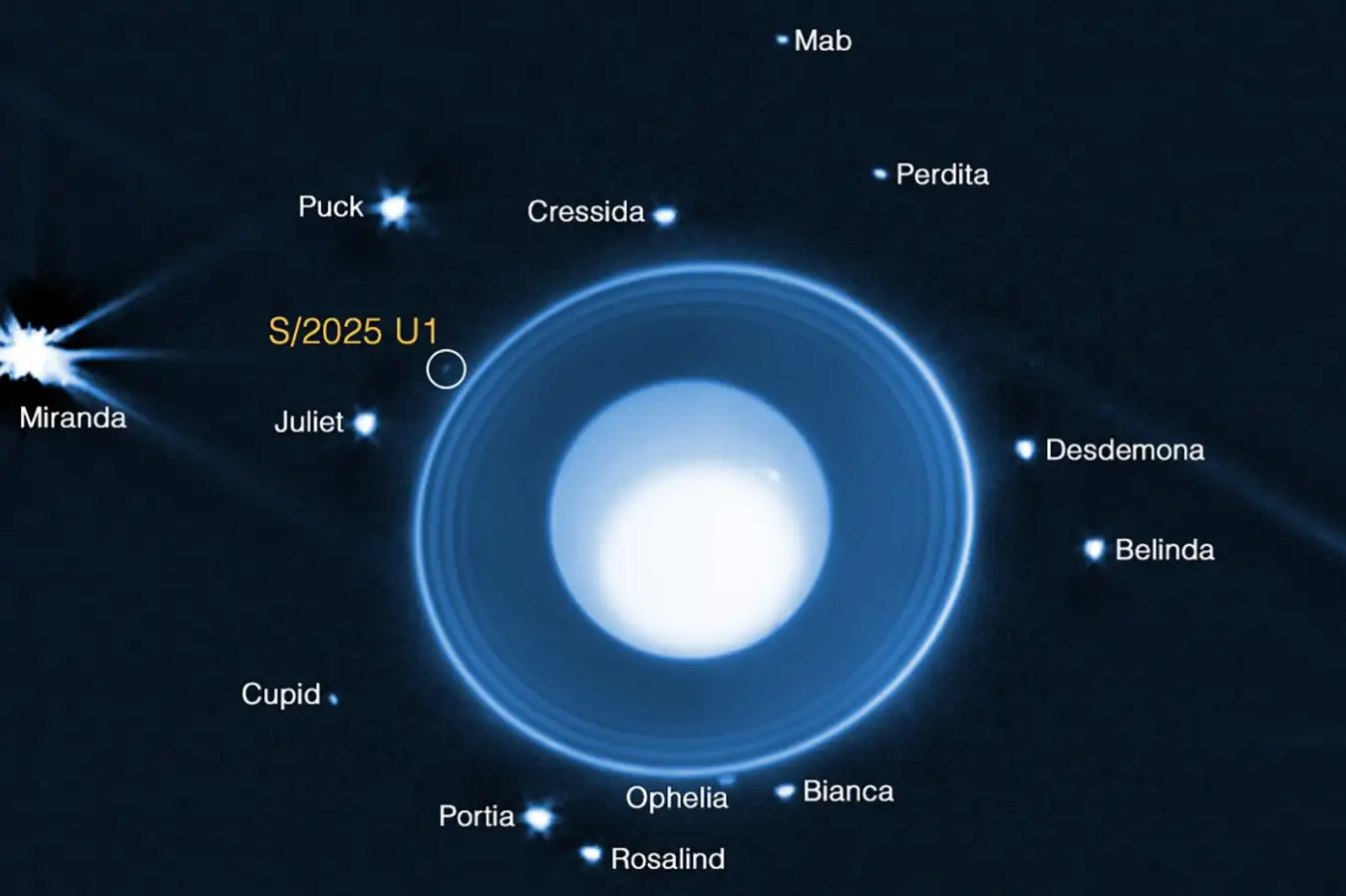
- A new moon around Uranus, named S/2025 U1, was detected using the James Webb Space Telescope, increasing its total to 29 moons.
- The ongoing discovery and cataloging of moons can enhance understanding of planet formation and the processes that create various moon shapes and sizes.
Recent Discoveries in Our Solar System
This year has been remarkable for astronomers, with the discovery of over 100 previously unknown moons in our solar system. This surge in lunar discoveries presents promising opportunities to deepen the understanding of planetary formation.
In March, a significant find was made by Edward Ashton and his team at Academia Sinica in Taiwan, who identified 128 new moons orbiting Saturn. This brings Saturn’s total moon count to an impressive 274. Utilizing extensive imagery from the Canada-France-Hawaii Telescope, the team stacked hours of photos to detect dim objects often missed in singular observations. While Ashton’s team has the rights to name these new moons, the sheer number of Saturn’s moons means that many may not receive individual names.
In August, the exploration continued as Maryame El Moutamid and colleagues at the Southwest Research Institute revealed the discovery of a small, dim moon orbiting Uranus. This moon, provisionally called S/2025 U1, raises Uranus’s moon tally to 29. The discovery was made using long-exposure infrared images from NASA’s James Webb Space Telescope. While the team hasn’t disclosed potential names for the new moon, it is anticipated that it will follow the same naming convention as 27 of Uranus’s existing moons, which draw names from characters in Shakespeare’s plays—a tradition dating back to the discovery of Titania and Oberon, Uranus’s first moons, in 1787.
According to Nigel Mason from the University of Kent, the ongoing search indicates there could be many more moons left to be found, particularly around Neptune and Uranus. He posits that while the largest moons have likely been mapped, smaller ones may still remain undiscovered. Mason emphasizes the excitement of finding new moons is not merely about numbers; it enriches the narrative of planetary science.
Cataloging these moons could unveil critical insights into their creation processes and refine existing models of how planets form. Mason notes that questions remain regarding the vast number of moons—sometimes numbering up to 60—and their diverse characteristics. As researchers gather more data, the mysteries surrounding the formation processes of these celestial bodies remain intriguing.
This ongoing research not only contributes significantly to planetary science but also excites the scientific community and the public alike. Each discovery adds to a legacy of understanding that helps frame how the solar system evolved and how complex the planetary processes are.
The content above is a summary. For more details, see the source article.