Key Takeaways
- A past collision involving Titan may explain the formation of Saturn’s rings and the planet’s anomalies.
- The hypothetical moon Chrysalis may have been responsible for Titan’s unusual orbit and the destabilization of Saturn’s inner moons.
- NASA’s upcoming Dragonfly mission aims to investigate Titan’s surface for evidence of this cosmic event.
Exploring Titan’s Role in Saturn’s Mysteries
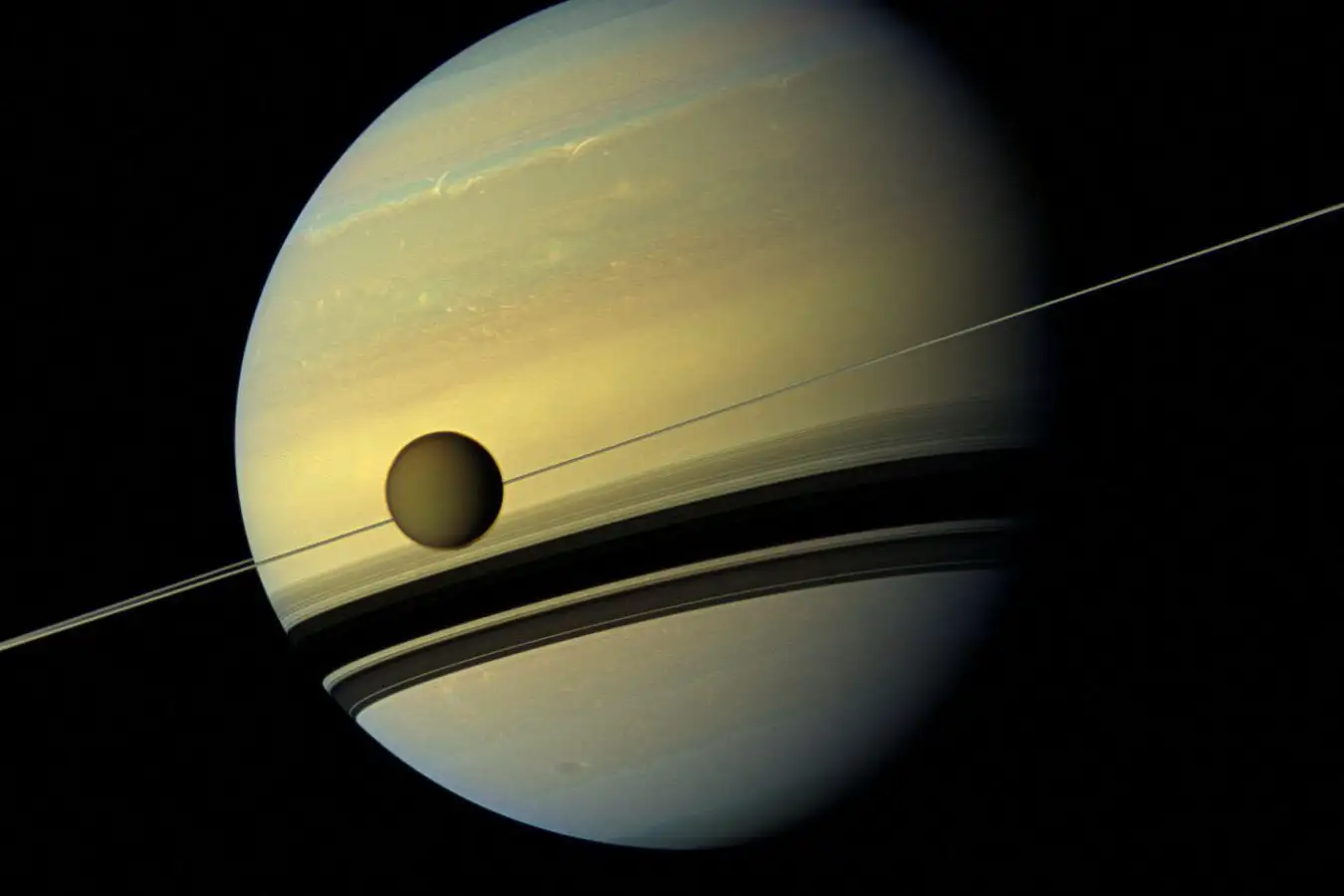
The formation of Saturn’s iconic rings, its unique wobble, and the peculiar orbits of its moons may have originated with a significant event involving Titan, Saturn’s largest moon. Recent research suggests that a collision between an early version of Titan and a smaller celestial body approximately 400 million years ago could be the key to understanding these cosmic phenomena.
Saturn is a planet rich with mysteries. For instance, its rings appear younger than anticipated, the planet’s wobble does not align with the movement of Neptune, and its small moon Iapetus has an unexpected tilted orbit. Additionally, Titan’s surface features fewer craters and exhibits an eccentric orbit.
Matija Ćuk from the SETI Institute leads a team proposing a unified theory that addresses these mysteries. The theory is supported by the existence of a hypothesized moon called Chrysalis, which was suggested in 2022 as a possible explanation for Saturn’s unusual wobble. Chrysalis is thought to have been projected towards Saturn, potentially colliding with Titan and subsequently forming the rings, while also destabilizing the orbits of other moons.
In examining simulations, Ćuk and his team found that a collision between Chrysalis and Titan is more plausible than initially believed. When considering the consequences of such an impact, they theorized that it would have erased Titan’s craters, distorted its orbit from circular to elliptical, and generated debris. Notably, this debris could include the smaller moon Hyperion, which notably appears younger than Saturn’s other moons.
The envisioned sequence of events posits that Titan’s altered orbit would lead to destabilization among Saturn’s inner moons. The resulting collisions would grind these moons down into the fine particles that comprise Saturn’s rings today. This scenario implies that Titan is pivotal in the formation and evolution of the entire Saturn system.
Sarah Hörst, a planetary scientist at Johns Hopkins University, praised the theoretical framework, noting its ability to cohesively address several outstanding mysteries surrounding Saturn.
Further investigation into this theory could occur soon, with NASA’s Dragonfly mission scheduled for launch in 2028 and arrival at Titan expected in 2034. This mission aims to thoroughly examine Titan’s surface, providing insights that could confirm or debunk the theory of a collision with Chrysalis. If the theory holds, it could significantly enhance our understanding of the Saturn system’s peculiarities and origins.
The content above is a summary. For more details, see the source article.