Key Takeaways
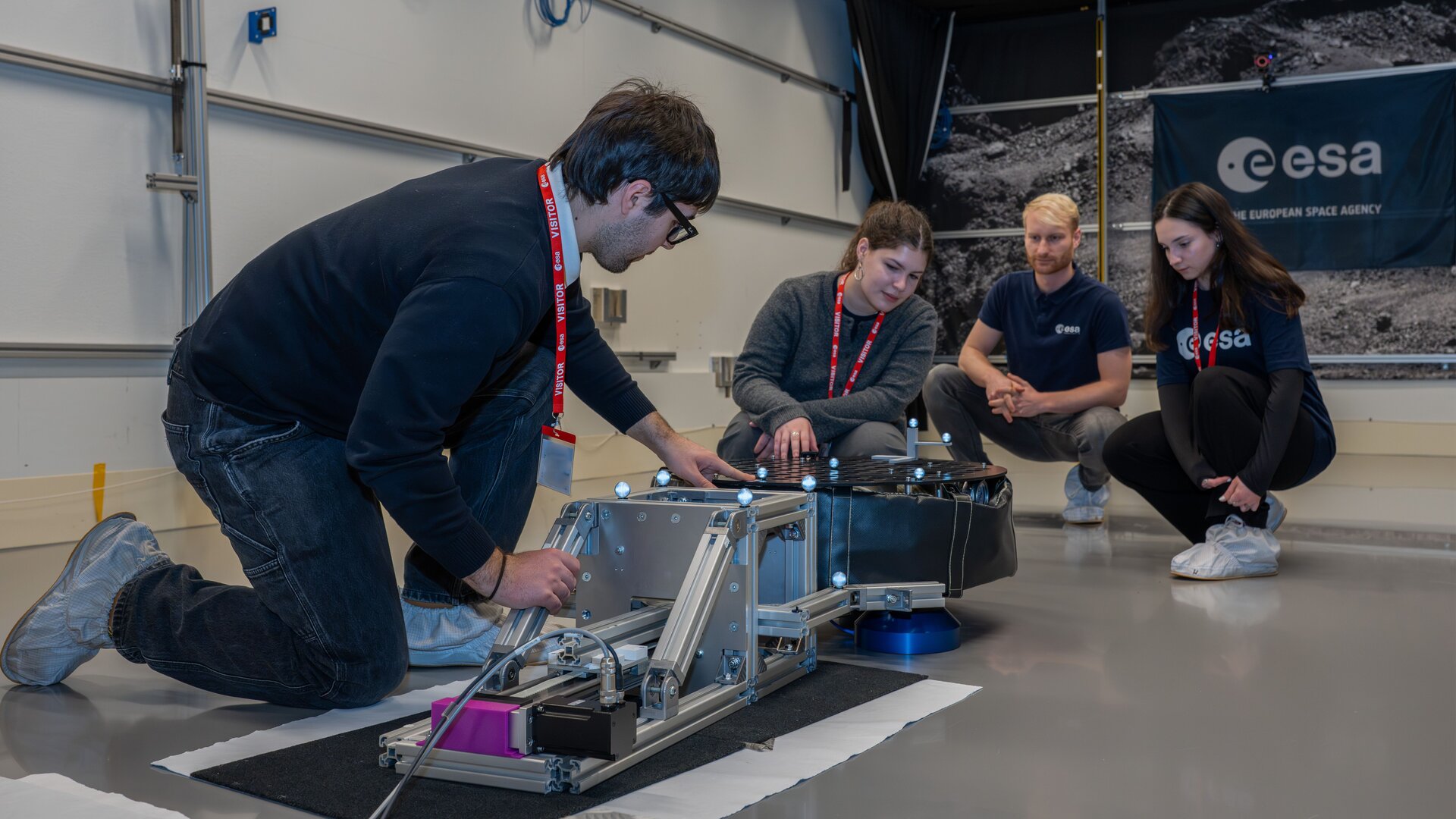
- University students from ESA Academy conduct experiments in the Orbital Robotics Laboratory at ESA’s ESTEC in the Netherlands.
- Team STAR-BOTS focuses on swarm robotics to manage space debris, while Team RobOcto develops flexible gripping arms.
- The program enhances hands-on learning and industry readiness for students from STEM and non-STEM backgrounds.
Innovative Student Research at ESA
This year, the European Space Agency (ESA) Academy is facilitating groundbreaking research through its Experiments programme, allowing university students to engage with cutting-edge technology at ESA’s technical centre, ESTEC, in the Netherlands. The programme provides students from various European universities the chance to transform their research ideas into practical experiments under expert guidance.
Two student teams are currently utilizing the Orbital Robotics Laboratory to conduct their experiments. Team STAR-BOTS, hailing from the University of Bologna in Italy, is exploring how small spacecraft can collaboratively manage space debris. Their research aims to develop a swarm of robots capable of safely approaching and surrounding hazardous objects in orbit.
On the other hand, Team RobOcto from the University of Twente in the Netherlands is working on octopus-like robotic arms that employ electrostatic-magnetic gripping techniques. This innovative approach seeks to enhance flexibility and efficiency in robotics applications.
The Academy Experiments programme invites students from across Europe to apply through a competitive proposal process. Laura Borella, the programme coordinator, emphasizes the comprehensive support provided to selected teams throughout their projects’ lifecycle—ranging from concept inception to operational execution and data analysis. Participants receive lectures on engineering fundamentals and space business as part of their preparation.
Once selected, teams advance to a final phase where they undergo training with the robotics facilities. Marti Vilella, an Automation and Robotics engineer, notes that initial sessions include hands-on activities designed to familiarize students with the laboratory’s equipment essential for their projects.
Borella highlights the programme’s broader impact, stating that it equips students with practical skills needed in the industry, thereby bridging the gap between academic theory and real-world application. Many alumni from the programme have successfully integrated into the space sector, showcasing the diverse academic backgrounds of participants from both STEM and non-STEM disciplines.
This innovative initiative not only fosters collaboration and experimentation among future space industry professionals but also contributes significantly to the ongoing development of robotics technology in managing space challenges. The engaging environment at ESA’s facilities offers students invaluable experiences that will be pivotal in their career paths as they contribute to advancements in space exploration and technology.
The content above is a summary. For more details, see the source article.