Key Takeaways
- Nasa’s CryoFILL project aims to produce liquid oxygen on the Moon or Mars, reducing launch fuel needs.
- Utilizing lunar water ice, NASA aims to create propellant for sustained space missions, supporting Artemis lunar expeditions.
- A testing phase at NASA Glenn will evaluate oxygen liquefaction, data guiding future technology for in-situ refueling efforts.
NASA’s Innovations in Space Fuel Production
The distance of a space mission directly impacts fuel requirements for rockets, which in turn affects spacecraft weight and launch costs. To address this challenge, NASA’s Glenn Research Center is exploring a groundbreaking approach through its CryoFILL (Cryogenic Fluid In-Situ Liquefaction for Landers) project.
CryoFILL aims to reduce operational costs and extend time spent on planetary surfaces by enabling the production and liquefaction of oxygen on the Moon or Mars. Evan Racine, project manager, explained that by generating fuel directly on these celestial bodies, the amount of propellant needing to be launched from Earth can be significantly minimized.
As part of the Artemis program, NASA plans to send astronauts for more extensive Moon exploration, which will serve both scientific and economic purposes while laying the groundwork for crewed missions to Mars. A key strategy for maintaining a long-term presence on the Moon includes utilizing its resources to create essential products such as rocket fuel.
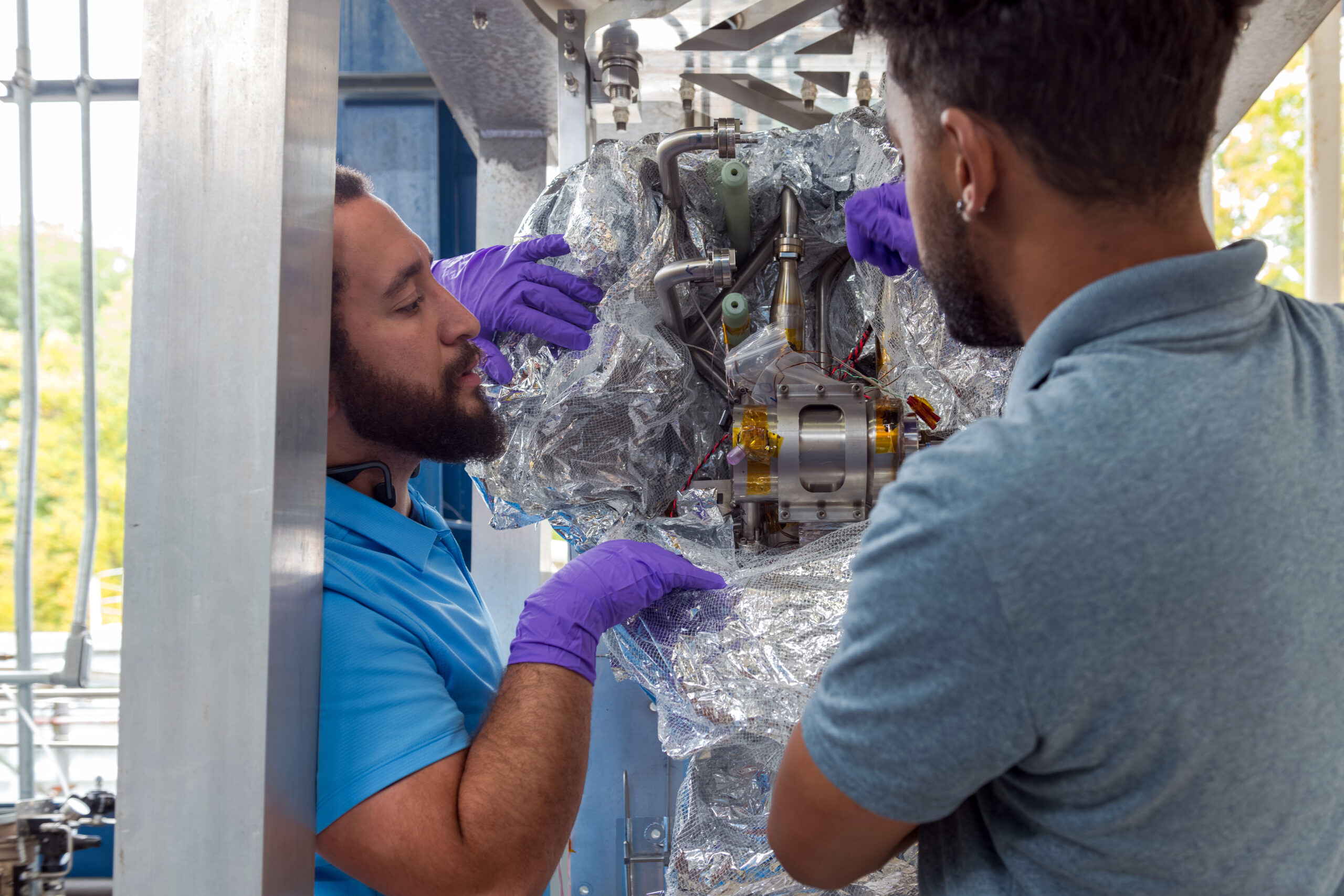
Oxygen, a critical component of propellant, can be extracted from lunar water ice found in permanently shadowed regions. While initially extracted in gas form, this oxygen must be condensed into liquid form for usability. To facilitate this process, NASA Glenn engineers are utilizing a flight-like cryocooler developed by Creare LLC, funded through NASA’s Small Business Innovation Research program. This equipment is essential for cooling the oxygen to beneath minus 300 degrees Fahrenheit, necessary for condensation.
Wesley Johnson, lead engineer for the CryoFILL project, noted that the team is testing hardware to assess how oxygen liquefies under varying scenarios. These tests are vital for evaluating the system’s efficiency and preparing for future in-situ refueling missions.
In the upcoming three months, NASA engineers will conduct thorough studies to understand the conditions affecting oxygen condensation. The data collected will not only validate temperature computer models but also inform the design of technologies crucial for lunar and Martian applications.
The Cryogenic Fluid Management Portfolio Project represents a collaborative effort between teams at NASA Glenn and Marshall Space Flight Center in Huntsville, Alabama. This project is part of NASA’s Space Technology Mission Directorate, encompassing over 20 technology development activities aimed at advancing space exploration capabilities.
The content above is a summary. For more details, see the source article.