Key Takeaways
- China is set to mark its 11th Space Day while preparing for the launch of the Chang’e-7 spacecraft aimed at lunar resource surveys.
- The Chang’e lunar missions have achieved significant milestones, including the first soft landing on the moon’s far side and successful sample returns.
- International collaboration is a key feature of the Chang’e program, with upcoming missions planned to include payloads from multiple countries and organizations.
China’s Chang’e Lunar Program Achievements
China celebrates its 11th Space Day with ongoing preparations for the Chang’e-7 mission, expected to launch in the latter half of 2026. This spacecraft will target the lunar south pole for environmental and resource studies.
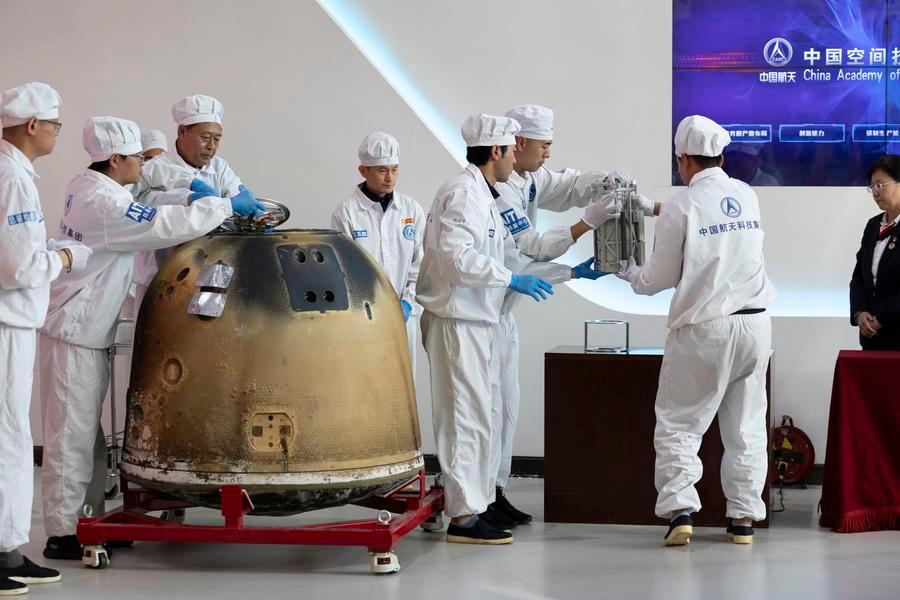
Over the past decade, the Chang’e program has recorded substantial achievements, including Chang’e-4’s historic soft landing on the far side of the moon and Chang’e-5’s return of the first youthful lunar samples. Most notably, Chang’e-6 accomplished the first-ever sample return from the moon’s far side, enhancing global lunar research.
Recent discoveries have significantly advanced lunar studies. Chang’e-4, which touched down in the ancient South Pole-Aitken Basin in 2019, revealed vital geological insights. Similarly, Chang’e-5 collected 1,731 grams of samples from the near side in 2020, while Chang’e-6 brought back 1,935.3 grams in 2024, which aided scientists in understanding the moon’s volcanic history and geological differences between its near and far sides.
Advancements in Deep Space Exploration
The Chang’e missions not only focus on the moon but also pave the way for future deep space endeavors. The relay communication satellites Queqiao-1 and Queqiao-2 addressed the challenges of communication with missions on the moon’s far side, providing groundwork for future projects involving asteroids and Mars. The knowledge gained has also been applied in the Tianwen-1 Mars mission.
China has utilized Lagrange points for scientific purposes, deploying the Queqiao-1 satellite in a halo orbit around the Earth-moon Lagrange point 2. Such locations are crucial for long-term space missions requiring minimal fuel.
International Cooperation and Future Plans
The Chang’e program promotes global collaboration, allowing international payloads to be included in missions. Chang’e-4 carried instruments from various nations, and Chang’e-6 hosted several international contributions as well. Planned for future missions, Chang’e-7 will include payloads from seven different countries, while Chang’e-8 aims to involve contributions from eleven.
China has also opened its lunar samples from Chang’e-5 for international research, with institutions from six countries granted access for scientific study. The Chang’e missions will play a central role in the proposed International Lunar Research Station (ILRS), which brings together 17 countries and over 50 international research institutions for collaborative lunar exploration.
The content above is a summary. For more details, see the source article.