Key Takeaways
- NASA’s Artemis II mission showcased a successful test of laser communications, transmitting data more efficiently than traditional radio systems.
- The Orion spacecraft exchanged 484 gigabytes of data during its 10-day lunar journey, enabling high-resolution imagery and real-time updates for the crew.
- This advancement supports future missions, including enhanced scientific exploration and potential crewed missions to Mars.
A Breakthrough in Space Communications
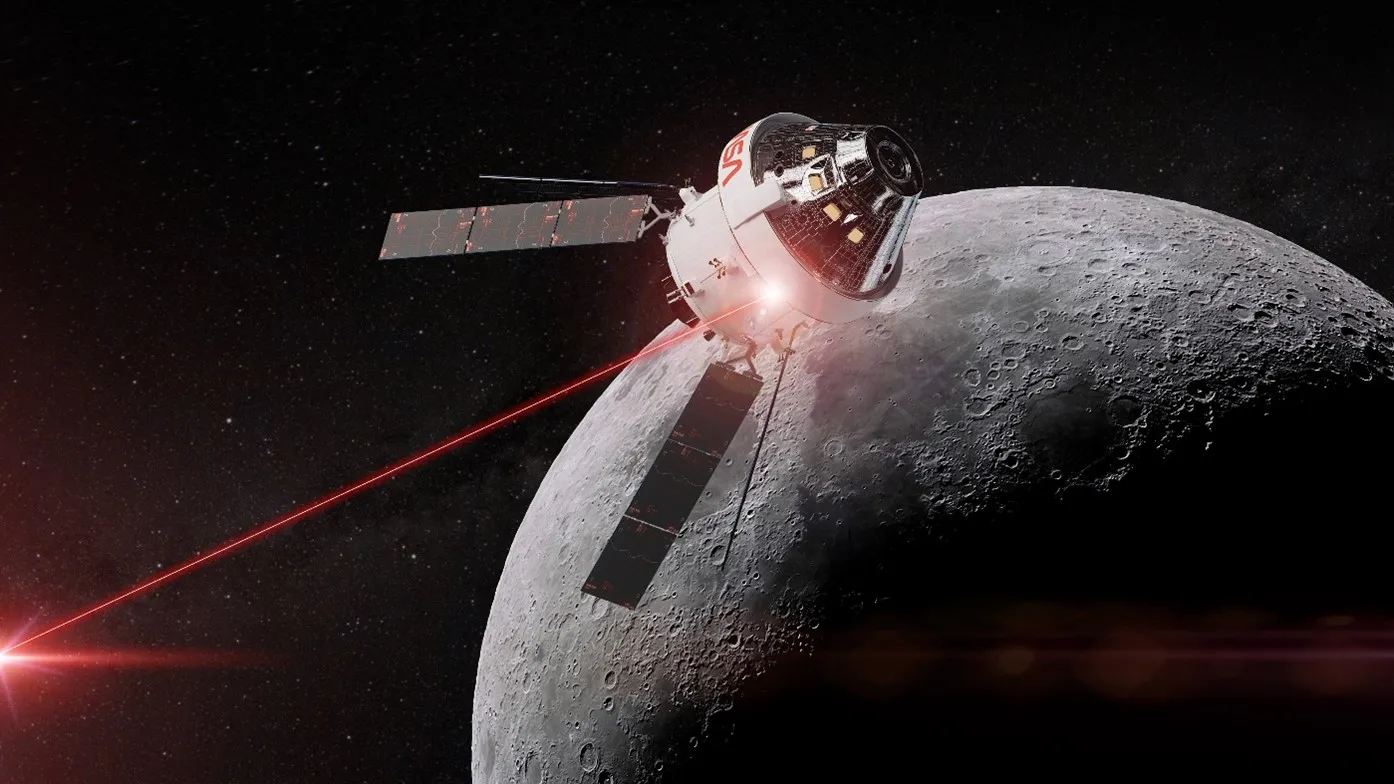
NASA’s Artemis II mission, which took place over 10 days, marked a significant leap in space communications. Astronauts Reid Wiseman, Victor Glover, Christina Koch, and CSA astronaut Jeremy Hansen traveled farther into space than any humans before. A key aspect of the mission was the testing of an optical communications system that utilized invisible infrared light to transmit a greater volume of data compared to traditional radio frequency systems.
This innovative optical terminal, installed on the Orion spacecraft, was integral to the mission’s success, functioning for the first time in a crewed lunar mission. It enabled the transmission of high-definition video, engineering data, and voice communications back to Earth whenever the spacecraft had a visual line to ground stations. Dr. Kelsey Young, the lunar science lead for Artemis II, emphasized the system’s potential: “Access to high-resolution imagery and other scientific data during dynamic science mission phases is a game changer,” she stated, noting its impact on effective decision-making for the crew’s exploration efforts.
Throughout the journey, the optical communications system managed to transmit a notable 484 gigabytes of data, equivalent to 100 high-definition movies. The brisk and clear visuals of Earth from space were sent via this system, including stunning images of Earthset and Earthrise. Additionally, mission data was relayed to the Orion capsule, keeping the crew well-informed.
Traditional communications during Artemis II were supported by NASA’s Near Space Network and Deep Space Network, which are limited to lower data rates at lunar distances. In contrast, the optical system achieved multiple downlinks of 260 megabits per second, exceeding most initial demonstration goals. The mission benefited from ground station telescopes at NASA’s Jet Propulsion Laboratory in California and White Sands Complex in New Mexico, both chosen for their optimal environments to establish reliable connections with the Orion spacecraft. Remarkably, they managed to downlink significant data volumes, achieving a record of 26 gigabytes in under an hour.
In addition to these facilities, a new optical ground station at the Australian National University in Canberra successfully participated in the mission. After years of collaboration, experts from NASA contributed to developing a lunar-capable optical telescope that demonstrated viability using commercial parts. The Australian site maintained a dual-stream video link with Orion for over 15.5 hours, enhancing NASA’s “Live Views from Orion” broadcast, which allowed millions to witness mission milestones in real-time.
Greg Heckler, the SCaN deputy program manager, remarked, “Space communications isn’t just about moving bytes, it’s about delivering the images, the video, and the voices of the crew that bring a mission to life.” The optical communications payload enabled viewers to watch the astronauts begin their journey, showcasing the experience of space travel as deeply personal and emotionally resonant.
As NASA forges ahead in human space exploration, the success of the laser communications system offers promising insights for future missions, including the potential for crewed missions to Mars. The foundation laid by Artemis will facilitate scientific discoveries and economic opportunities as astronauts continue to study and explore the Moon.
The content above is a summary. For more details, see the source article.