Key Takeaways
- A mini capsule, scaled down from the ExoMars landing module, was tested at supersonic speeds to gather data on its flight dynamics.
- This technology can withstand extreme g-forces, providing valuable insights for the upcoming Mars mission.
- The tests were conducted at the French-German Research Institute of Saint-Louis, enhancing understanding of Mars atmospheric entry.
Innovative Testing for Mars Mission
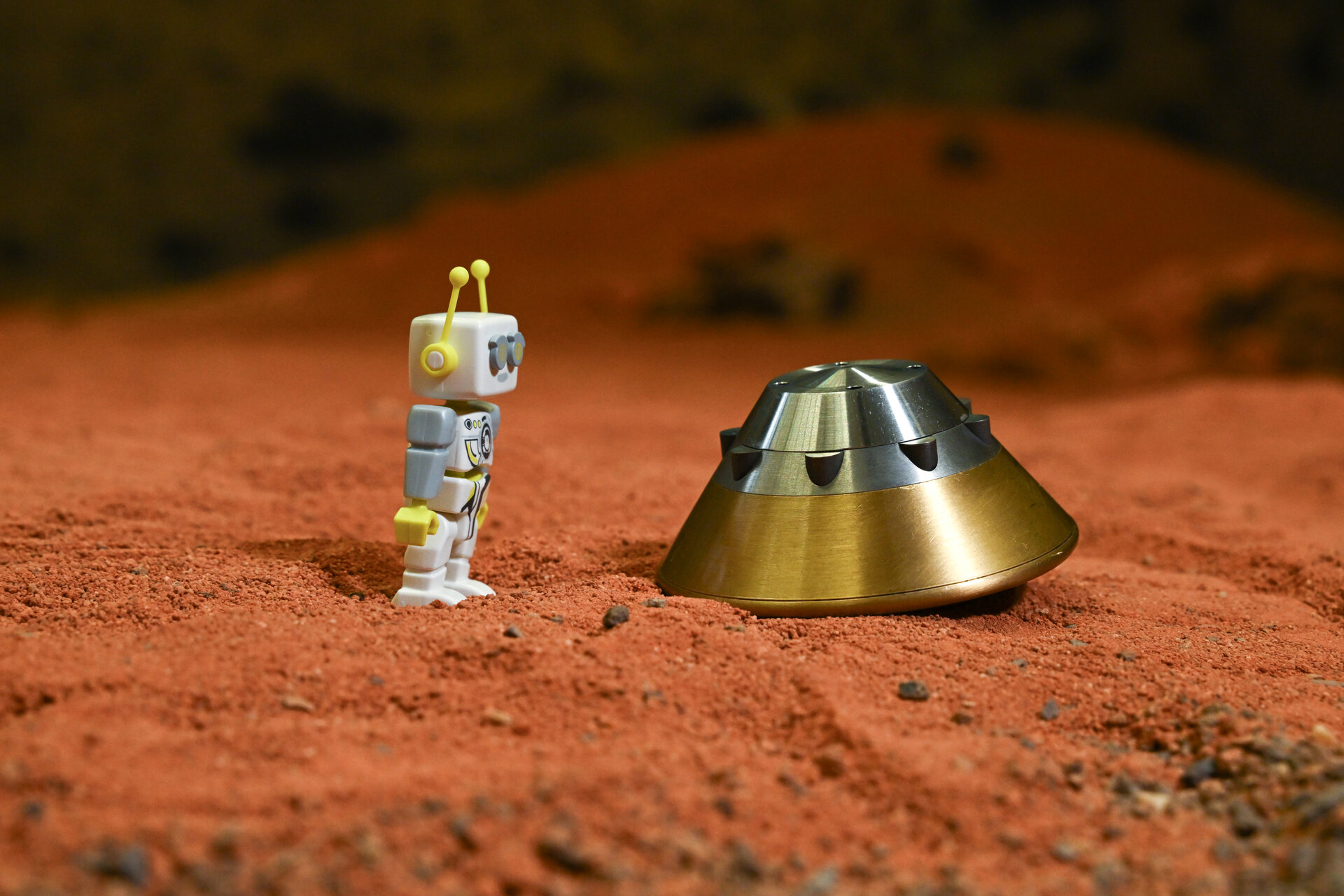
A small metallic capsule, a reduced model of the ExoMars landing module, was recently tested to collect crucial data for upcoming Mars exploration. Measuring just 8 cm in diameter, the capsule is a miniature version of the larger, 3.8-meter spacecraft designed to carry the Rosalind Franklin rover to Mars. The test involved launching the capsule at an impressive speed of 4,300 km per hour.
During the testing phase, 20 such models were utilized to simulate Mars entry dynamics at supersonic speeds. This technology is designed to withstand approximately 17,000 g-force of acceleration, a force 11,000 times stronger than what a Formula 1 driver experiences at full speed, highlighting its robustness.
Each miniature capsule was equipped with advanced electronic circuits, including magnetometers, accelerometers, and radar systems to monitor its flight path of 230 meters. These sensors recorded data on movement, trajectory, and stability during the free-flight experiment, which was executed using a smooth-bore gun. The data gathering process was rapid; the entire flight lasted only half a second, with a specialized tracking technology allowing for the capture of its trajectory on video.
The tests are significant in understanding how the ExoMars descent module will perform upon its approach to Mars, which will occur at a speed of 21,000 km per hour. The entry process will rely on a combination of heat shields, parachutes, and retro rockets to ensure a safe landing on the Martian surface.
Conducted at the French-German Research Institute of Saint-Louis (ISL), these tests contribute to a leading research facility’s efforts dedicated to studying vehicle aerodynamics, particularly in the context of reentry capsules. The insights gained from this campaign are vital for planning the future of interplanetary exploration, as they inform strategies to enhance spacecraft design and operational safety.
In summary, the recent testing of the mini ExoMars capsule has provided critical insights that will play a key role in the success of the ExoMars mission, paving the way for advanced aerospace technologies that will contribute to humanity’s exploration of Mars.
The content above is a summary. For more details, see the source article.