Key Takeaways
- Nepal spends about six billion rupees annually on foreign satellite services, highlighting the need for a domestic satellite program.
- Experts emphasize that without clear regulations and government support, Nepal’s space industry will struggle to develop further.
- Potential opportunities in astro-tourism, disaster management, and precision agriculture could significantly benefit from advancements in space technology.
The Need for Space Investment in Nepal
The conversation surrounding Outer Space in Nepal often encounters skepticism, overshadowed by pressing geopolitical and domestic issues. Despite its potential benefits, space exploration remains absent in Nepal’s policy framework, leading to tangible repercussions domestically. Suresh Bhattarai, founder of the Nepal Astronomical Society, argues for the importance of space technology in national development. He pointed out that Nepal spends around six billion rupees each year on foreign satellite services, money that could fund a domestic multipurpose satellite project.
Bhattarai noted that Nepal holds two geostationary orbital slots but has failed to utilize them due to a lack of political will. Jiten Thapa, co-founder of Orion Space, echoed concerns about the country’s lack of a domestic radio licensing framework, labeling it a “major hurdle.” Reliance on foreign satellites leaves Nepal vulnerable to external political pressures, complicating communication and mapping services.
Er. Hari Ram Shrestha, head of the Space Research Centre (SRC), emphasized the necessity of developing local capabilities to minimize delays in disaster response caused by reliance on foreign data. Current initiatives like NepaliSat-1 and SanoSat-1 demonstrate early achievements in space technology. However, Shrestha mentioned that hardware development alone is insufficient. Coordination issues among ministries have resulted in slow progress in drafting important policies and frameworks for the space sector.
Entrepreneurs in Nepal face challenges due to unclear regulations and insufficient institutional backing. Abhas Maskey, founder of Antarikchya Pratisthan Nepal, advocates for foundational infrastructure and resources before the space sector can evolve. Several young engineers, notably Bikalpa Dhungana, are making strides in space technology despite limited resources. Dhungana, who built a solar-powered scooter at 17, is now expanding his startup in radio-frequency technology.
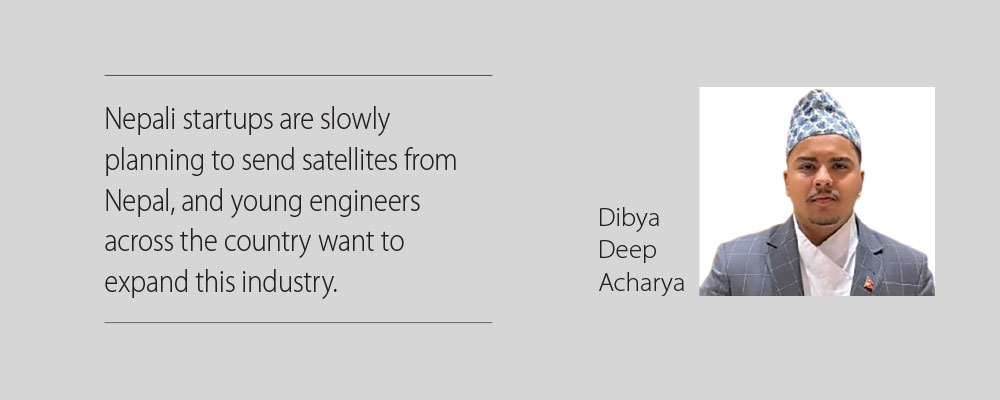
Young innovators are planning satellite launches, fueling aspirations for Nepal’s space industry. However, sustained government support is essential for growth. Bhattarai strongly advocates for dedicated space law and the establishment of a space agency under the Prime Minister’s Office due to the intersection of space with various sectors, including defense and disaster management.
Lastly, the recent fiscal budget has allocated Rs. 740 million for digital infrastructure, a mere fraction of the total. The budget speech acknowledges the need to establish Nepal’s satellites, marking a potential turning point for the country’s nascent space industry, which holds promise in fields like astro-tourism, disaster preparedness, and remote education.
The content above is a summary. For more details, see the source article.