Key Takeaways
- Active galactic nuclei could be ideal sites for forming millions of unique planets due to abundant dust and gas.
- These planets may grow to massive sizes and could even ignite nuclear fusion, resulting in unusual star-like objects.
- Upcoming telescopes may enable the detection of these planets through techniques like microlensing.
Planet Formation Around Supermassive Black Holes
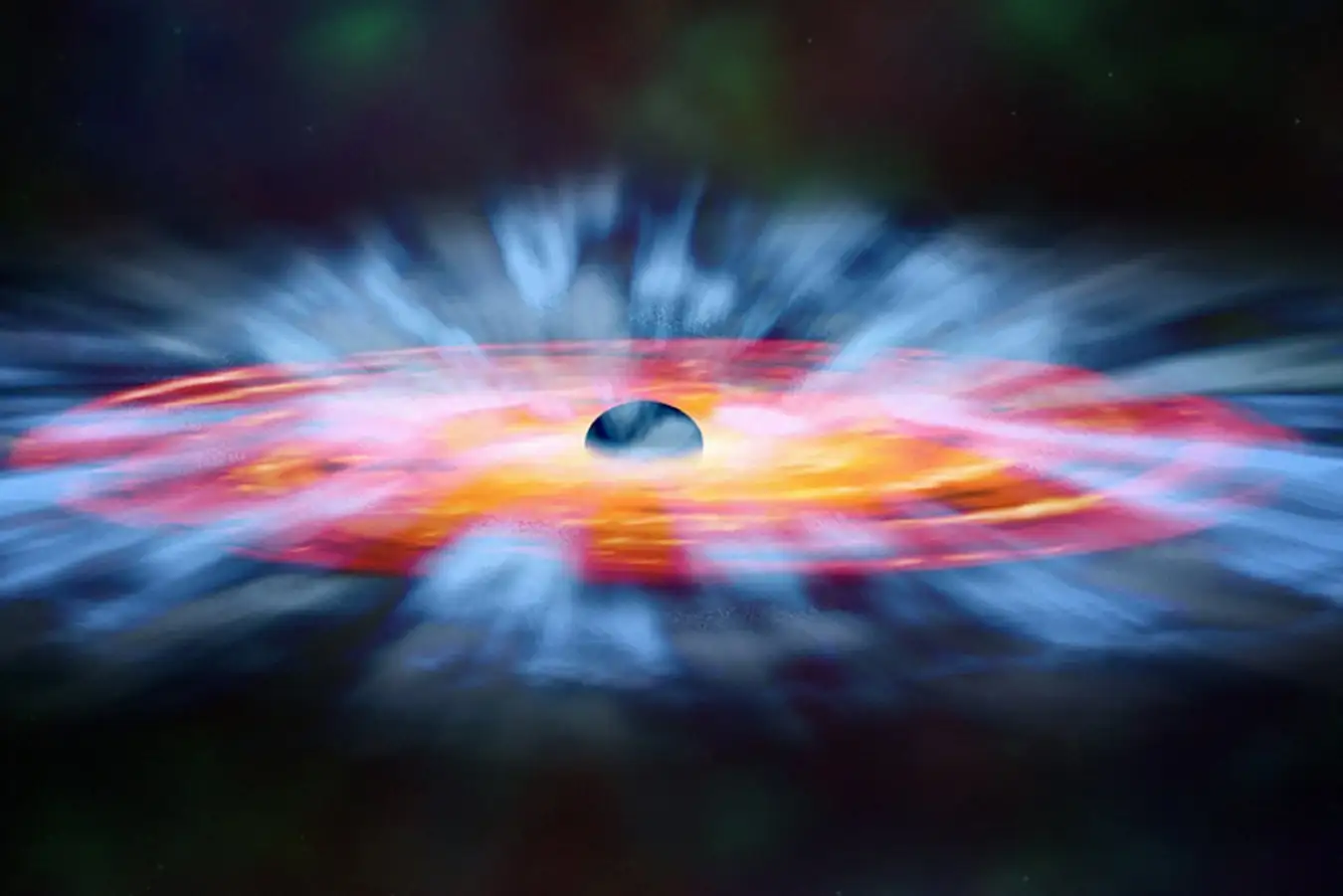
Most galaxies, including the Milky Way, harbor supermassive black holes at their centers. While typically dormant, these black holes can become active, consuming significant amounts of dust and gas from surrounding materials or through galaxy mergers. This activity may transform them into effective nurseries for planet formation.
Barry McKernan and his team from City University of New York investigated the dusty, gaseous disc around an active galactic nucleus, discovering its potential for creating immense numbers of planets. The abundance of material allows dust particles to coalesce into larger structures, leading to unusual planets far different from those within our solar system.
McKernan remarked, “This is a really amazing new pathway to form very alien planets.” The sheer volume of dust present can result in the formation of giant rocky planets, some potentially larger than Jupiter. Furthermore, conditions may be so extreme that some planets could have surfaces covered with lava, attributed to frequent collisions with other celestial bodies.
Interestingly, some planets might grow large enough to ignite nuclear fusion at their cores, morphing into what McKernan describes as “very weird alien stars” made from rock. Others may consume surrounding gas and evolve into intermediate-mass black holes. The dust disc surrounding an active galactic nucleus can span dozens of light years, raising the possibility of millions of planets in orbit around a supermassive black hole.
Sean Raymond from the University of Bordeaux notes that while the formation of stars and planets around black holes has been recognized, the scale outlined by McKernan’s study is unprecedented. “With that much stuff around a supermassive black hole, what else is going to happen?” Raymond asks, emphasizing the inevitability of such processes.
Despite the mass production of planets, many may end up spiraling into the black hole or being ejected into the wider galaxy due to gravitational interactions with each other. Remaining planets could potentially be detectable through their gravitational influence on distant stars, a method known as microlensing.
Upcoming observational technologies, like NASA’s Nancy Grace Roman Space Telescope, set to launch in September, are expected to capitalize on this method. Benne Holwerda from the University of Louisville highlighted, “We are going into the age when microlensing is very much a thing.”
Additionally, McKernan noted that many active galactic nuclei exhibit flickering, a phenomenon possibly caused by numerous small objects, such as planets, passing in front. He concludes, “These things should exist. So can we see them?” With the advent of new technology and methodologies, the potential for discovering these alien worlds has never been greater.
The content above is a summary. For more details, see the source article.