Key Takeaways
- NASA’s X-59 jet achieved its first supersonic flight, reaching Mach 1.1 on June 5, 2026.
- The aircraft will gather data on noise perception during future flights over U.S. communities.
- The X-59 aims to revive supersonic commercial flights with quieter sound profiles.
X-59 Jet Achieves Supersonic Milestone
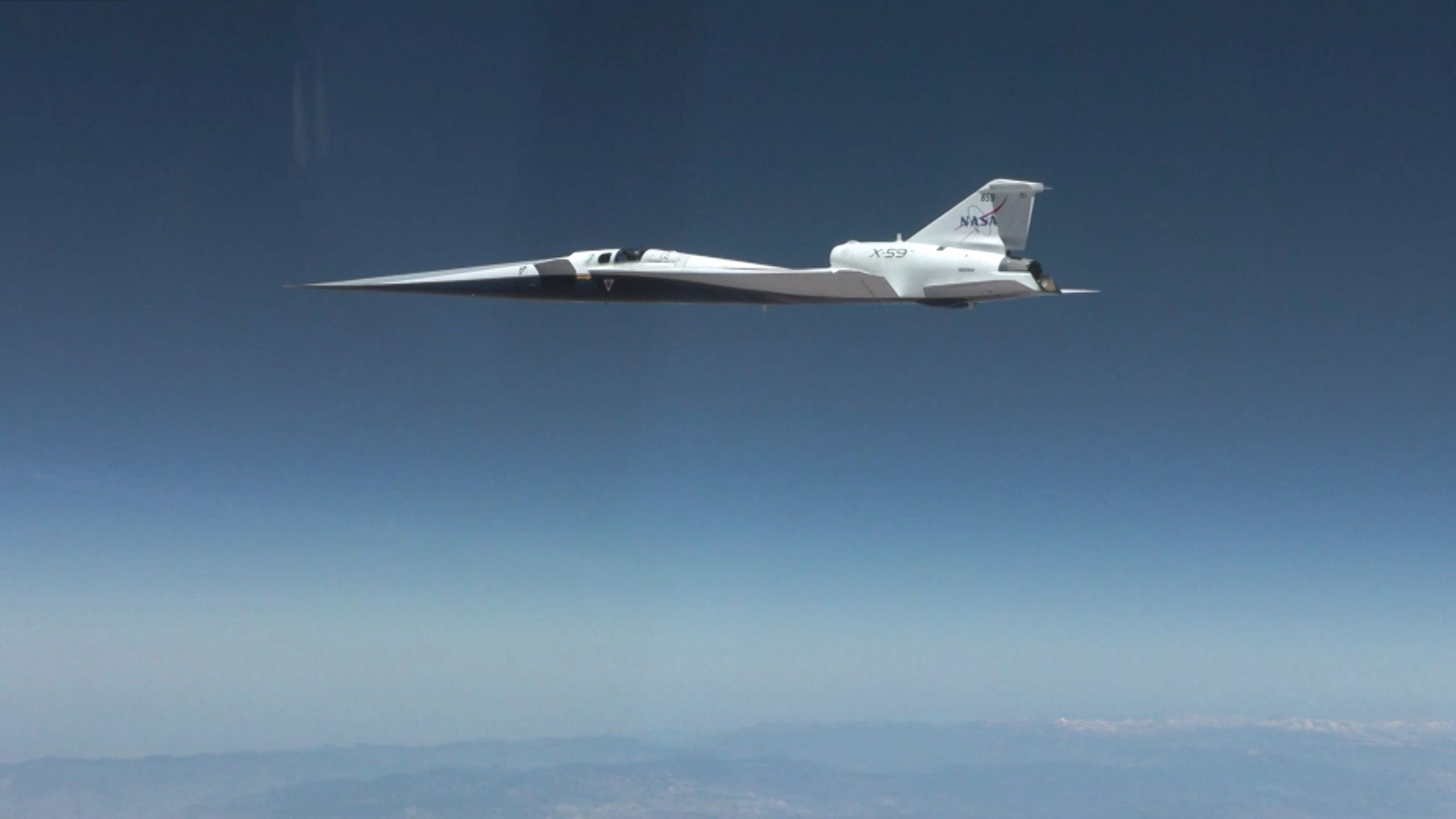
NASA’s X-59 jet has successfully achieved its first supersonic flight, marking a significant advancement in aviation technology. This milestone was accomplished on June 5, 2026, when the aircraft reached a speed of Mach 1.1, equivalent to approximately 713 mph (1,147 kph) at an altitude of 43,400 feet (13,228 meters). The flight lasted 81 minutes and was conducted at Edwards Air Force Base in California, piloted by NASA test pilot Jim “Clue” Less.
Michael Kratsios, assistant to the president for science and technology, commended the flight, stating, “The X-59’s first supersonic flight is a testament to America’s enduring leadership in science, engineering, and aerospace innovation.” The successful flight supports NASA’s Quesst (Quiet Supersonic Technology) mission, which seeks to develop technologies that enable quieter supersonic travel.
The X-59 is designed to create less disruptive sounds than traditional supersonic aircraft, generating mild thumps instead of loud sonic booms. This is particularly significant as the Federal Aviation Administration (FAA) banned supersonic flights over land in 1973 to prevent noise pollution. The data collected during future flights over populated areas will be essential for establishing new noise standards, which will potentially open the door for commercial supersonic flights over land.
NASA plans to conduct its next flight under “mission conditions,” targeting a speed of Mach 1.4 and an altitude of about 55,000 feet (16,764 m). This upcoming mission is crucial for understanding how the public will react to the jet’s noise, further informing regulatory processes.
According to NASA officials, the X-59 has shown remarkable progress, having flown 16 times in the past 90 days since its first flight in October 2025. NASA Administrator Jared Isaacman expressed gratitude for the collaboration with Lockheed Martin Skunk Works, the company responsible for building the jet, and emphasized the importance of this technological advancement in revitalizing NASA’s X-plane portfolio.
As the X-59 continues its testing regime, it aims to gather the data necessary to revive the commercial supersonic aviation market, which has been dormant for decades. If successful, this project could reshape air travel, merging speed with minimized noise impacts on communities below.
The content above is a summary. For more details, see the source article.