Key Takeaways
- Hanwha Q CELLS will provide tandem solar cell samples for NASA’s SSTEF-1 lunar demonstration program.
- The program aims to test solar cell performance in harsh lunar conditions, assessing stability and reliability.
- Hanwha Q CELLS has achieved IEC certification for its perovskite-based tandem module, validating its reliability for terrestrial use.
Testing Solar Technology in Space
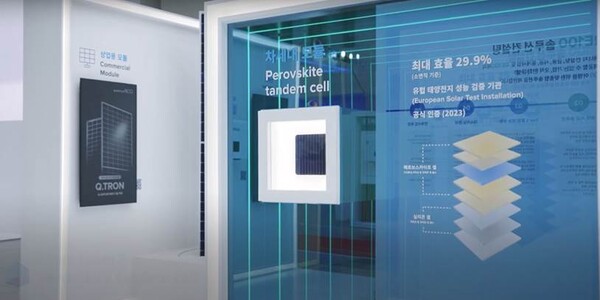
Hanwha Q CELLS, a leader in solar technology, is set to verify the application of its next-generation solar cells in a lunar environment. The company’s German unit will partner in NASA’s SSTEF-1 program, which is managed by Aegis Aerospace and involves the Georgia Tech Research Institute (GTRI). Hanwha will supply perovskite-based tandem cell samples for this initiative.
GTRI is tasked with demonstrating the performance of these tandem cells on a lunar lander, where they will be subjected to conditions unique to space, including vacuum, extreme temperature variations, ultraviolet light, and space radiation. This evaluation aims to gather data on the stability and reliability of the tandem technology, which can inform future research and development for space solar power applications.
Tandem solar cells are advantageous because they deliver efficiency similar to space-grade cells while being lighter, which can help reduce launch and operational costs. Hanwha Q CELLS is working on commercializing these cells for terrestrial use by 2029. The unique design entails a perovskite top cell working in conjunction with a silicon bottom cell, optimizing light absorption across different wavelengths and thereby enhancing energy generation efficiency compared to single-junction silicon modules.
In a significant milestone, Hanwha Q CELLS became the first globally to receive International Electrotechnical Commission (IEC) certification for a terrestrial perovskite-based tandem module. This certification, awarded by TUEV Rheinland, confirms that the module passed rigorous reliability assessments including exposure to ultraviolet radiation, thermal cycling, and varying humidity and temperature conditions.
CEO Seungdeok Park emphasized the importance of space solar power, stating that it represents a transformative platform industry with extensive implications across critical sectors linked to security, such as AI data centers, defense, and communications. The company aims to lead in renewable energy solutions, opening pathways for a new era in space solar power technology.
The content above is a summary. For more details, see the source article.