Key Takeaways
- Europe’s advanced Sample Transfer Arm (STA) is designed for future Moon and Mars missions.
- The arm mimics human movements and features sensors that provide a sense of touch to perform tasks with high precision.
- The project involves a consortium of companies, highlighting Europe’s commitment to space autonomy and exploration.
Overview of the Sample Transfer Arm
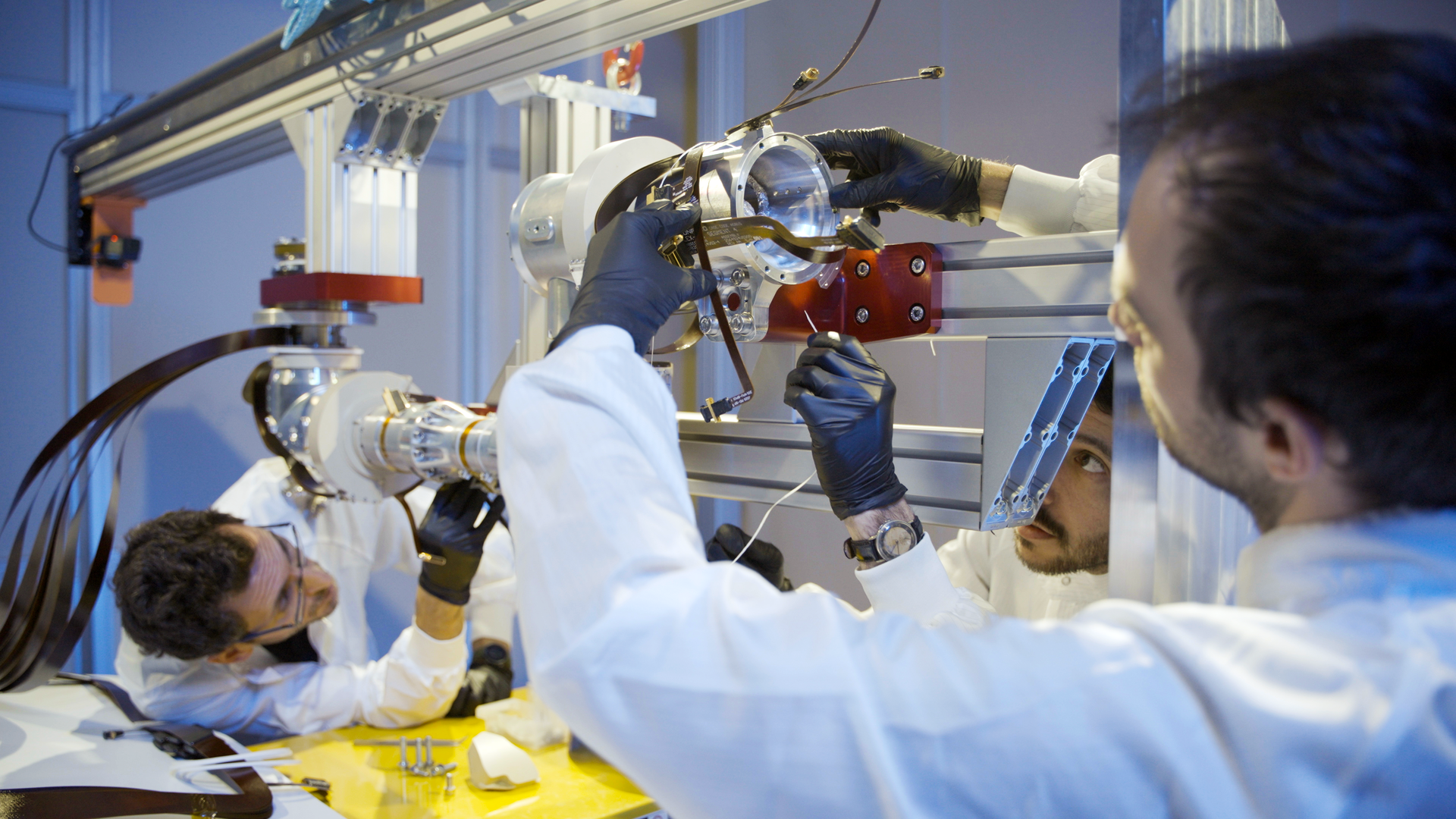
A team of engineers is actively working on Europe’s most sophisticated robotic arm, the Sample Transfer Arm (STA), which is set to play a crucial role in upcoming lunar and Martian missions. This advanced robotic system can extend up to 2.4 meters and boasts seven degrees of freedom, mimicking human arm movements through its design, which includes a shoulder, elbow, and wrist.
Equipped with two cameras and a variety of sensors, the STA is capable of performing complex tasks autonomously. It possesses the ability to ‘see’ and ‘feel,’ enabling it to make intelligent decisions during operations. Its gripper resembles a human hand, allowing it to handle objects with millimetric precision. A highly sophisticated force and torque sensor gives the arm a tactile sense, allowing it to gauge push, pull, and twist motions in three-dimensional space simultaneously.
Position sensors within the joints calculate the precise location of the arm’s tip, essential for executing intricate space operations such as collecting geological samples and aiding astronaut activities. Initially developed for the NASA-ESA Mars Sample Return campaign, the STA is tasked with transferring valuable Martian soil samples from the Perseverance rover to facilitate their return to Earth. However, its versatile design means it can also support numerous applications on both the Moon and Mars.
The development of the Sample Transfer Arm is backed by decades of experience in European space robotics, with teams from the Italian aerospace firm Leonardo leading the integration efforts. Engineers are set to test the arm’s initial movements in simulated space conditions at Leonardo’s Nerviano facility near Milan in the coming weeks.
The project is a collaborative effort involving several key players in the STA industrial consortium, including GMV and AVS from Spain, Maxon from Switzerland, 3DPlus from France, and COMOTI from Romania, along with additional suppliers from Denmark, Greece, and Germany. This collaboration not only demonstrates technological prowess but also emphasizes Europe’s ambition for increased autonomy and strategic independence in space exploration. The advancements made with the Sample Transfer Arm are expected to enhance Europe’s capabilities for future missions on the Moon and Mars, positioning the continent at the forefront of extraterrestrial exploration.
Explore more images of the Sample Transfer Arm as it takes shape by visiting our Mars blog.
The content above is a summary. For more details, see the source article.