Key Takeaways
- Phased array antennas utilize microchips to electronically steer radio beams without mechanical movement.
- Recent advancements in beamforming integrated circuits have made these antennas more compact and affordable for various applications.
- European companies are leading the development of high-performance chip solutions to enhance satellite communication and maintain a secure supply chain.
Advancements in Phased Array Antennas
Nestled within electronic circuit boards, a small but powerful microchip is revolutionizing antenna technology. This microchip, integral to phased array antennas, steers radio beams electronically, eliminating the need for mechanical tilting found in traditional antennas. The ability to control the phase and amplitude of signals through beamforming enhances communication capabilities for satellites and ground terminals.
Recent developments in silicon semiconductor technologies have significantly miniaturized beamforming integrated circuits, making phased array antennas more compact and reliable. This miniaturization has led to increased affordability, resulting in widespread adoption across various sectors, such as satellite communication, navigation, Earth observation, and space missions.
Václav Valenta, an engineer and phased array expert at the European Space Agency (ESA), emphasized that ESA has long been a pioneer in beamforming technology, focusing on innovative electronic steering methods for both space and terrestrial applications. Current efforts prioritize the design and manufacturing of integrated analogue and digital beamforming chips within Europe. These advancements not only enhance performance but also ensure the security of the European supply chain.
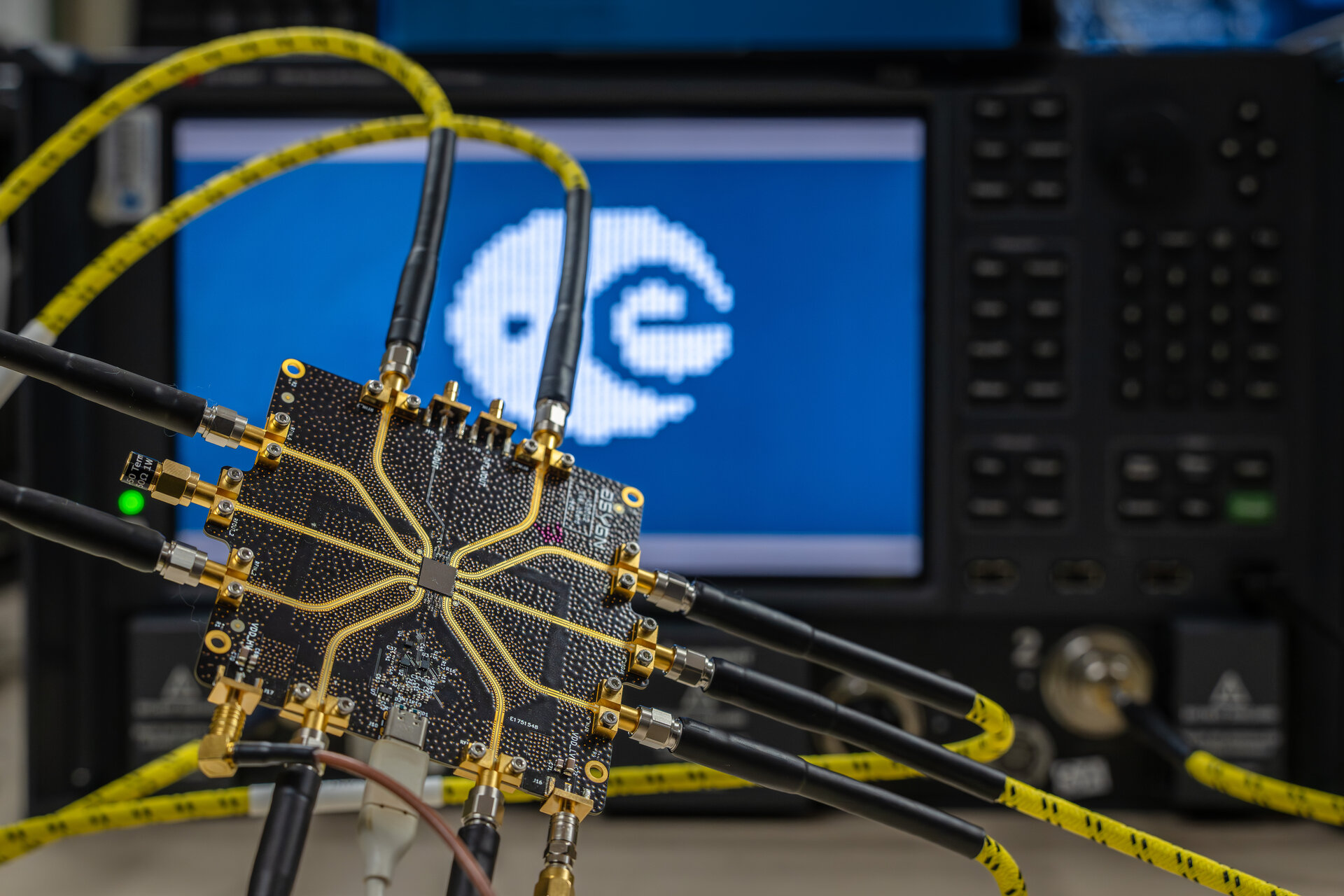
In a recent technology demonstration at ESA’s RF Active Technology Laboratory at ESTEC, the French company Asygn showcased their next-generation beamforming integrated circuits. Their notable presentation included the blue-and-white ESA logo formed by hundreds of individual dots, each manipulated through precise amplitude and phase settings enabled by the microchip.
Clement Jany, co-director of the Radio Frequency business unit at Asygn, highlighted the chip’s capability to achieve high performance tailored for specific frequency bands, particularly X and Ka. The goal is to simplify system integration for manufacturers of phased array antennas through the provision of high-precision phase and amplitude control along with an ultra-low noise figure, all packaged into a single chip.
These technological advancements indicate a significant shift in how satellite communication systems will operate, underscoring the importance of advanced materials and microelectronics. As demand for efficient and reliable satellite communication grows, the development of these microchips marks a critical step forward in the industry, promising enhanced performance for mission-critical applications while supporting a robust European supply chain.
The content above is a summary. For more details, see the source article.