Key Takeaways
- Astronomers have discovered the brightest and most distant maser, emitted by a galaxy nearly 8 billion light-years away.
- The H1429-0028 galaxy’s light is magnified by gravitational lensing, enabling the detection of this intense microwave radiation.
- Future observations, particularly with the Square Kilometre Array, might unveil even more distant masers from early galaxies.
Discovery of a Distant Maser
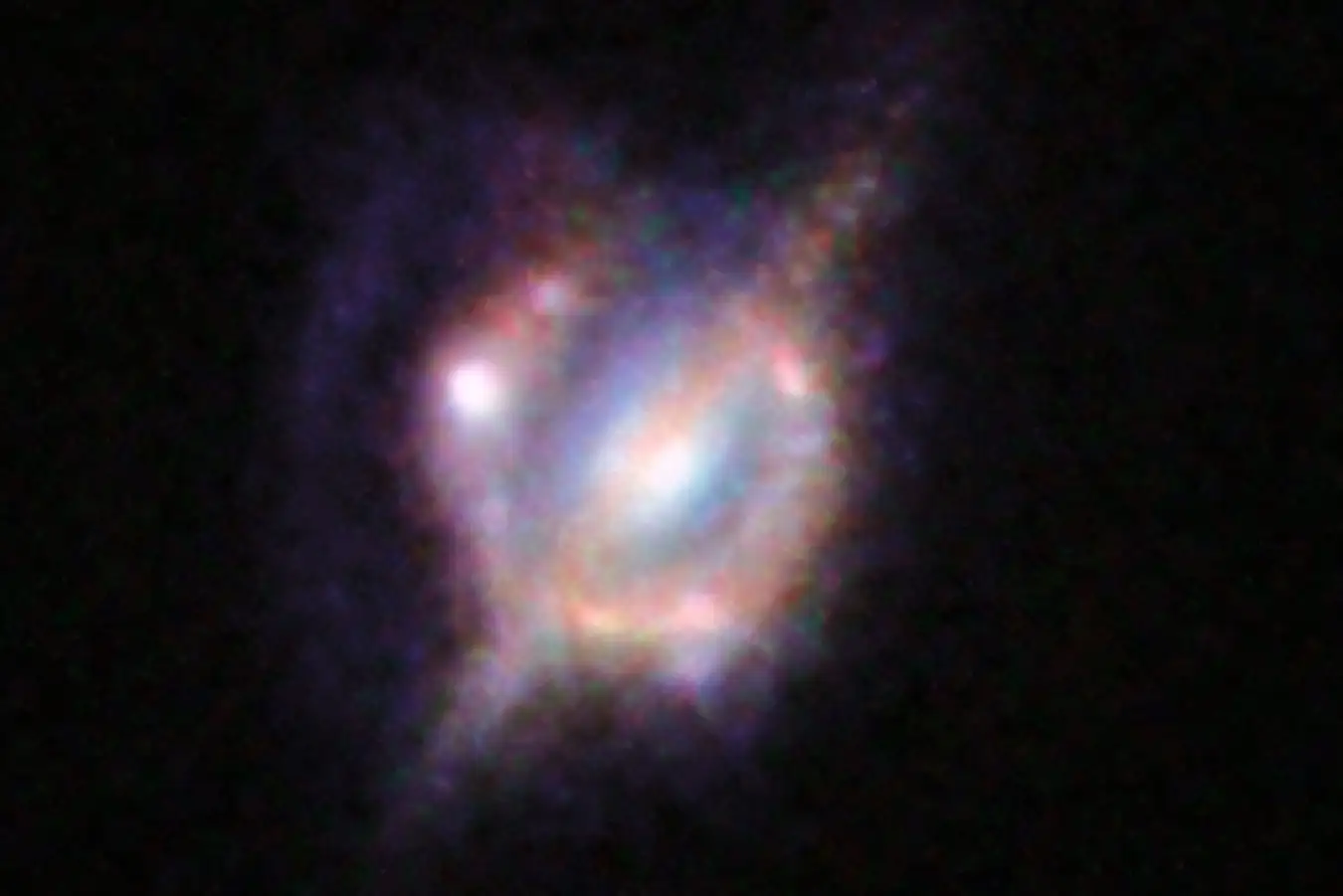
Astronomers have identified a remarkable phenomenon—a laser-like beam of microwaves emitted by two colliding galaxies, marking the brightest and most distant example of this occurrence ever observed. The process behind this event resembles that of laser generation, where atoms are stimulated into a higher energy state. When photons interact with these excited atoms, they initiate a chain reaction that results in a focused beam of coherent light.
This same principle applies when galaxies collide. As gas from both galaxies compresses, it leads to star formation and increased light emission. The light passes through dust clouds, exciting hydroxyl ions (composed of hydrogen and oxygen) into higher energy states. When these ions receive radio waves, often from a supermassive black hole, they emit a concentrated beam of microwave radiation, known as a maser.
Research led by Roger Deane from the University of Pretoria has uncovered the brightest known maser located in the galaxy H1429-0028, situated roughly 8 billion light-years away. The light from this distant galaxy is magnified by a massive galaxy acting as a gravitational lens, amplifying the view for observers on Earth.
While utilizing the MeerKAT telescope in South Africa, a network of 64 linked radio telescopes, Deane’s team aimed to identify galaxies rich in molecular hydrogen, which emit light at specific frequencies. During their observations of H1429-0028, they detected an unexpectedly high frequency of radiation, indicative of powerful maser activity.
Deane expressed enthusiasm, stating, “We had a quick look at the 1667 megahertz [frequency], just to see whether it was even detectable, and there was this booming, huge [signal]. It was immediately the record.” This extraordinary maser may even warrant a new classification as a “gigamaser,” significantly more luminous than previously observed megamasers. Deane noted, “This is about 100,000 times the luminosity of a star, but in a distant galaxy, concentrated into a very, very small part of the [electromagnetic] spectrum.”
Looking ahead, astronomers anticipate that future observations with the Square Kilometre Array, an advanced iteration of MeerKAT, will enhance the detection of similar masers from even more distant galaxies. Matt Jarvis of the University of Oxford highlighted that such discoveries could yield invaluable insights into the merging processes of some of the universe’s earliest galaxies.
Jarvis remarked on the specific conditions required for maser formation, explaining, “[Masers] need very precise conditions. You need this radio continuum emission and you need this infrared emission, which you only really get from dust heated around forming stars. In order to get these very specific physical conditions to get the maser in the first place, you need merging galaxies.” This suggests that the exploration of distant masers will deepen understanding of the universe’s formation and evolution while unlocking the mysteries surrounding early cosmic interactions.
The content above is a summary. For more details, see the source article.