Key Takeaways
- The merger of two black holes, GW250114, offers a unique opportunity to validate Einstein’s theory of general relativity.
- Gravitational wave detectors, including LIGO and Virgo, provided the clearest data yet, allowing researchers to test previous predictions accurately.
- Future observations could refine the accuracy of Einstein’s predictions, potentially revealing new insights into gravitational waves and black holes.
Validation of Einstein’s Predictions
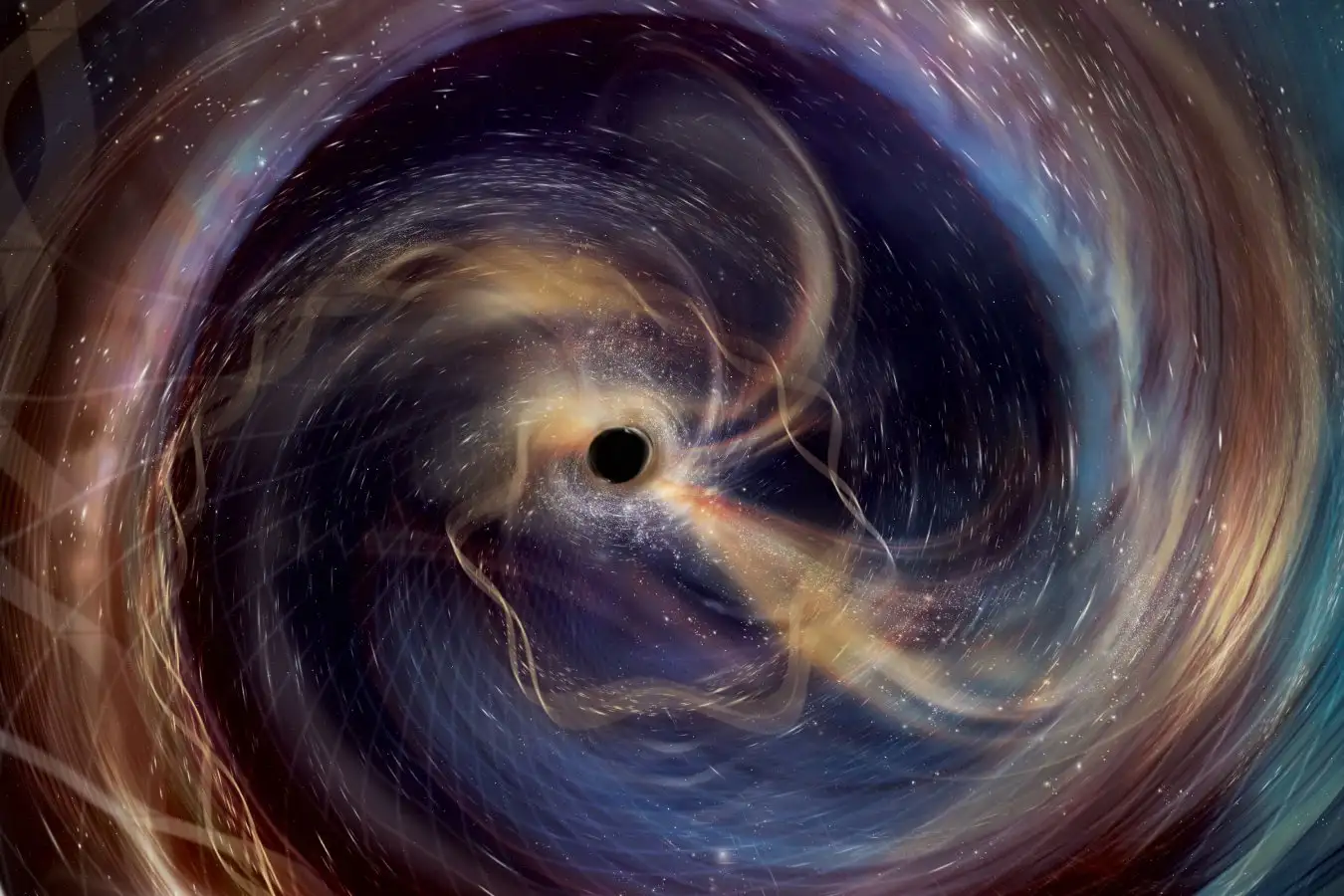
In 2025, an international collaboration of gravitational wave detectors recorded the loudest collision ever between two black holes, designated GW250114. This event provided scientists with an unprecedented opportunity to validate Einstein’s theory of general relativity.
The detectors, including the Laser Interferometer Gravitational-Wave Observatory (LIGO) in the United States and the Virgo detector in Italy, have become significantly more sensitive since LIGO’s first gravitational wave detection in 2016. As a result, the data from GW250114 was clearer and less noisy than previous observations, making it an ideal subject for testing various physical theories.
In prior research, data from GW250114 was used to confirm Stephen Hawking’s theorem, which proposed that the event horizon of a merged black hole could not be smaller than the sum of its parent black holes. This was verified with nearly 100 percent confidence, affirming Hawking’s earlier predictions.
Building upon that analysis, Keefe Mitman and colleagues at Cornell University conducted further tests on the merging black holes in accordance with Einstein’s theories. The equations derived from general relativity depict the motion of massive objects in space-time, illustrating how two black holes spiral towards each other, crash, and then produce distinct vibrational frequencies as they settle into a new form.
These frequencies, known as ringdown modes, were often too faint to detect in past gravitational wave events. However, GW250114 was intense enough to produce frequencies that could be analyzed effectively. Mitman and his team simulated the outcomes based on Einstein’s equations, predicting the amplitudes and frequencies of the vibrations that should result from such a collision. Their predictions closely matched the actual measurements taken from the event.
Mitman stated, “The amplitudes that we measure in the data agree incredibly well with the predictions from numerical relativity.” This marked a significant confirmation of Einstein’s equations, despite challenges in solving them.
Laura Nuttall from the University of Portsmouth highlighted that the findings reaffirmed Einstein’s relevance, stating, “Everything seems to look like what Einstein says about gravity.” This confidence comes even though the detected frequencies were still faint enough that the researchers could not eliminate the possibility of discrepancies of up to 10 percent from Einstein’s predictions. Such limitations stem from the current sensitivity of gravitational wave detectors.
Mitman emphasized the importance of ongoing observations: as more events are recorded and the sensitivity of detectors increases, the discrepancies could either decrease considerably or remain consistent, possibly indicating new physics. “If it shrinks to being away from zero, that’s much more interesting,” he remarked.
In conclusion, the extensive analysis of GW250114 provides compelling evidence supporting general relativity while also raising questions for future research. The ability to detect finer details in gravitational wave events promises to unlock further mysteries about the nature of black holes and the fundamental laws of physics.
The content above is a summary. For more details, see the source article.