Key Takeaways
- ESA’s CryoSat satellite, primarily designed to monitor polar ice, has been upgraded to measure Earth’s magnetic field disturbances.
- New data from CryoSat complements ESA’s Swarm mission and enhances scientific understanding of geomagnetic events.
- CryoSat provided valuable data during a recent X-class solar flare, showcasing its innovative capabilities.
Innovative Upgrade Enhances CryoSat’s Capabilities
ESA’s CryoSat mission, which has been operational for nearly 16 years, recently underwent a significant software upgrade that allows it to measure disturbances in Earth’s magnetic field, a task previously outside its primary function. This satellite, while originally designed to monitor polar ice sheets and floating sea ice, now features an upgraded platform magnetometer that enhances its scientific capabilities beyond its initial intentions.
CryoSat is renowned for its advanced radar technology, which accurately measures minute changes in the surfaces of ice sheets and sea ice. As part of ESA’s Earth Explorer family, it has contributed valuable datasets on polar oceans, subglacial lakes, and ice sheets over its operational history. With the new upgrade, CryoSat can effectively gather data on variations in Earth’s magnetosphere, providing essential calibration for the measurements made by ESA’s dedicated magnetic field mission, Swarm.
Despite primarily targeting ice measurements, CryoSat’s innovative use of its magnetometer allows it to generate scientific data that supports the geomagnetic community. Anja Stromme, ESA’s Mission Manager for Swarm, noted that this advancement significantly benefits ongoing research.
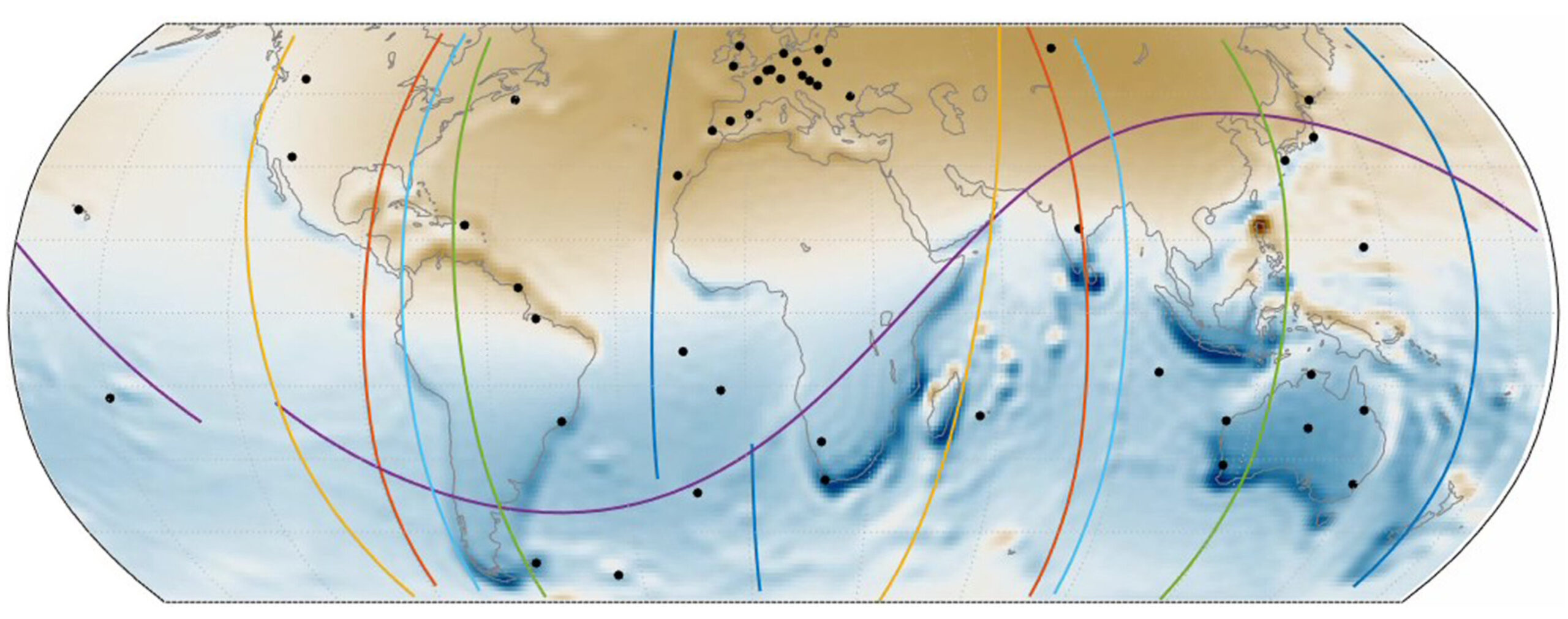
The satellite demonstrated its new capabilities during an X-class solar flare event in January 2026, which triggered a geomagnetic storm. Beginning January 18, the solar flare produced intense radiation storms, leading to spectacular auroras visible in regions where they are typically unseen, including parts of Europe and Mexico. During this period, CryoSat played a crucial role by precisely measuring the intensity of the geomagnetic storm, yielding high-quality scientific data that complemented Swarm’s findings.
Tommaso Parrinello, ESA’s CryoSat Mission Manager, emphasized the innovation of repurposing existing technology to produce valuable scientific information without incurring additional costs. The satellite’s platform magnetometer, originally intended for orbital control, is now being leveraged to monitor the Earth’s magnetosphere. Advanced data analysis techniques have been applied, allowing the production of animations that illustrate the impact of solar storms on Earth’s magnetic field.
The integration of CryoSat’s new magnetometry capabilities enriches the data landscape, offering complementary datasets alongside those from Swarm. This development not only extends the functionality of CryoSat but also presents new scientific opportunities as both missions continue to operate beyond their anticipated lifespans. The project exemplifies how innovative upgrades to existing satellite technology can facilitate groundbreaking scientific exploration and understanding of Earth’s systems.
The content above is a summary. For more details, see the source article.