Key Takeaways
- A giant impact crater near the moon’s south pole formed by a fast-moving asteroid created two canyons in under 10 minutes.
- The lunar canyons, Vallis Schrödinger and Vallis Planck, extend for 270 km and 280 km respectively, differing from the water-formed Grand Canyon.
- Findings are reassuring for NASA’s Artemis III mission, as the debris from the impact poses minimal risk to proposed landing spots.
Impact Crater Unveils Lunar Mystery
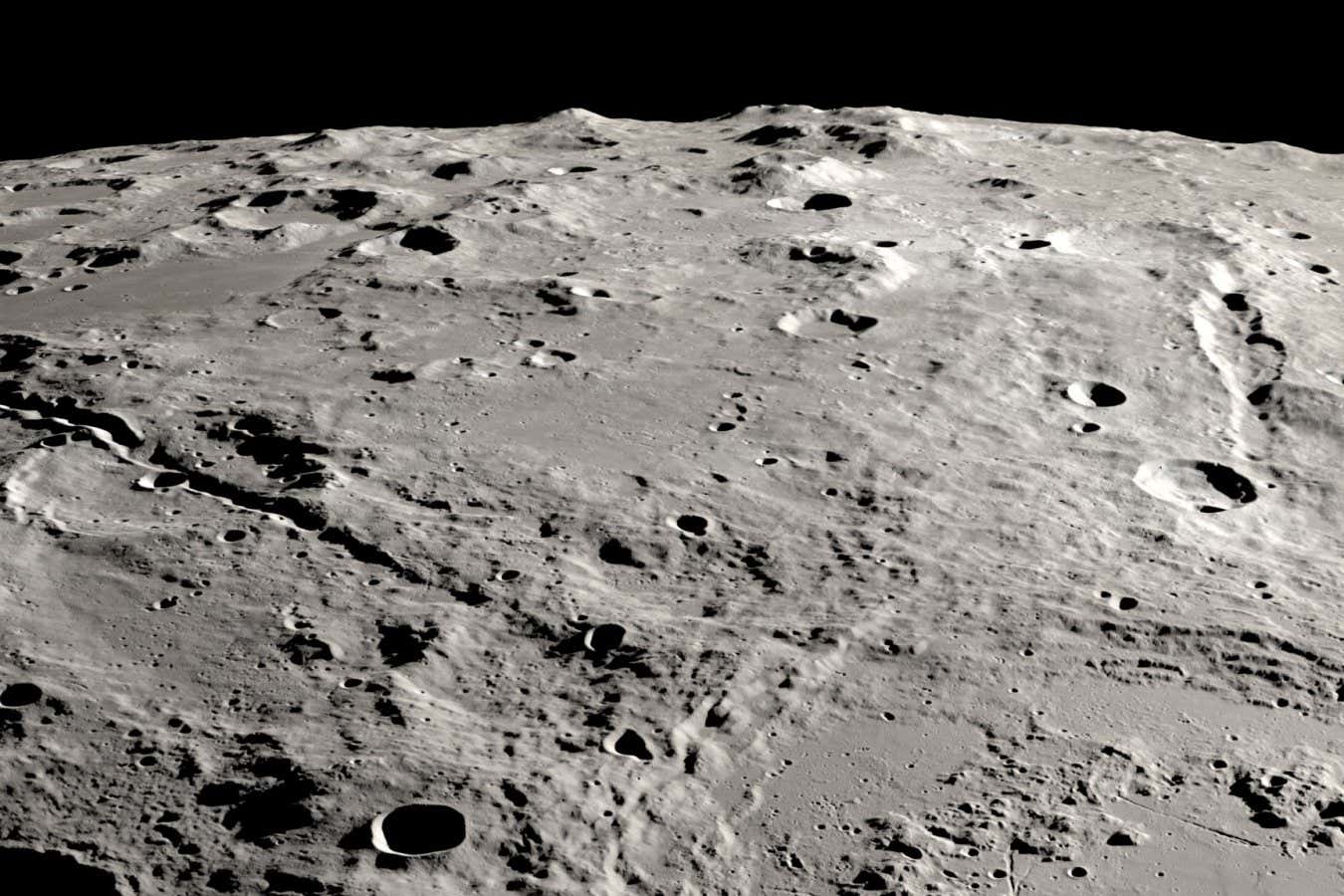
Recent research has revealed that the Schrödinger crater, a massive impact structure located near the moon’s south pole, was created by an asteroid traveling at over a kilometer per second. The collision released an energy equivalent to 130 times that of all existing nuclear weapons. New findings indicate that the two notable canyons radiating from the crater, known as Vallis Schrödinger and Vallis Planck, formed in less than 10 minutes due to secondary impacts from debris ejected during the initial collision.
David Kring, a researcher at the Lunar and Planetary Institute in Houston, Texas, has dedicated 15 years to studying the 312-kilometer-wide Schrödinger crater, part of which involved identifying potential landing sites for NASA’s Constellation program, which was ultimately canceled in 2009. The canyons, appearing on the moon’s far side, have often been overlooked due to their remote location. “They’re basically hidden… and so they’re commonly overlooked,” Kring noted.
Utilizing computer modeling, Kring and his team hypothesized the formation of the canyons, which measure 270 kilometers long and 2.7 km deep for Vallis Schrödinger, while Vallis Planck is 280 km long and 3.5 km deep. When compared to the 446 km long and up to 1.9 km deep Grand Canyon in Arizona, the lunar canyons highlight a stark difference in their formation processes. Unlike the Grand Canyon, which was shaped by water over millions of years, these lunar features emerged as sharp grooves formed by intense impact forces over a matter of minutes. The colossal asteroid impact not only affected the surface of the moon but also scattered dust and debris across its surface and into space.
The study reveals that debris ejected during the impact would have traveled at incredible speeds, resulting in the formation of additional craters outside the main impact site. Variability in the moon’s regolith likely helped focus this debris into the narrow canyons. The team theorized that an asteroid impact approximately 3.81 billion years ago had the necessary velocity and trajectory to facilitate the canyon’s formation.
Kring expressed confidence in NASA’s upcoming Artemis III mission, which aims to land astronauts in the south pole region of the moon, noting that the impact ejected regolith from the Schrödinger crater will not significantly obscure geological experiments at proposed landing sites. Conversely, landing north of Schrödinger would present challenges due to a thicker debris layer from the impact.
Mark Burchell from the University of Kent, UK, remarked that the research suggests the canyons’ origins from chains of impacts; however, confirmation would require close-up exploration. “The ultimate proof would be someone bringing back a rock from one of these canyons,” he stated, indicating that analysis of the rocks could reveal shock-induced mineral changes that would validate the findings.
The ongoing investigation into the Schrödinger crater and the canyons highlights both the dynamic geological history of the moon and the vital importance of understanding its surface for future lunar exploration.
The content above is a summary. For more details, see the source article.