Key Takeaways
- Strange vibrations from the supermassive black hole 1ES 1927+654 are becoming more frequent.
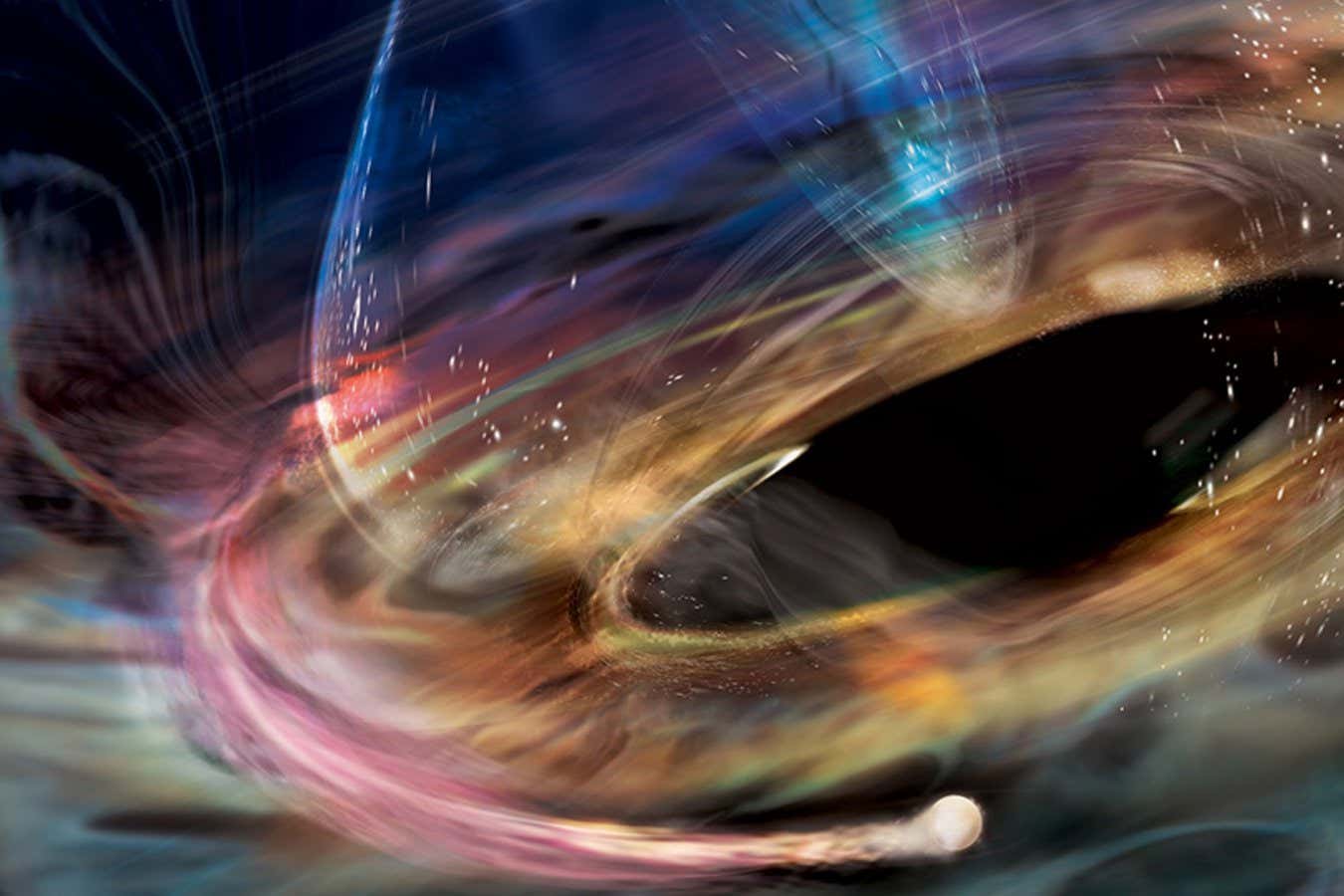
- A white dwarf star may be orbiting close to the black hole’s event horizon, causing these vibrations.
- This phenomenon highlights the dynamic nature of black holes, as observed since 2018.
Emerging Patterns in Black Hole Behavior
Recent observations of the supermassive black hole 1ES 1927+654 have revealed increasingly frequent vibrations emanating from this celestial object. The ongoing research suggests that these peculiar signals may be linked to a white dwarf star orbiting dangerously close to the black hole’s event horizon.
The black hole in question first caught the attention of the astronomical community back in 2018, when it unexpectedly transitioned from a relatively quiescent state to an extraordinarily bright one. This marked a significant milestone as it was the first recorded occurrence of a supermassive black hole changing its brightness in such a dramatic fashion. Researchers noted that this behavior showcased the complex and dynamic environments surrounding black holes, which can evolve rapidly and unpredictably.
The growing frequency of the vibrations observed since 2018 has prompted astronomers to investigate the underlying causes. Experts hypothesize that the white dwarf star, a remnant of a once larger star, is in a precarious orbit around the black hole. As the star spirals closer to the event horizon, intense gravitational forces are likely producing the observed vibrations, altering the behavior and brightness of the black hole itself.
This study offers crucial insights into the interactions between celestial objects in extreme gravitational fields. It emphasizes the importance of ongoing monitoring and research, as such phenomena can illuminate fundamental aspects of astrophysics and provide a deeper understanding of black holes and their surroundings. The case of 1ES 1927+654 serves as a reminder of the vast complexities present in the universe and the ever-changing dynamics that astrophysicists strive to comprehend.
As research continues, the astronomical community remains eager to uncover more details regarding the relationship between the white dwarf and the supermassive black hole, as well as the implications this may have for understanding black hole evolution and behavior across the cosmos.
The content above is a summary. For more details, see the source article.