Key Takeaways
- NASA’s new study suggests Titan’s interior may contain slush and pockets of warm water, rather than a vast ocean.
- Titan experiences significant internal heating due to tidal flexing from Saturn’s gravity, contributing to energy dissipation.
- Future data from NASA’s Dragonfly mission, launching in 2028, may offer deeper insight into Titan’s habitability.
Titan’s Interior Revealed
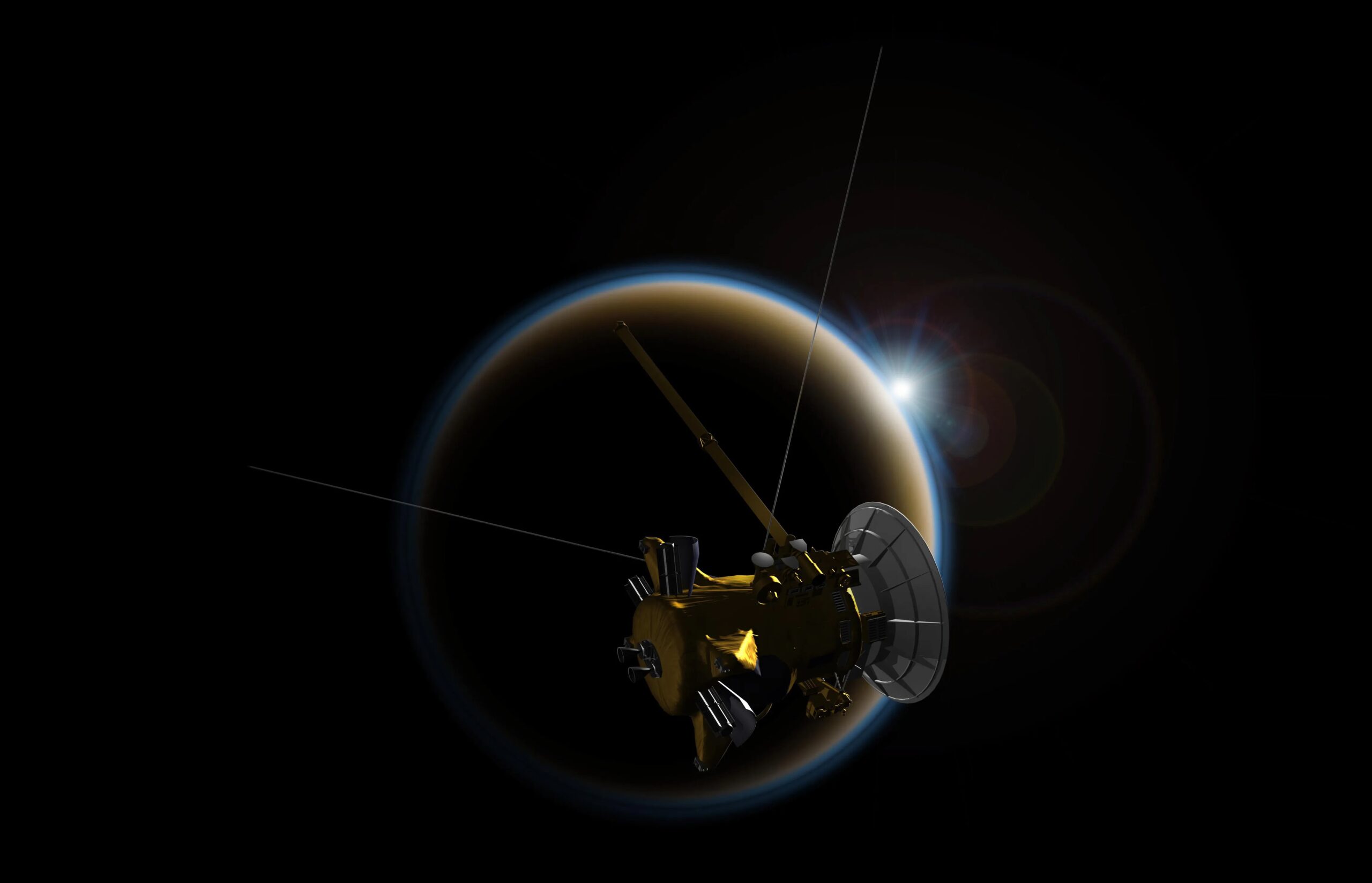
A recent analysis of data from NASA’s Cassini mission indicates that Titan, Saturn’s largest moon, may not have a vast ocean beneath its surface as previously thought. Instead, new research led by NASA’s Jet Propulsion Laboratory (JPL) suggests a more intricate interior composed of ice, slush, and pockets of warm water near its rocky core. The findings, published in the journal Nature, could reshape scientific understanding of Titan and similar icy moons in our solar system.
According to Julie Castillo-Rogez, a co-author and senior research scientist at JPL, this study underscores the value of archival planetary science data. She emphasized that the sophisticated analysis techniques developed over time allow researchers to uncover new discoveries from data collected years, or even decades, earlier.
To analyze Titan’s structure, scientists examined radio frequency data exchanged between spacecraft and NASA’s Deep Space Network. The analysis of Doppler shifts—variations in radio wave frequencies caused by changes in Titan’s gravity field—provided insights into its shape and flexibility. Titan’s elliptical orbit around Saturn results in tidal flexing, causing the moon to stretch and compress, generating internal heat.
Initially, scientists concluded that Titan must have a liquid interior due to its pronounced flexing—a balloon filled with water flexes more than a solid object, such as a billiard ball. However, the new research reveals that this flexibility could also indicate an alternative composition, comprising layers of slush over a solid ice core. This model explains the lag in Titan’s flexing response to Saturn’s tidal pull, as a fully liquid interior would show a more immediate reaction.
By employing a novel processing technique to refine the Doppler data, researchers identified a signature indicating significant energy loss within Titan. This resulted in the interpretation of an interior structure that consists mainly of slush, covered by a thick layer of solid ice. In this interpretation, only small pockets of meltwater exist, which are heated by the energy dissipated from tidal flexing. As these pockets of water rise toward the surface’s icy shell, they may create unique environments enriched with organic material from below and meteorite impacts.
Flavio Petricca, a JPL postdoctoral researcher and lead author of the study, remarked on the unexpected strong energy dissipation observed in Titan. The low viscosity of the slushy interior allows the moon to properly respond to tidal forces while preventing the formation of a global ocean.
Despite not having a continuous ocean, Titan remains an intriguing target for the possibility of basic life forms. The study suggests that temperatures in warm pockets of liquid water might reach as high as 20 degrees Celsius (68 degrees Fahrenheit), cycling nutrients from the moon’s core through its icy layers.
Excitingly, NASA’s forthcoming Dragonfly mission, set to launch no earlier than 2028, may provide definitive answers about Titan’s habitability. This innovative rotorcraft aims to explore the moon’s surface and investigate its unique environments, equipped with a seismometer to collect essential data on Titan’s internal structure.
Collaboratively developed by NASA, the European Space Agency, and the Italian Space Agency, the Cassini-Huygens mission has made significant contributions to understanding Saturn and its moons. For more information, visit NASA’s Cassini mission page.
The content above is a summary. For more details, see the source article.