Key Takeaways
- NASA’s DART mission successfully shifted the orbit of the asteroid Dimorphos by 32 minutes.
- The overall orbital speed of the Didymos system has decreased by 11.7 micrometers per second.
- Future asteroid deflection methods will benefit from this mission’s findings as the ESA’s Hera spacecraft approaches.
NASA’s Groundbreaking Achievement in Asteroid Deflection
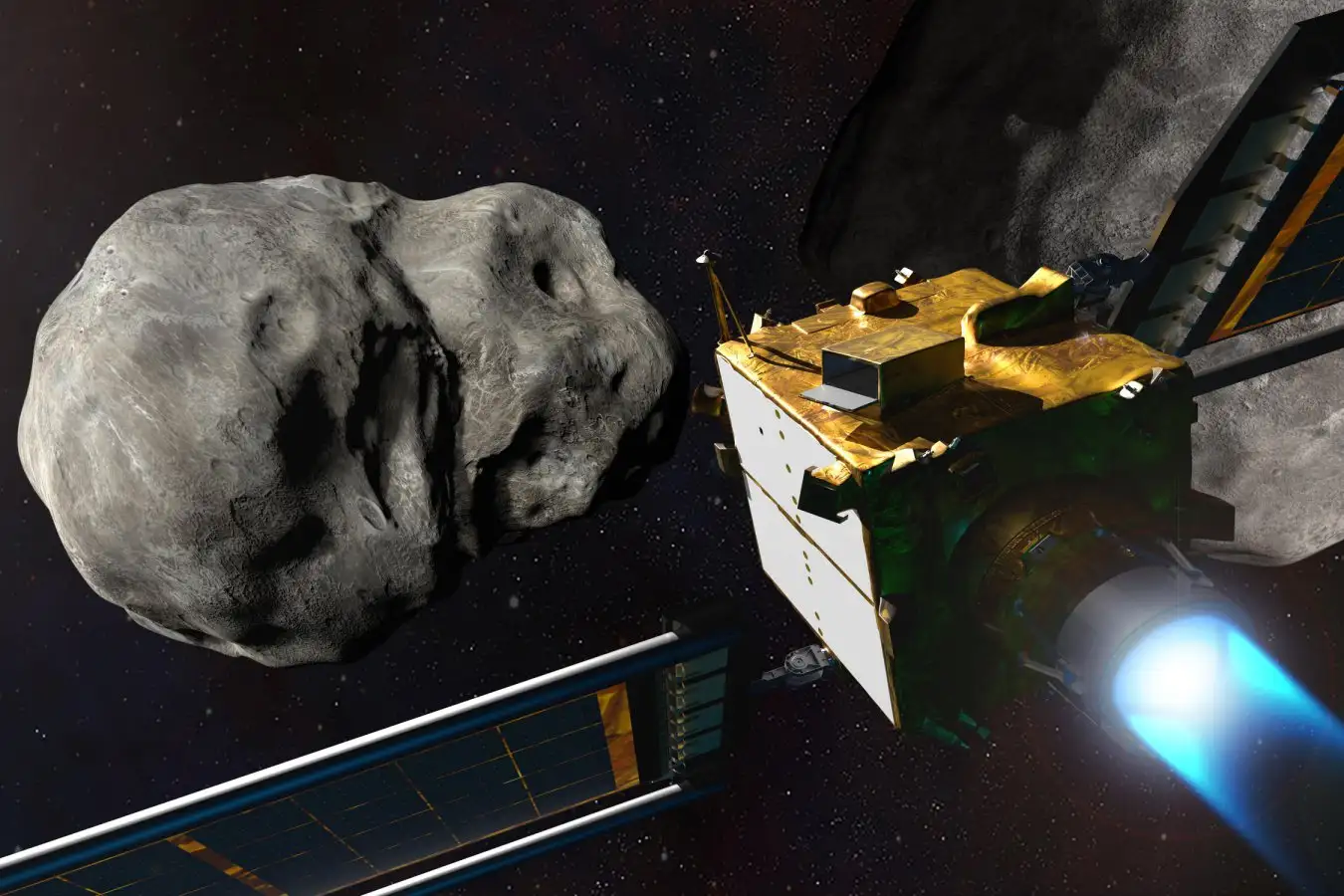
NASA has successfully altered the orbit of an asteroid for the first time in history through its Double Asteroid Redirection Test (DART) mission, conducted in 2022. This groundbreaking achievement involves the asteroid Dimorphos, which orbits a larger asteroid named Didymos. The DART spacecraft collided with Dimorphos to test the kinetic impactor technique, assessing its feasibility as a potential defense mechanism against asteroids on a collision course with Earth.
The collision led to a successful alteration of Dimorphos’s orbit, shortening its cycle by 32 minutes. Astronomers monitored the system post-impact, gathering nearly 6,000 observations to quantify the overall changes in their shared orbit around the sun. Remarkably, scientists determined that the system’s speed has slowed down by approximately 11.7 micrometers per second, equating to about 40 millimeters per hour. This alteration is expected to reduce the system’s orbital radius by around 360 meters.
Rahil Makadia, part of the monitoring team at the University of Illinois Urbana-Champaign, emphasized the significance of even small changes in orbit. He noted, “It doesn’t sound like a lot, but the whole idea behind these kinetic impacts is that if you do one early enough, a small impact makes a large change in the overall position.” This illustrates how minor adjustments can accumulate over time, potentially making a significant difference in future asteroid trajectories.
The decrease in the Didymos system’s speed can be attributed to two main factors: the initial impact of the DART spacecraft and additional thrust from debris expelled from Dimorphos’s surface after the collision. Makadia and his colleagues assessed that these two influences had equal effects, enabling their calculations regarding the masses and densities of the asteroids. Their findings suggest that Dimorphos is half as dense as Didymos, strengthening the hypothesis that it consists of a “rubble pile” formed from material ejected from Didymos due to its rotation.
The insights gained from this mission could be crucial for planetary defense strategies in the future. “We now have one solid anchoring point to predict any future kinetic impact missions,” stated Makadia, reflecting on the practical implications of their work. Furthermore, additional data is expected from the European Space Agency’s Hera spacecraft, which is currently en route to Didymos and is scheduled to arrive in November. Hera aims to provide even more precise measurements that will aid future attempts to safeguard Earth against potential asteroid threats.
NASA’s DART mission represents a pioneering step in humanity’s capability to alter celestial bodies’ trajectories. As efforts in planetary defense evolve, this research will serve as a critical foundation for developing effective methods to protect the planet from hazardous asteroids in the future.
The content above is a summary. For more details, see the source article.