Key Takeaways
- Nasa’s CryoFILL project aims to revolutionize fuel sourcing for space missions by liquefying oxygen on lunar or Martian surfaces.
- The approach could significantly reduce costs and extend operational capabilities for future space exploration.
- A collaborative team from NASA Glenn and Marshall Space Flight Center is assessing technologies to enable in-situ refueling.
Innovative Fuel Solutions for Space Missions
The challenge of launching rockets to distant destinations often lies in the fuel required. A heavier spacecraft demands more fuel, creating a cycle that complicates long-range missions. NASA’s Glenn Research Center is addressing this issue through the CryoFILL (Cryogenic Fluid In-Situ Liquefaction for Landers) project, which promises to change how fuel is created and utilized in space exploration.
Evan Racine, project manager for CryoFILL, noted that fueling a spacecraft for a Mars mission poses considerable challenges due to the high fuel demands. However, by producing and liquefying oxygen directly on the Moon or Mars, NASA could significantly decrease the propellant needed for launches from Earth. This capability would mark a significant step towards sustainable space exploration by minimizing reliance on Earth-sourced materials.
With the Artemis program, NASA intends to expand its missions to the Moon, not only for scientific research but also to establish a long-term presence that will facilitate future crewed missions to Mars. A key aspect of sustaining a lunar base involves utilizing local resources—specifically, extracting oxygen from water ice found in permanently shadowed lunar regions. This oxygen, initially in gas form, must be condensed into a liquid to function as propellant.
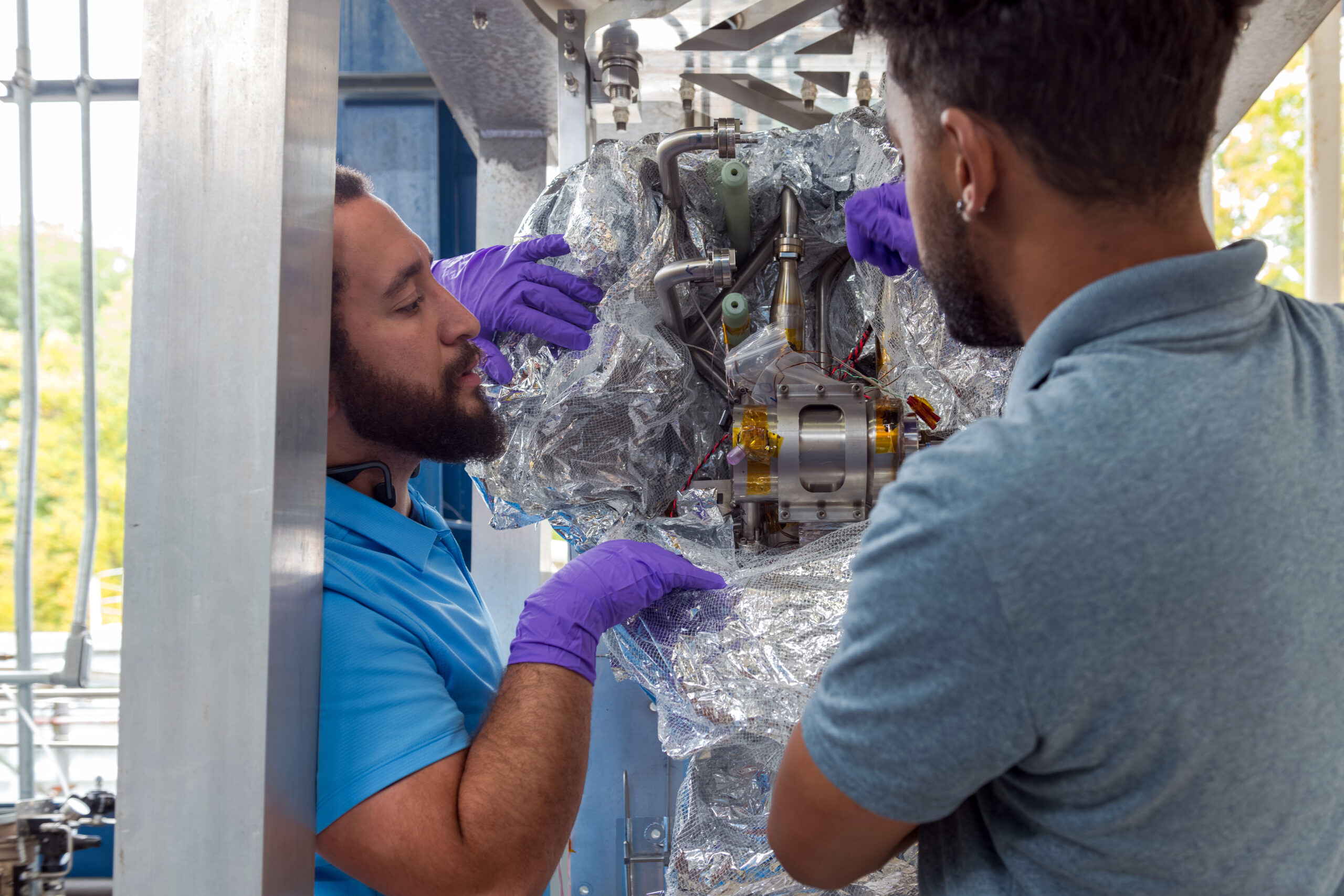
At NASA Glenn, engineers are implementing a flight-like cryocooler, developed by Creare LLC via NASA’s Small Business Innovation Research program, to achieve the necessary conditions for liquefying oxygen. By cooling the extracted oxygen to temperatures below minus 300 degrees Fahrenheit, the process allows for effective storage and use of this vital fuel component.
The ongoing tests over the next three months will investigate how oxygen behaves under various conditions, providing critical data that will refine temperature computer models and inform future technology scaling. Wesley Johnson, the CryoFILL lead engineer, emphasized the importance of these tests for automating and enhancing in-situ refueling capabilities.
The Cryogenic Fluid Management Portfolio Project is a collaborative effort that draws expertise from both NASA Glenn and NASA’s Marshall Space Flight Center in Huntsville, Alabama. This initiative encompasses over 20 technology development activities aimed at enhancing NASA’s operational capabilities in space.
As advancements in CryoFILL continue, the potential for future space missions to utilize local resources for propellant could reshape exploration efforts, extending the reach of astronauts and paving the way for long-term human presence on celestial bodies. The data generated from current studies will be instrumental in designing refueling technologies applicable to the Moon, Mars, or beyond, marking a significant leap towards sustainable off-world operations.
The content above is a summary. For more details, see the source article.