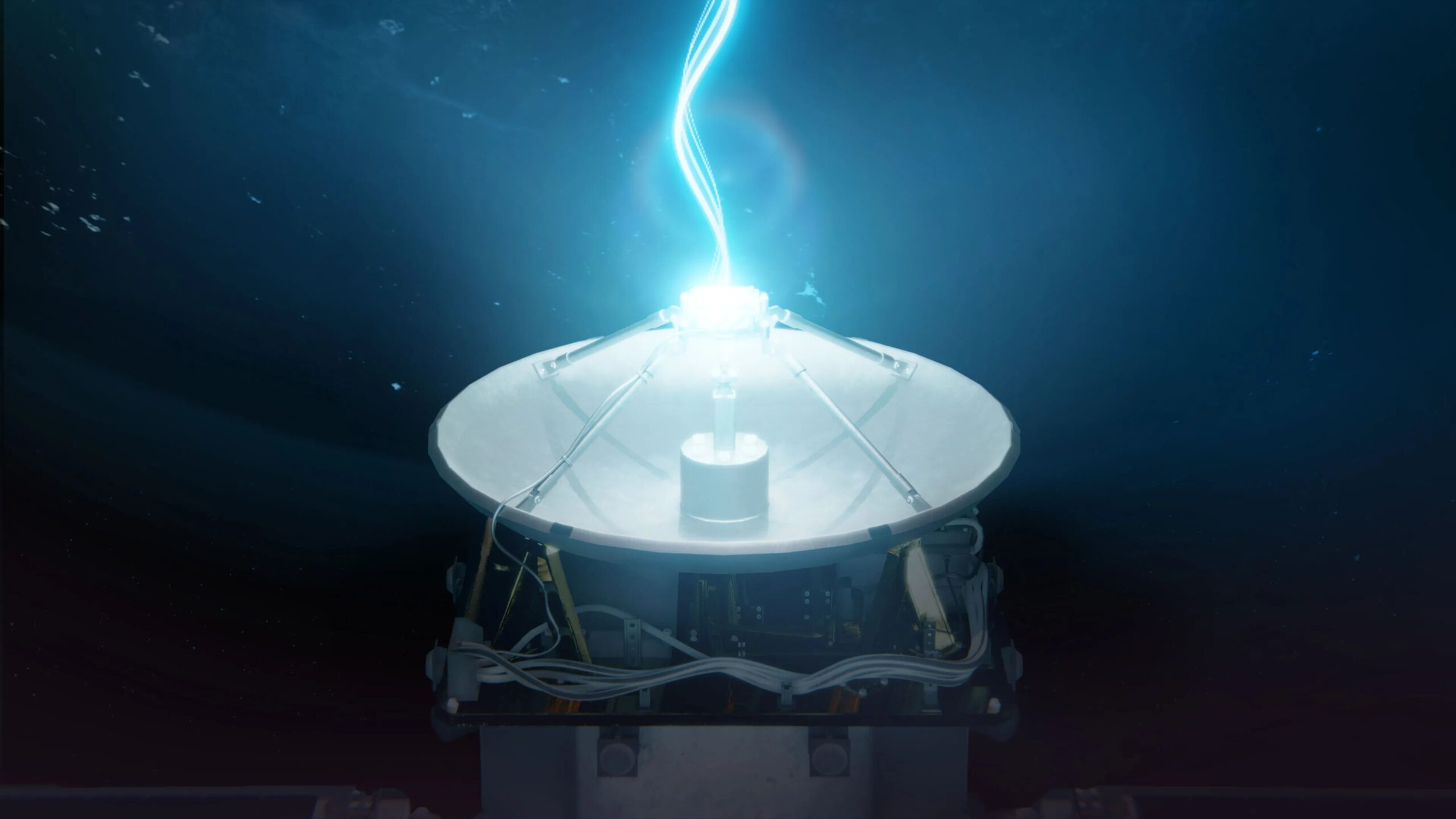
Key Takeaways
- NASA’s Polylingual Experimental Terminal (PExT) enables seamless communication between government and commercial networks for space missions.
- The technology improves mission reliability, allowing spacecraft to switch between networks without data interruptions.
- PExT’s demonstration was successfully conducted in low Earth orbit, paving the way for advanced communications in future missions, including those to the Moon and Mars.
Innovating Space Communications
NASA’s Polylingual Experimental Terminal (PExT) technology is revolutionizing space communications by enabling seamless transitions between government and commercial networks, similar to how cellphones roam between cellular networks. This advance ensures that vital data required for navigation, monitoring spacecraft health, and transmitting scientific information remains consistent and reliable.
Kevin Coggins, deputy associate administrator for NASA’s Space Communications and Navigation (SCaN) Program, stated, “This mission has reshaped what’s possible for NASA and the U.S. satellite communications industry.” He emphasized that the success of PExT demonstrates the potential for interoperability in near-Earth operations, while highlighting NASA’s continued collaboration with commercial space partners.
The PExT utilizes wideband technology, permitting data exchange across a wide frequency range. This capability enables NASA to effectively link with commercial entities, offering new advantages not previously accessible for agency missions. With ongoing advancements by commercial providers, missions equipped with wideband terminals can incorporate updated features during active operations, ensuring mission resilience amid network disruptions.
Greg Heckler of NASA’s SCaN team compared this innovation to the evolution of mobile phones, stating that earlier mobile devices could only connect to one network. The successful tests signal an important shift for space missions as they can now connect to multiple networks—an essential feature as NASA looks to adopt commercial services in the 2030s.
The PExT’s testing phase began on July 23 when it launched aboard York Space Systems’ BARD mission into low Earth orbit. Developed by the Johns Hopkins Applied Physics Laboratory, this compact wideband terminal operates over the Ka-band frequency, commonly utilized by NASA and commercial satellite providers. Initial tests featured communications via NASA’s Tracking and Data Relay Satellite (TDRS) system along with networks managed by SES Space & Defense and Viasat.
Throughout these tests, the wideband terminal successfully executed real-time tracking, mission commands, and high-rate data transmissions, illustrating that future NASA missions can achieve interoperability with both government and commercial systems.
Given the promising results, NASA has decided to extend the PExT demonstration for an additional 12 months, which will include new tests with the Swedish Space Corporation beginning in early 2026. This extended mission will continue to refine space communications capabilities through April 2027, with plans to acquire satellite relay services from U.S. companies by 2031.
Further details regarding the PExT technology demonstration can be found on NASA’s official website.
The content above is a summary. For more details, see the source article.