Key Takeaways
- The northern lights can appear outside their typical viewing months if geomagnetic conditions are favorable.
- Recent images captured by the Suomi NPP satellite revealed auroral displays over Iceland and Canada during a minor geomagnetic storm.
- A NASA rocket mission is gathering data to improve understanding of the electrical currents associated with the auroras.
Unusual Auroral Activity Observed in February 2026
The aurora borealis, commonly known as the northern lights, is primarily seen in March and September, but can also occur at other times under suitable conditions. Notably, in February 2026, a minor geomagnetic storm produced remarkable auroral displays across northern regions, captured by the Visible Infrared Imaging Radiometer Suite (VIIRS) on the Suomi NPP satellite.
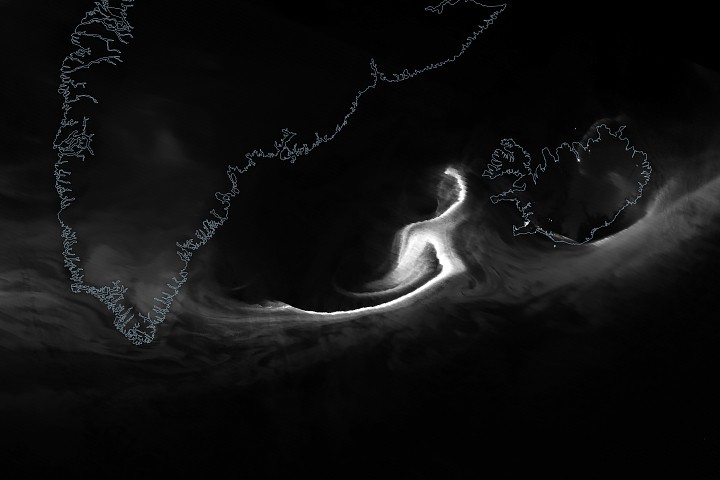
On the early morning of February 16, the VIIRS day-night band, which detects light in various wavelengths, provided visual evidence of the auroras. While the satellite images are displayed in grayscale, observers on the ground reported seeing a spectrum of colors including green, purple, and red, with green being the most prevalent.
The first satellite image depicts vibrant light patterns above the Denmark Strait and Iceland at 04:45 UTC (local time in Reykjavík), while the second image shows the aurora over the Canadian provinces of Québec and Newfoundland and Labrador around 06:30 UTC (local time in Montreal).
According to the NOAA Space Weather Prediction Center, a G1-level geomagnetic storm was active at the time, which is the lowest level on a scale that extends to G5. G1 storms can render the aurora visible at high latitudes and may lead to minor disruptions, such as slight fluctuations in power grids and satellite operations.
Later on the same day, the storm escalated to a G2 level, associated with a coronal hole and a high-speed solar wind stream. G2 storms, classified as moderate in strength, can sometimes enable auroras to be seen as far south as New York and Idaho, expanding their reach beyond typical viewing areas.
A week prior, on February 10, a NASA rocket mission was launched from the Poker Flat Research Range near Fairbanks, Alaska, aimed at studying the electrical environment of auroras. The GNEISS (Geophysical Non-Equilibrium Ionospheric System Science) mission involved two sounding rockets that collected crucial data. This research is intended to assist scientists in constructing a 3D model of the electrical currents stemming from the northern lights. Combined with both ground-based and satellite data, this information will enhance the understanding of the space weather systems that affect Earth.
Images showing the stunning auroral activity in Iceland and Canada were produced by NASA Earth Observatory’s Michala Garrison, utilizing data from the VIIRS day-night band.
Overall, these recent events underscore the dynamic nature of space weather and its impressive visual manifestations in the form of the aurora borealis.
The content above is a summary. For more details, see the source article.