Key Takeaways
- Saturn now boasts 274 moons, thanks to the discovery of 128 new moons detected by astronomers.
- All newly found moons range from 2 to 4 kilometers in diameter and are likely remnants from ancient collisions.
- Discussions are ongoing about the criteria for classifying moons, particularly regarding what size qualifies as a moon versus a rock.
New Moons Discovered at Saturn
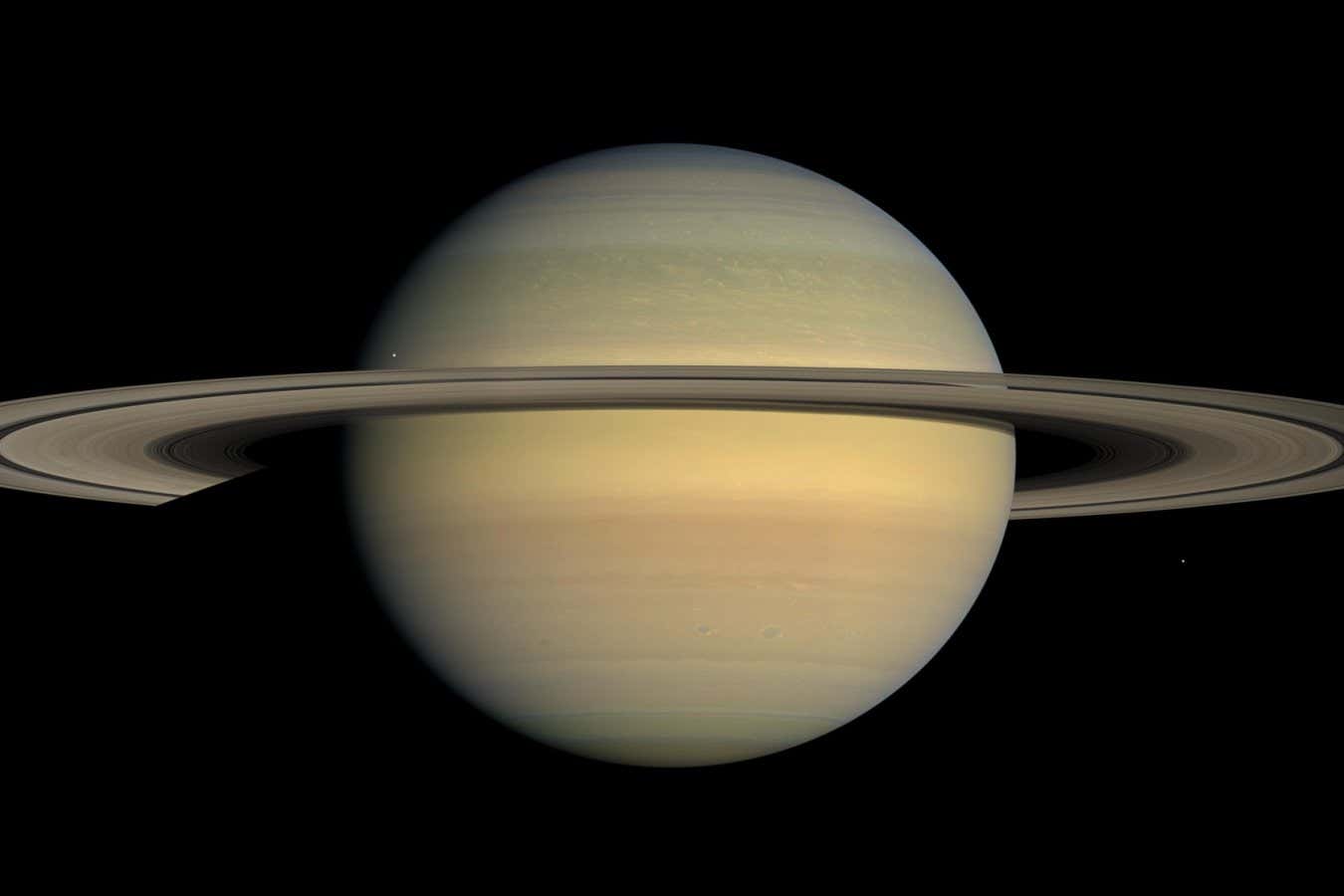
Recent astronomical advancements have led to the discovery of 128 new moons orbiting Saturn, raising the planet’s total to 274. This remarkable number surpasses the total number of moons found around all other planets in the solar system combined. New observational techniques have enhanced the ability to detect smaller objects, prompting scientists to confront a pertinent question: how small can a moon be before it simply becomes a rock?
The discoveries were made by Edward Ashton and his team at Academia Sinica in Taipei, utilizing the Canada-France-Hawaii Telescope. They spent hours capturing images of Saturn, compensating for the planet’s movement, and stacking the photos to uncover previously undetected moons that are dim and small. The new moons, each between 2 and 4 kilometers in diameter, are hypothesized to have formed through collisions involving larger moons over millions or billions of years.
Ashton noted that while some may view these discoveries as slight achievements due to their size, he believes cataloguing all objects in the solar system is a critical task. Despite the extensive data collected, the new moons still appear as “fuzzy blobs” in images. Although there are more advanced telescopes available that could provide clearer images, their smaller fields of view would necessitate capturing many more photographs, a time-consuming process.
The International Astronomical Union (IAU) has officially recognized the newly discovered moons, granting Ashton’s team the opportunity to name them. Ashton indicated that he has sought input from Canada’s Indigenous peoples for suggestions and is also considering the possibility of a public naming contest.
The findings raise questions about the potential for even more moons around Saturn. Over the years, astronomers have conducted extensive scans of the area surrounding the planet. Recent efforts yielded significant discoveries, including 20 new moons in 2019 and another 62 in 2023 prior to the last collection of 128 moons. Ashton speculates that there may be thousands of additional moons orbiting Saturn, particularly neglecting smaller rocky debris typically found in the planet’s rings.
Mike Alexandersen, representing the Minor Planet Center as a recorder for the IAU, believes that many more moons await discovery throughout the solar system as telescope capabilities evolve to detect smaller entities. He mentioned that the IAU has decided not to prioritize the naming of any celestial body smaller than 1 kilometer; however, this does not imply it will not be acknowledged as a moon. Alexandersen remarked that the delineation between a moon and a mere rock fragment will likely be contentious and arbitrarily set.
Additionally, Elizabeth Day from Imperial College London highlighted the growing importance of mapping celestial bodies, especially as future advances in technology may enable resource extraction from asteroids and moons. Comprehensive knowledge of various bodies in the solar system could have practical implications in the pursuit of these resources.
The content above is a summary. For more details, see the source article.