


Key Takeaways
- Laughlin Air Force Base retired its last T-1A Jayhawk trainer aircraft on December 17, joining a transition to the new T-7A Redhawk.
- The retirement is part of the Air Force’s strategy to modernize pilot training and reduce its fleet of aging T-1s.
- Enhanced training techniques, including simulators and advanced aircraft like the T-6A, will improve the efficiency of pilot education.
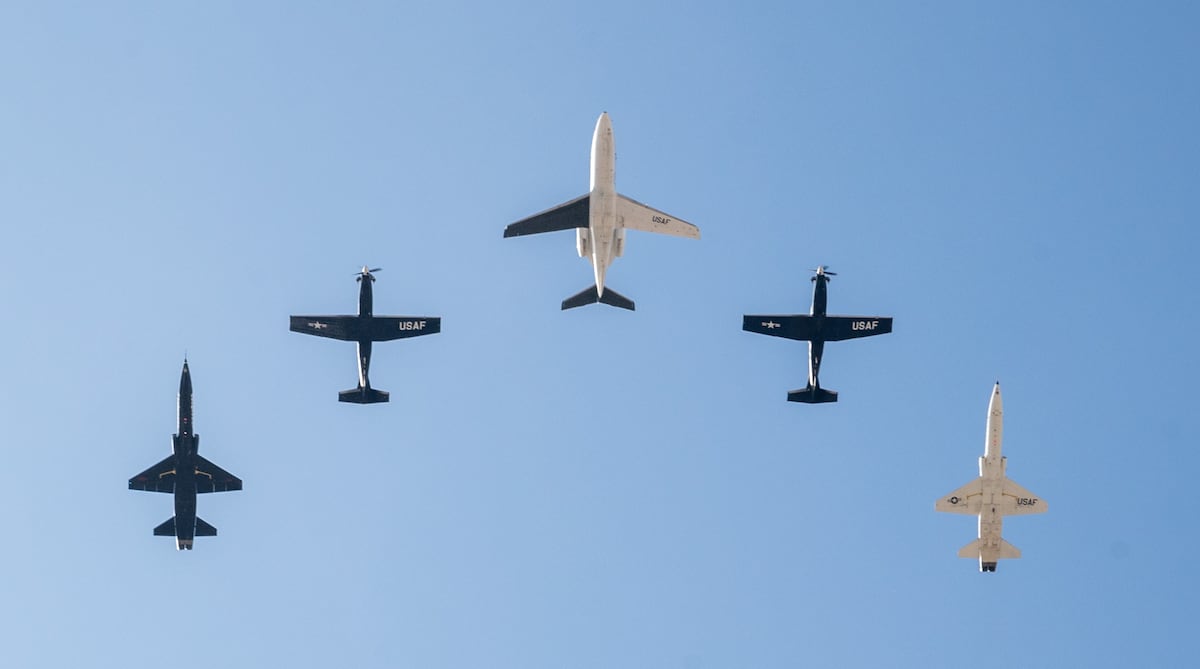
Laughlin Air Force Base in Texas marked the retirement of its final T-1A Jayhawk trainer on December 17, reflecting the Air Force’s efforts to phase out older aircraft in favor of more advanced training solutions. The last Jayhawk, from the 86th Flying Training Squadron, participated in a flyover with two T-6A Texan IIs and two T-38C Talons before heading to its retirement at Davis-Monthan Air Force Base in Arizona, often referred to as “The Boneyard.”
Lt. Col. Nathan Hedden, the commander of the 86th Flying Training Squadron, acknowledged the legacy of prior pilots in his farewell, stating, “We stand on the shoulders of giants,” highlighting the crucial role the T-1 played in training Air Force pilots for over 30 years. The twin-engine Jayhawk, originally manufactured by Raytheon subsidiary Beech, has served as a stepping stone for Airmen learning to fly cargo planes and tanker aircraft.
However, as the T-1 fleet ages, the Air Force has initiated plans to reduce the number from 177 to 53 by 2025. The shift is part of a broader transition toward utilizing the T-7A Redhawk trainer, which is anticipated to more effectively meet modern pilot training needs. The Air Force’s retirement of the Jayhawk started in 2023, with a reduction plan launched after the announcement in early 2022.
The Air Force’s decision to phase out the T-1s is aligned with their implementation of new pilot training methodologies, such as virtual reality, which are designed to enhance learning experiences and streamline the education process. Improvements in the T-6 aircraft mean that new pilots can develop the necessary mobility skills on a single platform, leading to the retirement of certain T-1s that require costly engine replacements.
Under the updated training framework, Air Force pilots now start with the T-6 during their undergraduate training. From there, about 900 candidates proceed to more advanced lessons for flying mobility aircraft. The previously used pathway required students to spend significant time flying the T-1 before progressing to mobility-oriented instruction. The new simulator-based system enables students to acquire vital flight skills more efficiently.
The 47th Flying Training Wing at Laughlin will continue to train students using the T-6 and T-38C Talon until the T-7A becomes operational. Meanwhile, the 99th Flying Training Squadron at Joint Base San Antonio-Randolph also retired its last T-1 Jayhawk in July 2024, reinforcing the Air Force’s commitment to modernizing its training fleet.
The content above is a summary. For more details, see the source article.









