


Key Takeaways
- Asia-Pacific navies are enhancing amphibious capabilities amid rising military tensions from China.
- Japan and Australia are set to introduce new landing crafts to bolster their maritime transport and defense strategies.
- The Philippines and Taiwan are expanding their amphibious fleets, while India is lagging in developing its capabilities.
Increased Amphibious Capabilities in Response to Regional Threats
Navies in the Asia-Pacific region are ramping up their amphibious capabilities as a counter-measure to increasing military assertiveness from China. Notably, the Japan Ground Self-Defense Force (JGSDF) is receiving significant upgrades, including 10 new landing craft slated for completion by the end of Fiscal Year 2027. This upgrade will consist of two 3,500-ton Logistics Support Vessels (LSV), four 2,400-ton Landing Craft Utility (LCU), and four smaller Maneuver Support Vessels. The first LSV and LCU were launched by Japanese shipbuilder Naikai Zosen in late 2022. These vessels will support the Amphibious Rapid Deployment Brigade, Japan’s marine corps equivalent, and will be part of a new Maritime Transport Group commencing its operations in March 2024. The JGSDF states, “In light of the current severe security environment, the JGSDF will steadily build transport vessels to strengthen transport functions to islands.”
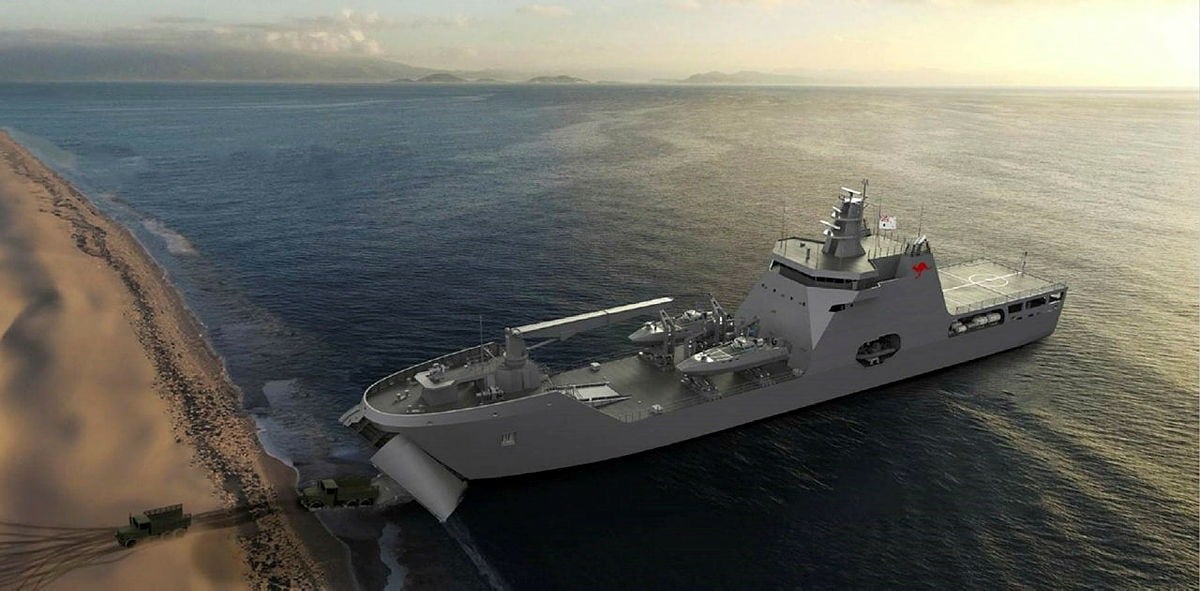
Australia is also strategically enhancing its amphibious capabilities, planning the introduction of 18 new Landing Craft Medium (LCM) and eight Landing Craft Heavy (LCH). These developments follow a Defence Strategic Review that emphasized the need for improved littoral capabilities. Designed by Birdon Group, the LCMs will transport 90 tons of cargo, whereas the LCHs will displace 3,900 tons. The first medium craft is expected to launch by the end of 2026, with the first heavy set for completion by the end of 2028. Australia’s Army chief, Lt. Gen. Simon Stuart, highlighted that the new vessels will facilitate a strategy focused on deploying and sustaining modernized land forces within the region.
The Philippines has already taken steps to enhance its amphibious capabilities with two Tarlac-class landing platform dock (LPD) vessels, and it is set to acquire two additional vessels by 2026. These LPDs will facilitate operational mobility across the Philippine archipelago, especially at its South China Sea bases, which are currently under pressure from Chinese maritime activities. Taiwan has similarly commissioned the Yushan, a domestically built 10,000-ton LPD, though it faces limitations regarding its ability to counteract a full-scale invasion. Its roles will include supporting mine countermeasures and resupplying offshore islands.
However, India appears to be falling behind in terms of amphibious capability enhancement. The Indian Navy has expressed interest in procuring four LPDs but has not made significant progress since issuing a request for information in 2021. Despite a partnership between Navantia of Spain and Larsen & Toubro to propose the Juan Carlos I platform, funding constraints and India’s historical focus on land borders with China and Pakistan complicate the situation.
As tensions escalate in the region, the development of amphibious capabilities among these nations underscores the need for enhanced maritime defense while aiming to secure their respective interests in the contested waters of the Asia-Pacific.
The content above is a summary. For more details, see the source article.









