Key Takeaways
- NASA installed a 133-ton reflector dish at Deep Space Station 23, enhancing the Deep Space Network.
- Once operational in 2026, the new antenna will support various missions, including Perseverance and Voyager 1.
- This upgrade ensures NASA’s communication capabilities keep pace with the increasing number of deep space missions.
Deep Space Station 23 Installation Enhancements
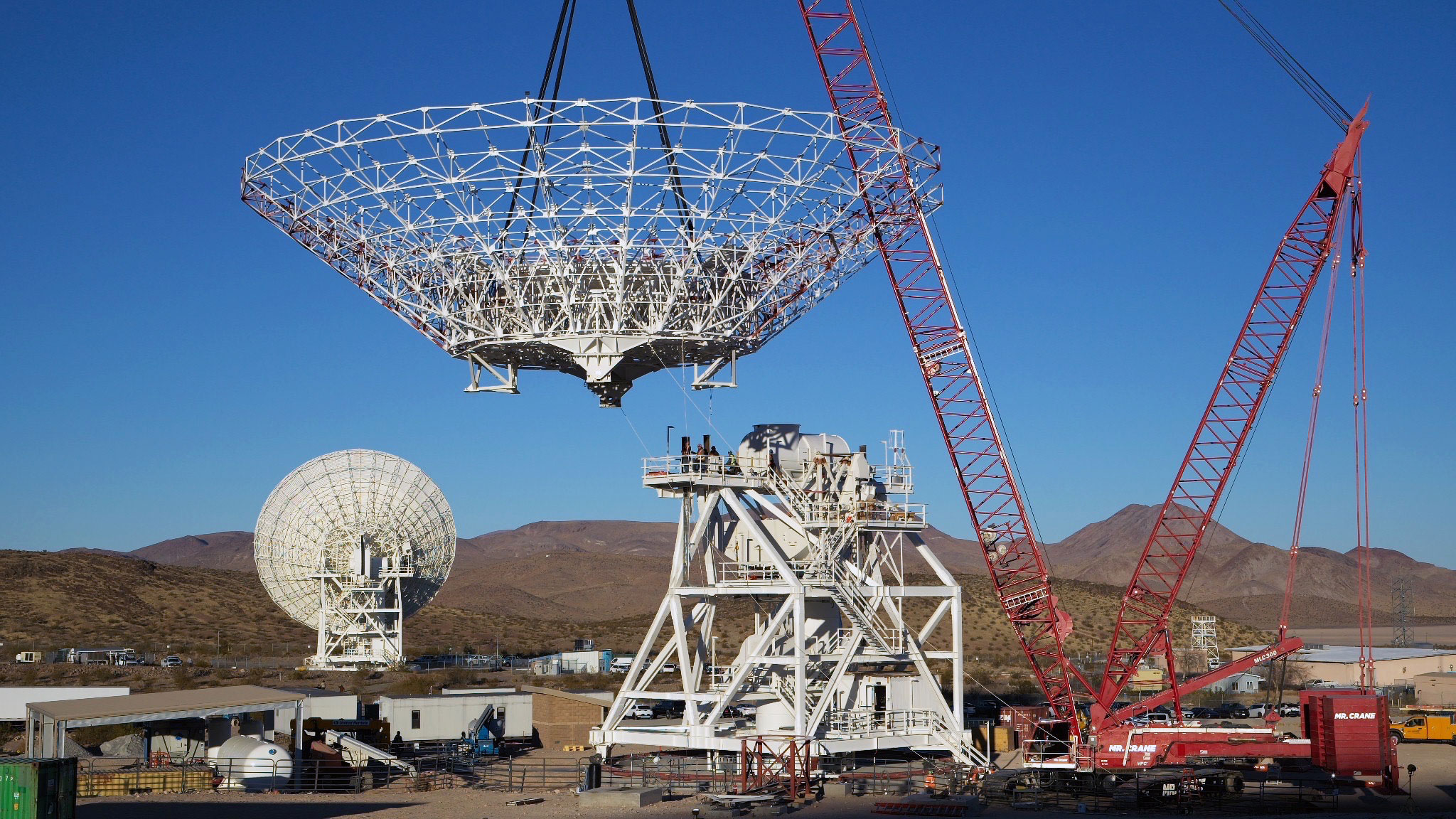
NASA’s Deep Space Network (DSN), a vital system of giant radio antennas, recently took a significant step forward with the installation of a 133-ton reflector dish at Deep Space Station 23. This addition, completed on December 18 at the Goldstone Deep Space Communications Complex in California, bolsters the DSN, allowing it to manage the growing demand for data transmission and communication from spacecraft exploring the Moon and beyond. With this new installation, the network expands to 15 antennas, enhancing its capabilities.
The reflector framework is a part of a multifrequency beam-waveguide antenna, which will be fully operational by 2026. Once functioning, Deep Space Station 23 will handle transmissions from important missions such as Perseverance, Psyche, and Europa Clipper, along with the legendary Voyager 1. Kevin Coggins, deputy associate administrator of NASA’s SCaN program, emphasized the upgrade’s importance, asserting that it prepares NASA for the increasing number of missions heading into deep space.
Construction of the antenna has been a four-year effort. On the day of installation, teams used a crawler crane to correctly position the 112-foot-wide (34-meter) parabolic reflector, which was then mounted to a 65-foot-high (20-meter) alidade – a support structure allowing the antenna to steer the reflector during operations. Germaine Aziz, a systems engineer with NASA’s Jet Propulsion Laboratory, described the meticulous alignment required for the 40 bolt-holes during the lift, ensuring the operation proceeded smoothly.
Following the main installation, a lighter lift was executed to place a 16.5-ton quadripod on the reflector’s center. This quadripod features a curved subreflector, which directs radio frequency signals from deep space into the antenna’s receivers.
The DSN is unique, enabling NASA to engage in over 40 deep space missions, including the historic Voyager probes—the farthest human-made objects currently in space. The upcoming Deep Space Station 23 represents the fifth of six planned beam-waveguide antennas to enhance this framework, following the addition of Deep Space Station 53 in Madrid in 2022.
Laurie Leshin, director of the Jet Propulsion Laboratory, asserts that the Deep Space Network plays an integral role in showcasing the agency’s accomplishments, from Martian rover expeditions to the groundbreaking observations made by the James Webb Space Telescope. This robust communication network is essential for supporting missions that delve into scientific inquiries across the solar system and beyond.
Managed by JPL and overseen by NASA’s SCaN Program, the Deep Space Network supports over 100 NASA and non-NASA missions, including those related to the International Space Station and future Artemis lunar exploration programs. Through these advancements, NASA continues to pave the way for significant scientific exploration and discovery.
The content above is a summary. For more details, see the source article.