Key Takeaways
- Over 15,000 mounds on Mars have been found containing clay minerals, indicating the presence of liquid water nearly four billion years ago.
- This evidence supports the idea of a warmer, wetter Mars with rivers and lakes, especially in its northern regions.
- The European Space Agency’s Rosalind Franklin rover will explore this area, aiming to investigate the potential for past life on Mars.
Findings on Mars’ Ancient Climate
Recent research led by Joe McNeil from London’s Natural History Museum has revealed that thousands of hills and mounds on Mars contain layers of clay minerals. This finding suggests that liquid water was once abundant on the surface of the planet nearly four billion years ago. The study highlights a significant change in Mars’ climate, indicating it was much different—likely warmer and wetter during its early history.
Mars is distinguished by its two contrasting geographical regions: ancient highlands to the south and low-lying eroded plains to the north. The research supports the presence of a vast northern sea which existed millions of years ago, further affirming that Mars had flowing rivers, lakes, and possibly oceans.
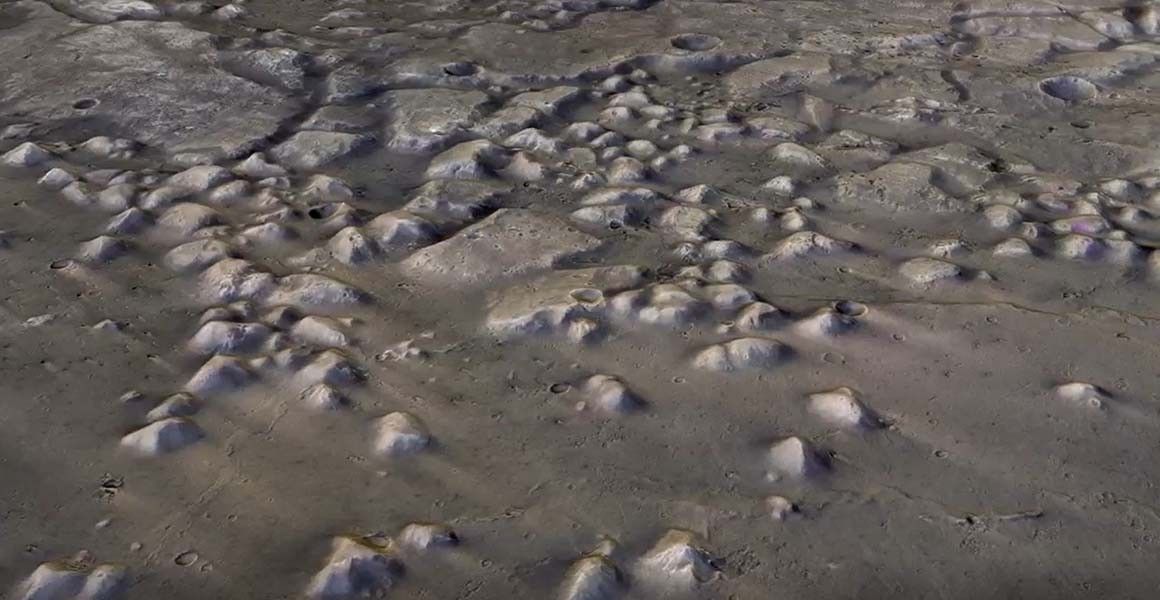
McNeil’s team focused their investigation on a region comparable in size to the United Kingdom, identifying over 15,000 mounds, some reaching heights of up to 1,640 feet (500 meters). Similar formations, known as buttes and mesas, are found on Earth and are created through long-term erosion in desert regions. The specific site of the research is Chryse Planitia, the landing spot of NASA’s Viking 1 mission in 1976, where the terrain has been shaped by erosive forces for eons.
Utilizing advanced imaging and spectral analysis from multiple space agencies’ orbiters, including NASA’s Mars Reconnaissance Orbiter and the European Space Agency’s Mars Express, the research team determined that these structures consist of layered deposits, featuring clay minerals formed through prolonged interaction with liquid water. The depth of these layers may extend up to 1,150 feet (350 meters), indicative of a significant wet period in Mars’ history during the Noachian era, lasting from 4.2 to 3.7 billion years ago.
McNeil emphasized the implications of these findings, suggesting the presence of a substantial amount of water on Mars’ surface during that time. Although there are different theories regarding the source of this water, the concept of an ancient northern ocean remains a subject of debate among scientists.
The geological layers present at the site show a clear chronological sequence: clay-rich layers sit atop older, non-clay rock layers, while younger rocks above again lack clay minerals. This stratification reinforces the notion that the clay layers were deposited during a specific wet phase, forming a geologically significant window into the planet’s watery past.
Importantly, the mounds documented in this study form a comprehensive geological record that researchers hope to further investigate. The European Space Agency plans to deploy the Rosalind Franklin rover, which will head toward the Oxia Planum region, potentially uncovering crucial evidence regarding Mars’ habitability. The mission, launching in 2028, is positioned to enhance understanding of whether Mars ever had conditions conducive to life and if such life forms ever existed there.
These groundbreaking findings were published in the journal Nature Geoscience on January 20, marking a significant step forward in unraveling the mysteries of Mars’ ancient environment and its capacity to support life.
The content above is a summary. For more details, see the source article.