


Key Takeaways
- Decentralised computing at home promotes privacy, security, and rewards for network contribution.
- Devices like HomePortal Neuron, NVIDIA Jetson, and Intel NUC facilitate edge computing for blockchain applications.
- Integration of edge computing, blockchain, and IoT enables efficient data processing and enhanced user control.
The Rise of Home-Based Edge Computing
As demand for data control and decentralisation increases, individuals are looking to establish their own computing nodes at home. This shift allows for reduced dependency on centralised cloud providers and enables users to earn rewards, thereby fostering a resilient network.
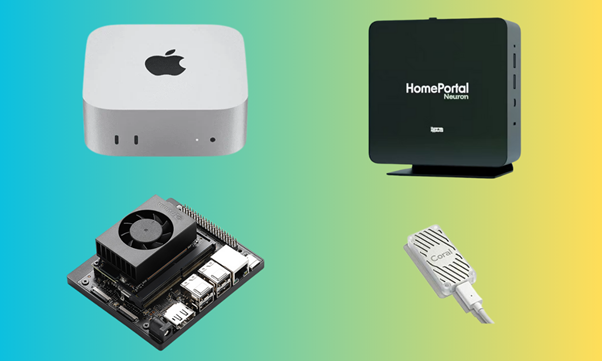
Edge computing, especially when combined with blockchain technology, promises rapid processing and low latency. Below are six notable devices designed for individuals interested in blockchain and edge computing.
HomePortal Neuron
The HomePortal Neuron, developed by HyperAppliance, is specifically tailored for decentralised computing at home. This plug-and-play device is perfect for students, developers, and researchers aiming to engage in the computation economy. It is pre-configured to run HyperCycle nodes and allows users to effortlessly provide computing power in exchange for rewards.
Designed for energy efficiency (65W), the Neuron features a powerful 12-core processor, expandable RAM options (16GB to 64GB), and storage that ranges from 512GB to 2TB, making it ideal for demanding tasks such as AI training.
NVIDIA Jetson Series
The NVIDIA Jetson series serves a similar purpose as HomePortal, supporting lightweight blockchain and AI node deployments. Its various modules leverage NVIDIA’s CUDA-X software for efficient AI network operation and deployment. The Orin Nano series delivers impressive AI performance at power-efficient levels while the AGX Xavier series enhances compute power and efficiency. An active developer community further enriches the user experience.
Intel NUC Series
The Intel NUC series offers modular hardware and robust computing capabilities suitable for complete blockchain validators and staking nodes. With options ranging from 15W to 125W TDP, these compact systems provide high performance and extensive RAM and storage capabilities, making them a practical choice for at-home blockchain setups.
Raspberry Pi 4
The affordable Raspberry Pi 4 is ideal for hobbyists and light validators. This Linux development board features a passive cooling system, a quad-core processor, and GPIO headers for sensor connections, making it versatile for light blockchain applications. It supports integration with Edge Impulse for building and deploying machine learning models.
Apple Mac Mini
The Mac Mini, equipped with Apple’s M4 chip, delivers impressive performance in a compact design. Enhancements over the previous M1 include substantial improvements in CPU and GPU performance, making it well-suited for validators and high-performance blockchain nodes. Its compact footprint allows for easy setup in home environments.
Google Coral
Google Coral focuses on customisation capabilities through local data processing. It features an Edge TPU for efficient AI computations, enabling real-time processing crucial for blockchain IoT tasks. The Edge TPU ensures rapid decision-making while eliminating reliance on cloud infrastructure, thus reducing latency.
Integrating Edge Computing, Blockchain, and IoT
The architecture for integrating edge AI, blockchain, and IoT consists of several layers: sensor, edge, networking, and blockchain, culminating in cloud applications. Sensors capture data, which is transmitted via edge gateways to higher layers. Equipped with adequate memory and processing power, these gateways run complex algorithms while protecting data integrity through cryptography.
The networking layer facilitates communication amongst various devices, while the blockchain layer ensures data immutability and trust. A specific blockchain protocol enables secure data exchange between nodes, enhancing overall user control in the decentralised ecosystem.
The content above is a summary. For more details, see the source article.









