


Key Takeaways
- Cedar enhances model training in PIoT systems through a three-phase workflow that includes task preparation, meta-model training, and deployment.
- The system uses meta-learning and adaptive updates to improve model efficiency and security against malicious attacks.
- Cedar outperforms traditional methods across various tasks, demonstrating significant improvements in model accuracy and adaptation speed.
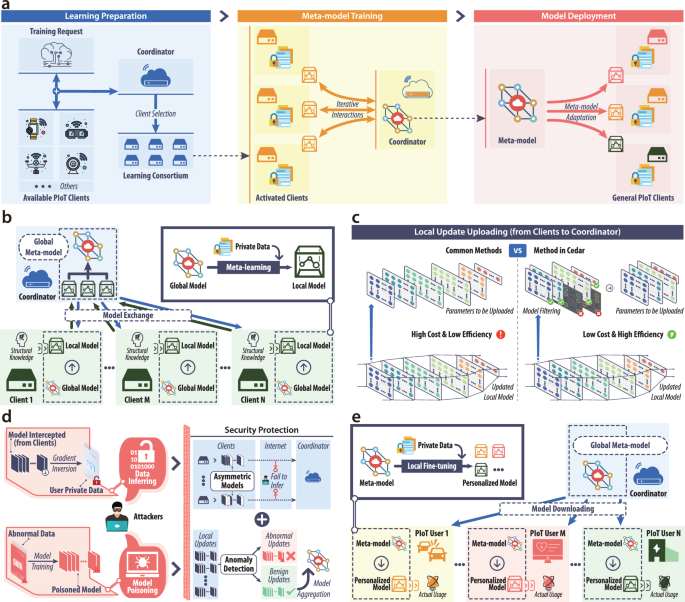
Cedar operates through a three-phase process designed for enhanced model training in Physical Internet of Things (PIoT) systems. In the first phase, the learning coordinator receives and parses training requests, defines the learning task, and sets up a consortium of clients with requisite data. In the second phase, the global meta-model is trained securely and iteratively through interactions between the coordinator and selected clients. Clients perform local training and upload only the most significant model layers to the coordinator, which aggregates them to refine the global meta-model. The training continues until convergence or a predetermined limit of learning rounds is reached.
Once trained, clients can download the global meta-model for personalization by fine-tuning it with local data, enabling optimal model performance across diverse applications. Cedar also encompasses four core functions: leveraging meta-learning to manage data diversity, offering adaptive model updates for cost efficiency, ensuring security against potential attacks, and allowing for model personalization.
Cedar’s capacity to function across multiple domains was evaluated using twelve standard datasets across three tasks: structured data regression, text classification, and image classification. Comparisons with five baseline methods revealed Cedar’s superior performance, with enhancements of up to 60.39% in accuracy and a stable learning curve across varying task complexities. For instance, Cedar exhibited a noteworthy 17.77% improvement in simpler regression tasks and a 22.75% boost in text classification tasks.
In tackling data heterogeneity, Cedar proved effective at maintaining model stability for various individual and overall heterogeneity levels. By employing strategies that minimize communication overhead without sacrificing performance, Cedar also delivers a more cost-efficient training process. It achieves noticeable reductions in data transmission costs and accelerated convergence rates compared to traditional models.
Cedar’s defenses against malicious attacks, such as data sniffing and model poisoning, were rigorously tested. The system maintained low attack success rates, outperforming several baseline methods. Through effective strategies, Cedar’s mechanisms ensured the protection of users’ privacy and data security while optimizing collaborative learning in PIoT settings.
An ablation study highlighted Cedar’s integrated approach, confirming that the combination of layer-wise uploading and adaptive weighting effectively improves performance and resilience against adversarial attacks. This multifaceted capability positions Cedar as an advanced solution for secure, efficient, and personalized model training within heterogeneous data environments. More detailed results and methodology can be found in the supplementary materials.
The content above is a summary. For more details, see the source article.









