


Key Takeaways
- Oregon aims for 100% clean electricity by 2040, supported by key legislation and utility companies transitioning from fossil fuels.
- Challenges remain in energy infrastructure, including transmission issues and the economic impact on local communities.
- Opposition from local tribes and fishing industries highlights the complexities of renewable energy projects in Oregon.
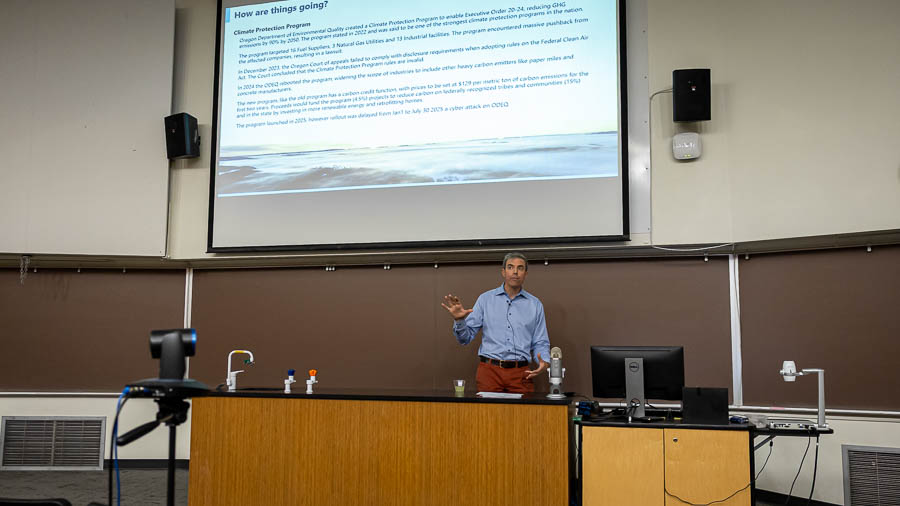
During a recent talk at Southern Oregon University, Erik Steimle, the chief development officer of Rye Development, discussed Oregon’s ambitious goal to achieve 100% clean electricity by 2040. Graduating in 2000 with a degree in Environmental Biology, Steimle noted the state’s significant progress towards this target through legislative actions like Executive Order 20-04 and House Bill 2021. These initiatives mandate a substantial reduction in greenhouse gas emissions and encourage utility companies to evolve their energy sources.
Steimle emphasized that the state’s three primary utility companies—Portland General Electric, Pacific Power, and Idaho Power—are making strides by developing wind, solar, and energy storage projects. However, he acknowledged that these efforts come with challenges, including the complexities of energy transmission and high development costs. While Oregon currently enjoys some of the lowest electricity rates globally due to its hydropower infrastructure, anticipated rate increases are expected as the grid transitions.
Rural communities play a vital role in this energy shift, with renewable projects significantly enhancing local economies. For instance, solar and wind projects in Lake and Sherman Counties have been described as “transformational,” providing long-term economic benefits. However, concerns have surfaced from local tribes and the fishing industry regarding energy storage and transmission, particularly related to Rye Development’s pumped storage hydropower project northeast of Klamath Falls. This project faces resistance due to potential impacts on culturally significant lands.
Furthermore, apprehensions from independent fishermen and seafood companies led to calls for halting a federal offshore wind energy initiative, citing potential disruption to marine ecosystems. Steimle pointed out that politics have hindered federally-owned renewable energy projects, as opposition to transmission lines transcends political affiliations. He highlighted the necessity of enhancing infrastructure to accommodate renewable energy sources, recognizing that wind and solar require complex grid adjustments.
Steimle concluded by stressing the need for innovation and improved construction practices in the U.S. energy sector. He remarked that states like Tennessee and Kentucky cannot simply abandon reliance on coal without a suitable renewable alternative, which can take decades to implement. For future advancements, he asserted that universities must take initiative to rethink how to develop energy projects within their communities.
The content above is a summary. For more details, see the source article.









