


Key Takeaways
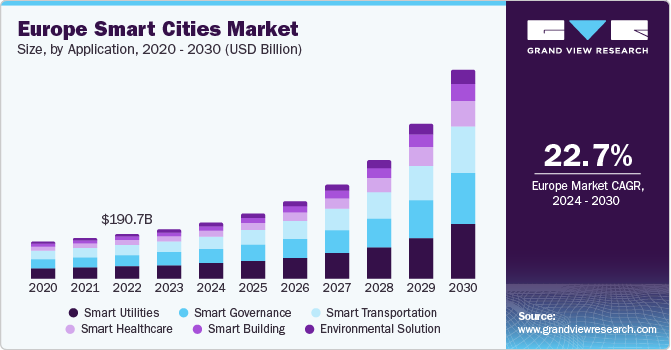
- The Europe smart cities market is projected to grow from USD 212.5 billion in 2023 to USD 888.8 billion by 2030, with a CAGR of 22.7%.
- Smart utilities, particularly energy management, dominated the market with a 28.5% share in 2023, driven by sustainability initiatives and smart technologies.
- The UK leads the European smart cities market, followed closely by Germany, both fueled by government support and technological advancements.
Market Overview
The European smart cities market was valued at USD 212.5 billion in 2023 and is anticipated to experience a compound annual growth rate (CAGR) of 22.7% from 2024 to 2030. This expansion is driven by increasing urbanization, the necessity for effective resource management, and advancements in technologies such as the Internet of Things (IoT), artificial intelligence (AI), and big data analytics. Collaborative initiatives among governments and organizations, exemplified by the European Innovation Partnership on Smart Cities and Communities, play a significant role in transitioning European nations toward smart city infrastructures.
Europe held 28.4% of the global smart cities market share in 2023. Smart cities utilize innovative technologies to enhance citizens’ quality of life and improve governance efficiency. Integrating data analytics, IoT, and information and communication technology (ICT) aims to optimize services and infrastructure. The market’s growth is characterized by initiatives focusing on technical innovation and sustainable urban development as cities adopt smart solutions for enhanced living conditions.
Opportunities for growth arise from investments in research and innovation, the establishment of policies targeting triple-bottom-line benefits, and the application of technologies in transport, energy, and ICT sectors. A comprehensive report by the European Court of Auditors details current smart city initiatives, challenges faced, and funding sources, revealing that 50% of funding originates from EU support, 43% from local economies, and 10% from other avenues.
Application Insights
The smart utilities segment led the market in 2023, making up 28.5% of revenue. This growth can be attributed to heightened awareness regarding environmental impacts, prompting users to adopt smart electric meters. Energy management accounted for 55.3% of the smart utilities revenue, primarily influenced by the EU’s “Fit for 55” initiative aimed at reducing emissions and energy use by 2030. The water management segment, supported by initiatives like the Smart Water Management Platform (SWAMP), also saw significant advancement due to aging infrastructure and the need for innovative water solutions.
Regional Trends
In the UK, the smart cities market represented 22.7% of the total, encouraged by rising demands for smart energy and transportation solutions alongside robust government backing. Germany’s market growth was significantly bolstered by advancements in digital technology and the rise of startups focused on automation in various sectors, enhancing quality of life and reducing costs.
Key players in the European smart cities market, such as AVEVA Group and Siemens AG, are employing strategies to boost renewable energy projects and foster innovation through partnerships, further paving the way for future developments in the sector.
The content above is a summary. For more details, see the source article.









