Key Takeaways
- Aerogel, the world’s lightest solid, has inspired artist Ioannis Michaloudis to create unique art installations over a 25-year journey.
- Michaloudis’ work in aerogel has gained attention in both the art world and high fashion, including collaborations with brands like Boucheron and Coperni.
- Nasa’s Stardust mission played a pivotal role in advancing aerogel technology, making it suitable for artistic applications.
Innovative Journey of Ioannis Michaloudis with Aerogel
Aerogel, comprising 99% air, is recognized as the lightest solid material on Earth. This remarkable substance has been utilized in diverse fields, including space missions and artistic endeavors. Greek artist Ioannis Michaloudis embarked on a 25-year journey to harness the unique properties of aerogel for his artwork, motivated by a vision of creating a 3D cloud.
His path led him to prominent institutions like the Massachusetts Institute of Technology (MIT) and NASA’s Jet Propulsion Laboratory (JPL). It was at MIT that a researcher introduced Michaloudis to aerogel, piquing his interest. The composition of aerogel involves combining a polymer with a solvent to form a gel, which is then flash-dried under pressure to yield a solid with microscopic pores.
The use of aerogel in scientific applications traces back to the mid-1990s when NASA selected it for the Stardust mission. This mission aimed to capture particles by utilizing aerogel’s porous structure as a probe trailed a comet. Although initial lab tests were promising, the challenge lay in consistently manufacturing aerogel that could withstand space conditions. To address this, NASA hired materials scientist Steve Jones, who eventually secured funding to establish an aerogel lab.
Upon the success of the Stardust mission, Michaloudis connected with JPL and was welcomed into the lab by Jones. Jones shared valuable knowledge about aerogel, explaining the various types and their distinct properties. Michaloudis was particularly impressed by Jones’ large reactor, which allowed the production of sizable aerogel objects, and he adapted his own lab accordingly.
During his time in India, Michaloudis gained insights into aerogel recipes suitable for creating large-scale, durable forms that neither crack nor shrink during the drying process. His persistent exploration of aerogel has culminated in an expansive portfolio of art that consistently showcases its extraordinary characteristics.
Having held over a dozen solo exhibitions, Michaloudis’ work is predominantly aerogel, known for its ethereal appearance and unique optical properties. The translucent blue material casts orange shadows and is capable of enduring extreme temperatures, including molten metals.
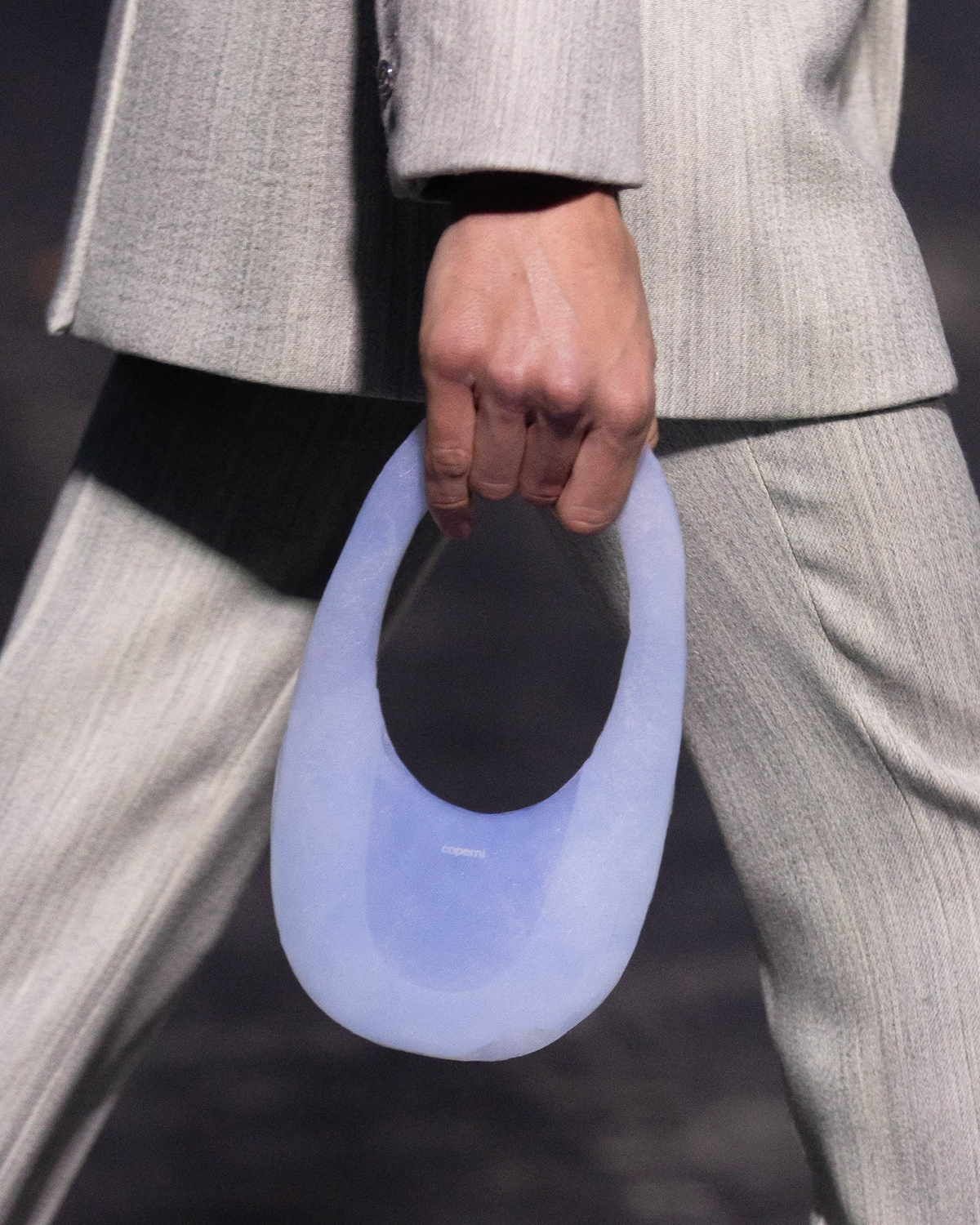
In 2020, he created a quartz-encapsulated aerogel pendant for French luxury jewelry brand Boucheron, marking a significant moment in his foray into high fashion. More recently, his innovative approach to aerogel caught the eye of the fashion industry when he unveiled an aerogel handbag during the debut of Coperni’s 2024 fall collection.
Reflecting on his artistic journey, Michaloudis credits NASA and the Stardust project as foundational to his achievements with aerogel. He states, “I am what I am, and we made what we made thanks to the Stardust project,” underscoring the interconnectedness of science and art in his work.
The content above is a summary. For more details, see the source article.