


Key Takeaways
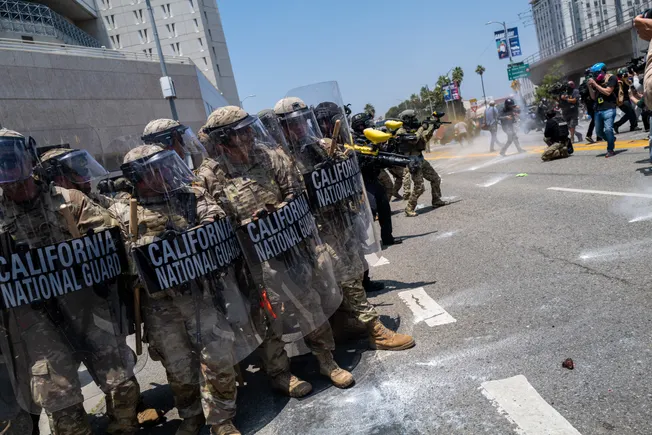
- California has filed a motion to remove federal troops from its cities, with support from the U.S. Conference of Mayors.
- Governor Newsom plans to sue the Trump administration over the troop deployment, asserting local law enforcement sufficiency.
- Democratic leaders criticized President Trump’s actions as an abuse of power, undermining local governance and trust in law enforcement.
Conflict Over Federal Troops Deployment
On June 11, 2025, California took a significant step by filing a motion for a temporary restraining order to remove military and federalized National Guard troops from its communities. This action was supported by the U.S. Conference of Mayors, which voiced confidence in Los Angeles Mayor Karen Bass’s capability to maintain order alongside local authorities. Mayor Andrew Ginther, President of the Conference, emphasized that the military should not be present in American cities and affirmed that public safety is a local responsibility.
President Trump has also issued a warning, stating he may send troops to other cities with “greater force” if rioting unfolds. The Democratic Mayors Association accused the Trump administration of creating a crisis for political gain, asserting that collaboration, rather than confrontation, is essential for community safety.
Amid this backdrop, Mayor Bass imposed a curfew in a downtown Los Angeles area to maintain order. She indicated that numerous police and sheriff’s department officers are coordinating with the LAPD under a unified command. Additionally, Bass and a coalition of mayors planned a press conference to collectively call for the cessation of federal troop deployments.
In a statement highlighting the discord, Governor Gavin Newsom criticized the federal action, asserting that there was no issue before Trump’s involvement and that a lawsuit was forthcoming against the president. Newsom’s legal team addressed U.S. Defense Secretary Pete Hegseth, contending that local authorities are equipped to manage public safety and that the federal troops’ presence is a violation of state sovereignty.
Historically, the deployment of federal troops against a state’s wishes occurred in 1965, but Trump’s reliance on Title 10 authority for troop mobilization has raised legal questions. This authority is generally invoked to address actions deemed as national rebellion or invasion.
Compounding tensions, acting ICE Director Todd Lyons pointed out that the LAPD response to a federal facility incident was delayed. However, LAPD Chief Jim McDonnell defended his department, indicating that officers were on the scene within 38 minutes, although their response faced challenges like heavy traffic and crowd conditions.
McDonnell also stated that the LAPD typically seeks mutual aid prior to requesting federal assistance, adding that their recent engagement with national troops was minimal. He noted the department’s adequate resources to handle incidents locally.
Democratic governors expressed alarm over Trump’s troop deployment, labeling it an alarming abuse of power. They argue that such federal actions diminish public trust and stray from the initial mission of military personnel. Civil rights organizations, including the ACLU of Southern California and the NAACP, echoed these sentiments, describing the situation as an effort to incite fear and destabilize local governance.
In summary, the friction between state and federal leadership represents a pivotal moment in understanding the balance of local authority versus federal intervention in community control and public safety management.
The content above is a summary. For more details, see the source article.









