


Key Takeaways
- The 912Rwanda software, developed with the University of Birmingham, aims to enhance emergency medical care in Rwanda.
- The initiative could save nearly one million lives and reduce serious disabilities among 250 million people in low- and middle-income countries.
- Backed by over £3m in funding, the program optimizes ambulance deployment and facilitates quicker access to appropriate medical facilities.
Innovative Software Enhances Emergency Response in Rwanda
Ambulance technology developed in Rwanda, in collaboration with experts from the University of Birmingham and local partners, has the potential to save nearly one million lives. The software, known as 912Rwanda, was launched on August 4, 2025, and aims to improve the coordination of care between ambulance crews and hospitals for emergency patients.
By automatically suggesting the nearest available healthcare facility, the 912Rwanda software aims to expedite care for patients experiencing emergencies. This initiative could significantly reduce fatalities and disabilities from critical medical conditions, which currently account for about 50% of deaths in low- and middle-income countries (LMICs). Conditions such as post-partum hemorrhage, sepsis, malaria, heart attacks, and strokes are expected to see improved outcomes through this technology.
Jean Claude Byiringiro, an associate professor of surgery and former dean at the University of Rwanda, stated that the program could markedly decrease the time it takes for injured patients to reach hospitals. Furthermore, Byiringiro emphasized the project’s importance in fostering similar solutions in countries facing analogous health challenges.
The initial phase of the 912Rwanda software, focusing on optimizing ambulance deployment based on data from dispatchers, is currently operational in Kigali. To date, it has facilitated over 20,000 ambulance journeys, proving particularly beneficial in areas lacking robust smartphone usage or cell phone triangulation.
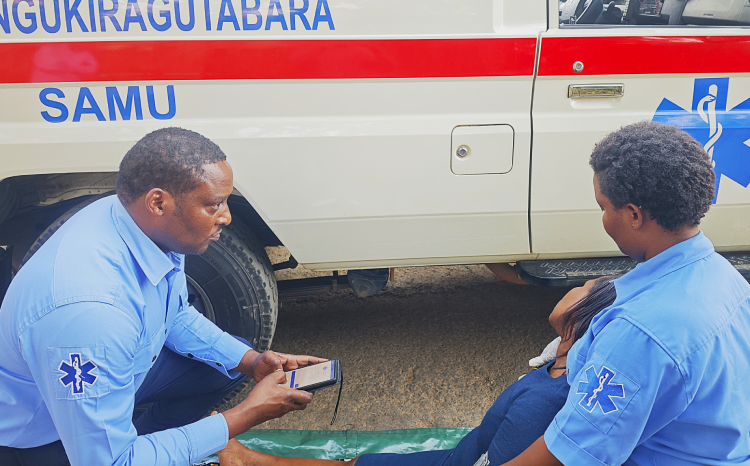
The second phase of the software introduces advanced triage capabilities via a Destination Decision Support Algorithm (DDSA). This feature allows ambulance crews to gather essential patient information and determines the most suitable healthcare facility for treatment. Justine Davies, a professor of global health research at the University of Birmingham and co-principal investigator of the project, highlighted that reducing response times is critical; even a few minutes can significantly affect emergency outcomes.
Davies also noted that the program aligns with Rwandan policymakers’ recognition of the need for more efficient ambulance services, particularly given the number of fatalities following injuries.
The 912Rwanda project has received substantial financial backing, including over £3 million from the UK’s National Institute for Health and Care Research (NIHR) and the Research and Innovation for Global Health Transformation (RIGHT) program, along with nearly $1 million from the U.S. National Institute of Health. This funding supports the development and implementation of the software, which could also serve as a model for other regions facing similar challenges.
In addition to this project, the University of Birmingham has plans for developing a non-invasive saliva test aimed at identifying children lacking immunity to tetanus and who may have missed essential vaccinations. This test will be evaluated in Rwanda following laboratory testing, further demonstrating the institution’s commitment to improving health outcomes in the region.
The content above is a summary. For more details, see the source article.









