


Key Takeaways
- The proposed Radial Basis Function Network (RBFN) framework employs microservices and Differential Privacy (DP) to ensure the privacy of healthcare data.
- Structured into four layers—IoT, Privacy Preservation, Knowledge Aggregation, and Application—the framework securely processes sensitive healthcare information.
- By utilizing local differential privacy and a Randomized Training Microservice (RTMS), the system minimizes data exposure while maintaining computational efficiency.
Framework Overview
The Radial Basis Function Network (RBFN) framework addresses healthcare data privacy through a four-layer structure: IoT, Privacy Preservation (PP), Knowledge Aggregation (KA), and Application. Each layer functions collaboratively to manage sensitive data securely.
The IoT Layer acts as the foundation, gathering healthcare data from devices such as sensors and medical apparatus. It partitions this data into smaller segments for the next layer, focusing on real-time organization and analytics while prioritizing patient privacy.
Next, the Privacy Preservation Layer employs multiple private edge servers that implement Differential Privacy techniques. Using a Randomized Training Microservice (RTMS), the layer adjusts the data before forwarding it to ensure confidentiality. This step employs a supervised learning method to calculate perturbed outputs, incorporating noise to enhance privacy.
The Knowledge Aggregation Layer processes outputs from the PP layer using public servers. This layer combines the differentially private results, creating a comprehensive model with updated centers and weights. These results are vital for analysis and decision-making, culminating in the data that the Application Layer utilizes.
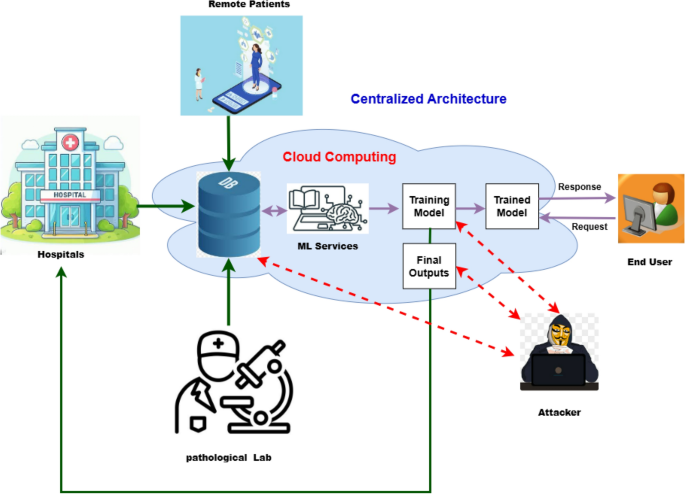
The Application Layer employs a cloud-based machine learning service to monitor health and predict diseases using the trained RBFN model. The entire framework allows for real-time predictions while safeguarding sensitive healthcare information by sending only altered outputs through its layers.
In terms of computational complexity, the framework is designed to operate efficiently even in resource-limited environments. It uses lightweight microservices that ensure low overhead and fast data processing.
Furthermore, the architecture embodies a robust approach to privacy. It injects Laplace noise into model parameters, ensuring a differential privacy guarantee. This mechanism facilitates safeguarding sensitive information while allowing for effective model training and prediction.
By establishing secure communication channels and focusing on local differential privacy, the framework effectively mitigates risks from both internal and external threats. It addresses concerns from honest-but-curious adversaries and malicious nodes, ensuring a balanced approach between data accuracy and user privacy.
In conclusion, the proposed RBFN framework stands as an innovative solution for privacy-conscious healthcare applications, combining state-of-the-art techniques to protect sensitive data while enabling effective machine learning analysis.
The content above is a summary. For more details, see the source article.









