


Key Takeaways
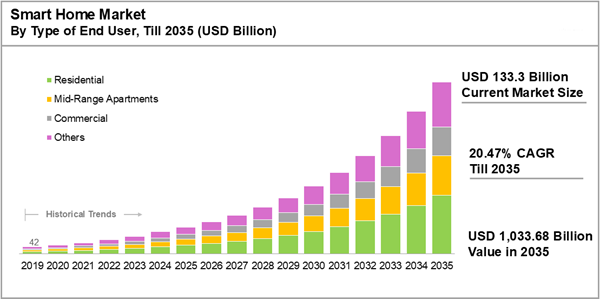
- The global smart home market is expected to grow from USD 133.3 billion to USD 1.03 trillion by 2035, with a CAGR of 20.47%.
- Smart home products, particularly entertainment devices and security systems, are driving market growth, led by innovations in AI and IoT.
- North America currently dominates the market share, while Asia is projected to exhibit the highest growth rate.
Market Overview
The smart home market is witnessing remarkable expansion, projected to surge from USD 133.3 billion in the current year to USD 1.03 trillion by 2035. This growth reflects a compound annual growth rate (CAGR) of 20.47%. Smart homes leverage internet-connected devices to enhance convenience, security, and efficiency, with the rising popularity of artificial intelligence (AI) and the Internet of Things (IoT) significantly boosting demand for products like smart lighting, security systems, and kitchen appliances.
Key players are increasingly focusing on personalized experiences, exemplified by Apple’s initiative to replace Siri with a home robot in 2024. The market comprises various segments, including entertainment devices, home appliances, healthcare products, HVAC systems, security, smart furniture, and kitchen appliances. Currently, the entertainment segment commands the largest market share, primarily due to the demand for smart TVs and soundbars, while security and access control are expected to experience the highest growth rates.
Wireless protocols, such as Wi-Fi, ZigBee, and Bluetooth, remain dominant in the market, catering to the need for mobile connectivity. New construction projects incorporating smart technologies lead in market share, with retrofitting initiatives expected to grow more rapidly. Additionally, proactive software that utilizes AI to anticipate user needs is seeing substantial market adoption.
In terms of user demographics, commercial sectors, particularly smart hotels and hospitals, are leading in market share, with residential users anticipated to exhibit the highest CAGR moving forward. The market is currently characterized by indirect sales channels; however, direct sales are projected to gain momentum. While North America holds the most significant market share, Asia is poised for the highest growth rate in the coming years.
The content above is a summary. For more details, see the source article.









