


Key Takeaways
- A Chalmers University research team has developed a method to produce hydrogen without platinum, using sunlight and conductive plastic particles.
- The new process is both cost-effective and efficient, showing potential to outperform traditional platinum-based systems.
- Future goals include achieving water splitting using only sunlight and water, eliminating the need for additional chemicals.
Innovative Hydrogen Production without Platinum
A research team at Chalmers University of Technology in Sweden has introduced a groundbreaking method for producing hydrogen gas without the use of platinum, a scarce and expensive metal. This innovative process utilizes sunlight and tiny particles of electrically conductive plastic, making hydrogen production more efficient, sustainable, and economically viable.
Hydrogen is critical in the transition to renewable energy. While it generates only water as a by-product, sustainable large-scale production remains a challenge due to the reliance on platinum as a co-catalyst. Platinum mining is concentrated in a limited number of countries and poses environmental and health risks.
In a recent study published in the journal Advanced Materials, the team led by Professor Ergang Wang demonstrates that solar energy can facilitate hydrogen production without platinum. Researchers Alexandre Holmes and Jingwen Pan, co-first authors of the paper, highlight how the conductive plastic particles interact with sunlight and water to generate hydrogen.
The key to overcoming the platinum dependency was in modifying the molecular properties of the commercially viable conjugated polymers, which traditionally had limited water compatibility. The researchers adjusted these properties, allowing for greater interaction with water. They also developed nanoparticles that improved light absorption, enhancing the hydrogen production process.
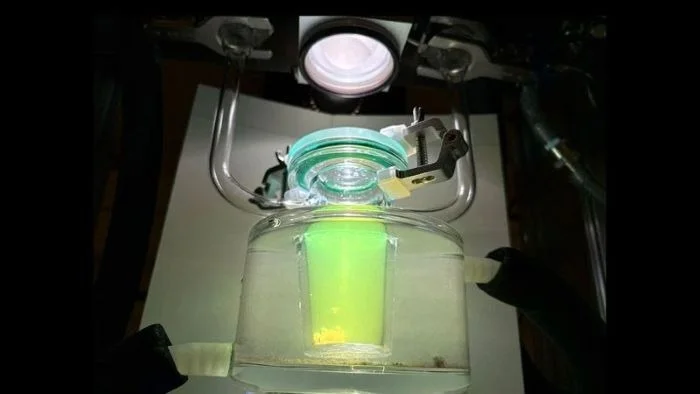
In practical applications, the reactor at Chalmers produces easily observable hydrogen gas bubbles when the nanoparticles are illuminated with simulated sunlight. Remarkably, one gram of the polymer material can yield 30 liters of hydrogen in just one hour. The process was also made more environmentally friendly by eliminating the use of harmful chemicals in the production of the conductive plastic.
Currently, the researchers employ vitamin C as a sacrificial antioxidant in their hydrogen-producing process, allowing the reaction to continue unimpeded. The objective moving forward is to achieve water splitting using only sunlight and water, with no extra chemicals involved.
Ergang Wang emphasizes that removing platinum from this process is vital for sustainable hydrogen production. The team is actively exploring materials and strategies to achieve full water splitting without any additives, with the research expected to progress over the coming years.
Chalmers University’s work signifies a promising advancement in sustainable energy technology, potentially transforming hydrogen gas production on a global scale.
The content above is a summary. For more details, see the source article.









