

Key Takeaways
- Over 160 miles of new transit lines opened in the U.S. in 2025, with 94 more expected this year.
- Cities are favoring cost-effective bus rapid transit (BRT) over expensive light rail systems.
- Significant transit projects are planned for 2026, including new lines in Atlanta, Baton Rouge, Kansas City, and Seattle.
Transit Expansion Trends in North America
In 2025, the United States saw the opening of over 160 miles of new rail, bus, and other fixed-guideway transit lines, as reported by The Transport Politic. This year, an additional 94 miles are projected to be completed, reflecting a shift in transit planning across various cities.
Researcher Yonah Freemark attributes this trend to a growing preference for bus rapid transit (BRT) systems, which offer more flexibility and lower costs compared to traditional light rail projects. BRT lines typically operate on dedicated traffic lanes, while arterial rapid transit systems utilize existing traffic lanes with options for bus signal priority. Freemark notes that the high costs associated with light rail have prompted many cities to reconsider their options for public transit investment.
In a broader context, approximately 150 miles of new fixed-guideway transit lines are expected to open in the U.S., Canada, and Mexico this year, down from over 240 miles in 2016. This indicates not only a decline in the length of new transit projects but also a shift in the nature of those projects towards more budget-friendly solutions.
Several significant projects are set to launch in the United States in 2026. These include:
– Atlanta’s 3.1-mile BRT line connecting downtown to the Atlanta BeltLine.
– Baton Rouge’s 9.3-mile arterial rapid transit line to link the city’s north and south sides to downtown.
– Kansas City’s 0.7-mile streetcar extension to Berkeley Riverfront Park.
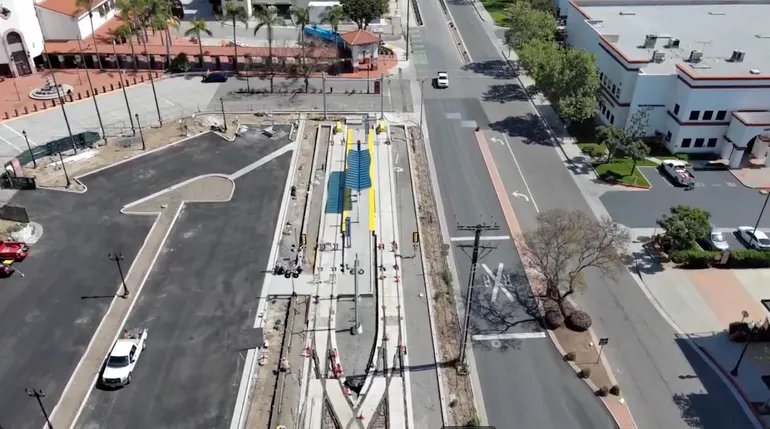
– A 4-mile streetcar line in Orange County, California, connecting Santa Ana and Garden Grove.
– Seattle’s 7.5-mile light rail extension, which will connect two existing lines across Lake Washington.
In contrast to the U.S., Canadian cities such as Montreal, Ottawa, and Toronto are actively developing light rail projects. Freemark highlights that Canada is progressing at a faster pace with rail line construction and is mirroring a global trend in urban transit development that the U.S. is currently not following. This divergence may be indicative of varied priorities and approaches to public transit in North America.
Overall, as transit needs evolve, cities are increasingly looking for sustainable and economical alternatives to traditional light rail, opting for models that better align with current funding realities and urban transit demands.
The content above is a summary. For more details, see the source article.