


Key Takeaways
- Coty’s Q2 FY26 results show a 3% decline in like-for-like sales and a significant drop in operating profit.
- Management emphasizes the need for better execution amid intense competition in the beauty market.
- The sale of Wella has improved Coty’s balance sheet, but raises questions about growth potential for remaining brands.
Financial Performance Overview
Coty’s recent quarterly report indicates a company struggling between recovery efforts and growth aspirations. The completion of the Wella sale has marked a pivotal shift, but the latest financials reveal ongoing challenges in converting brand strength into profit.
Despite Q2 FY26 results being described as “broadly in line” with expectations, the reality is more complex. Overall, like-for-like sales experienced a 3% decline in the quarter and a 6% drop over the first half of the fiscal year. Gross margins also faced substantial compression, with a nearly 300 basis point decrease during the quarter and the adjusted operating margin falling to 16.3%, a drop of 370 basis points. These issues culminated in a reported net loss of $127 million, starkly contrasting with the profit recorded a year prior.
The Prestige segment, once seen as Coty’s growth driver, has also faltered on an underlying basis. Consumer Beauty remains the weakest link, with like-for-like sales down 6% in Q2 and 8% over the six-month period. Management attributes these declines to foreign exchange fluctuations, promotional activities, and retailer destocking. However, the underlying problem appears to be execution within a fiercely competitive and promotion-heavy market, particularly concerning mass cosmetics, where Coty is losing market momentum.
Reflecting on these challenges, new Executive Chairman and Interim CEO Markus Strobel conveyed a blunt tone during his first earnings call. He remarked that while Coty possesses “outstanding assets,” the disappointing performance is palpable, as reflected in the share price. Strobel introduced the “Coty. Curated.” strategy, which aims for a sharper focus on investment priorities and a renewed commitment to sell-out and market share. However, immediate forecasts are concerning; Coty has withdrawn its full-year guidance, predicting mid-single-digit declines in like-for-like sales for Q3 and anticipates only breakeven adjusted EPS in the upcoming quarter.
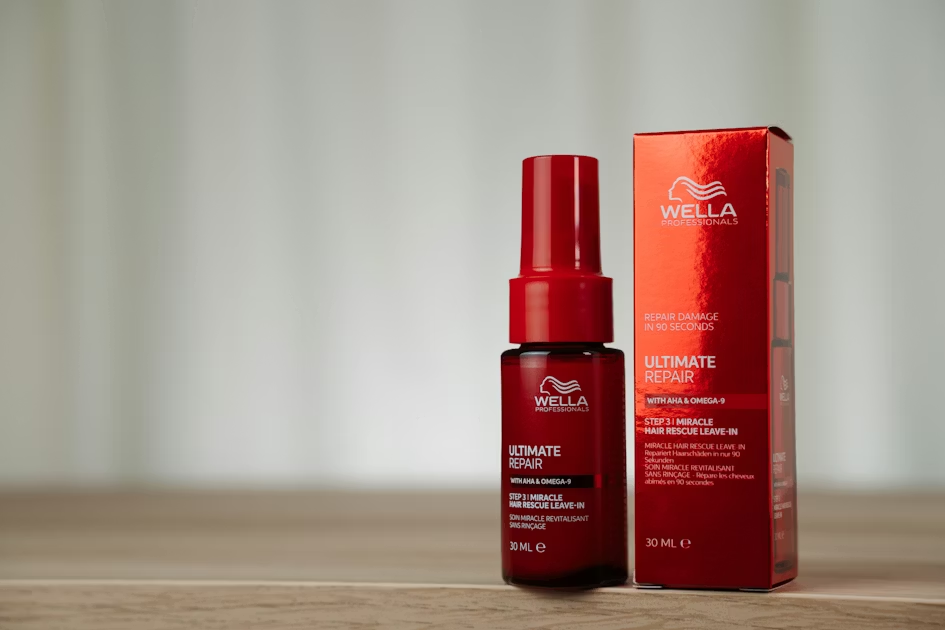
Amid these struggles, there is a silver lining in Coty’s balance sheet. The company concluded the quarter with net debt reduced to $2.6 billion and a leverage ratio of 2.7x adjusted EBITDA, the lowest in nearly ten years. This improvement stems mainly from the divestiture of Wella, where Coty sold its remaining stake to KKR for $750 million in upfront cash, primarily using the funds to reduce debt. While this marks a strategic departure from Coty’s focus on professional hair care, it also highlights an opportunity cost, as Wella is reportedly preparing for a potential U.S. IPO, which could significantly surpass the $4.3 billion valuation agreed upon when KKR acquired it from Coty in 2020.
As Wella transitions fully into KKR’s hands, the key question for Coty is whether the remaining streamlined portfolio can thrive. New fragrance launches from notable brands like Hugo Boss, Kylie Jenner, and Calvin Klein could provide short-term boosts. Still, ongoing pressures from heavy promotions, thin margins, and a struggling Consumer Beauty division continue to weigh heavily on the company’s performance. Strobel’s mandate moving forward is clear: demonstrate that Coty’s brands can reclaim market share, rather than simply sound appealing in theoretical frameworks.
In summary, while Coty has shored up its balance sheet, significant challenges remain in stabilizing its operational model. Moreover, with the possibility of Wella’s return to public markets at the forefront, Coty’s turnaround timeline is becoming increasingly urgent.
The content above is a summary. For more details, see the source article.









