


Key Takeaways
- Vertical power-delivery solutions with integrated voltage regulators (IVRs) are essential for managing the increasing power demands of AI and high-performance computing.
- Noah Sturcken’s research at Columbia University led to innovations in IVRs that significantly enhance power integrity and efficiency in data centers.
- Urgency for effective power management has risen as kilowatt-class processors become mainstream, making IVRs a critical design element.
Understanding the Need for Vertical Power Solutions
A futurist specializes in predicting future trends across various fields, including technology and business. In the realm of computing, a significant challenge arises in powering modern processors and hardware accelerators used for artificial intelligence (AI) and high-performance computing (HPC).
Traditionally, data center processors like CPUs and GPUs have relied on lateral power delivery, which involves distributing power horizontally across a printed circuit board (PCB). Unfortunately, as the demand for power increases, so does the complexity of managing the high-speed voltage fluctuations caused by billions of rapidly switching transistors. For instance, a processor with 1,000W power requirements could demand an astonishing 1,000A of current. Future projections suggest these requirements will continue to grow.
To address these challenges, experts are advocating for vertical power-delivery systems that use integrated voltage regulators (IVRs) placed directly beneath the processor. Although the concept of IVRs has become a focal point, it was relatively unfamiliar until recently.
Noah Sturcken, the CEO of Ferric Corporation, began exploring IVRs during his PhD at Columbia University in 2008. His experience at AMD highlighted the importance of power integrity in optimizing digital designs, sparking his interest in improving energy delivery systems. Initial research collaborations with Intel signaled a shift towards recognizing that traditional power management methods would not suffice as supply voltages continued to drop.
The breakthrough came when Sturcken engineered advanced ferromagnetic composite materials that combined the strengths of traditional ferrites and ferromagnetic materials. These materials facilitate the development of ultra-thin inductors capable of efficient operation at high frequencies, paving the way for practical IVR implementations.
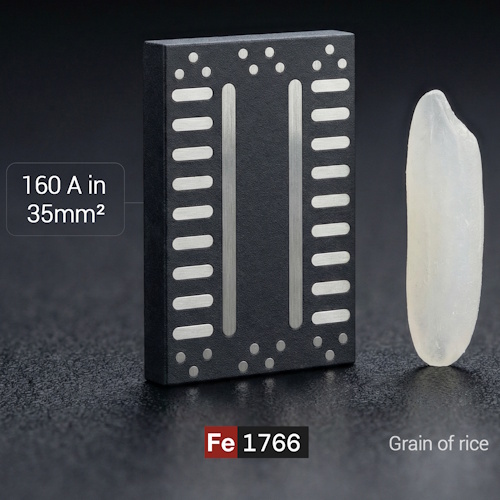
Ferric Corporation has since commercialized this innovation, now offering IVR chiplets that integrate essential components such as controllers and inductors into a compact design. These devices efficiently convert voltage down from a standard 48V rail to tightly regulated sub-1V supplies necessary for modern processors, significantly reducing board-level current losses and improving thermal efficiency.
The IVR technology can achieve sustained current densities of up to 4.5A per square millimeter, making it an attractive solution for high-performance applications. The compact size and capability of the Fe1766 device, for instance, allow it to deliver 160A while being just 1mm thick.
As the urgency for effective power management intensifies—especially as kilowatt-class processors hit the market—IVRs are transitioning from experimental technology to essential design components in modern computing systems. Many engineers now openly acknowledge the critical need for these solutions in their designs, marking a significant change in industry priorities.
The landscape for power delivery in processing has evolved dramatically, with Ferric’s innovations demonstrating the potential of vertical power solutions to meet the emerging challenges of the next generation of computing. The future of computing technology increasingly hinges on effective power management, making vertical power delivery not just a possibility but a necessity.
The content above is a summary. For more details, see the source article.









